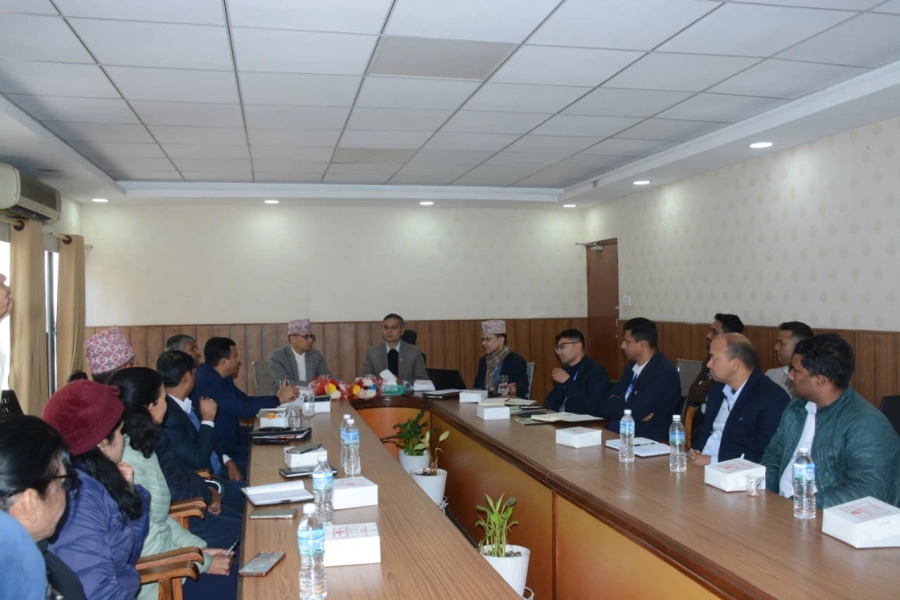
International Monetary Fund (IMF) along with the Government of India organized a conference entitled 'Advancing Asia' in New Delhi last week. The conference that was organized with a theme 'Investment for the Future' discussed about the need for more investment in the region, spillover effects from the policies of other parts of the world, and economic and financial challenges for Asia.
Related story
Economic trends: Bright spots and malaise

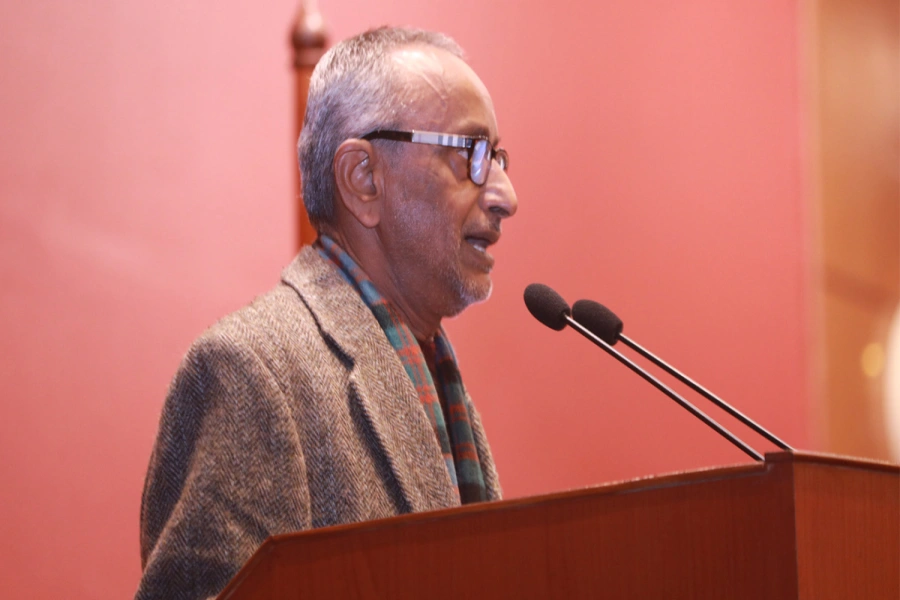
On the sidelines of the event, Sagar Ghimire of Republica talked with Thomas J Richardson, IFM's Senior Resident Representative to India, Nepal and Bhutan, about the takeaways of conference for Nepal, reasons of failure to reap benefit from higher growth of the neighboring countries, inflation and other financial issues. Excerpts:
What is the major takeaway for Nepal from this conference?The activities and the macroeconomic policies of the big country, not just the India but the US, Japan and the others, also affect Nepal. The monetary policy condition, interest rate condition and exchange rate policy of big countries affect Nepal. And, the country like Nepal needs to ensure that you have adequate reserves and buffers to be able to withstand volatility in the international markets. From my perspective, it is really important that Nepal Rastra Bank (NRB) continue to make healthy level of international reserves. Things that happen in the world affect Nepal as well. We are happy with the foreign currency reserve of the NRB which is very strong and healthy. We also think that the government aims at thinking about maintaining sensible budgetary policy. We have long felt that the fiscal policy in Nepal is too tight. In most countries, we are arguing that you should not have such a big deficit. In Nepal, we think that you should not have such a big surplus. Nepal is a developing country that needs to spend, build, improve infrastructure and rebuild from earthquake, which is of course a number one priority.
Why do you think that Nepal has not been able to reap benefit from the growth of other countries?
Nepal has not benefitted much from the stronger growth around Asia as it could have. I don't want to go into the political reasons for that, which is not our role. Not only the structural reforms, there is a need to boost capital spending to ensure that people can manufacture and conduct economic activities. The lack of reliable electricity is the major impediment to growth and manufacturing industries in Nepal. Load-shedding makes it almost impossible to think about big manufacturing in Nepal. There is a strong need for developing hydropower. You have the capacity to generate lot of energy for Nepal and also to export. Energy export would also provide foreign currency to Nepal which would be really beneficial to help in poverty reduction as well as for economic growth. Harnessing hydropower should be Nepal's second priority. The first priority now should be the reconstruction.
India is dubbed as a 'bright spot' in the world economy. However, Nepali economy is still languishing in darkness. Do you agree?
I would say that Nepal has suffered from real political challenges as well as natural disaster which have set the country back. But Nepal is a bright spot. Nepal has terrific opportunities as you have massive hydropower capacity. If you have a power capacity and build infrastructures like roads and railways, there is no reason why you do not have big manufacturing industries in Nepal. If you have solid railway links and good roads in and out of India, you could be manufacturing a lot of stuffs for the Indian markets. As we expect India to grow rapidly over the next 20 years, there is no reason why Nepal cannot benefit and grow rapidly as well. I would say Nepal is a potential bright spot as well.
Nepal's economic growth is lower than many other countries of Asia. What do you think is the reason?
Nepal's growth has been lower than many countries in Asia. You should be growing as fast as India because you are so close with it. China and India are going very rapidly and Nepal should also be going rapidly. But Nepal is a landlocked country and we know from the other parts of the world that small landlocked countries do face challenges in generating growth and employment opportunities. The only solution for this problem is to build infrastructures to get connected from the rest of the world. Roads, railway and power are crucial for Nepal's growth. Similarly, Nepal also needs to think about human capital investment. You have terrific smart young people, many of whom are going abroad to work. You need to keep educating them and build infrastructures so that there is better employment opportunity.
Isn't it time for Nepal to reconsider pegged exchange rate regime with Indian currency?
In our annual Article IV consultation with Nepal, we have consistently argue that the peg with the Indian currency has been a nominal anchor that has served Nepal well and helped to generate some additional stability. However, the choice of peg is the sovereign choice of Nepal and its authorities.
Taming inflation that has hit double-digit has become a nightmare for the NRB. What risks do you see from such scenario?
Inflation has spiked partly because of supply disruptions at the border and partly because of the earthquake. Those are not the factors that you should try to offset from the monetary policy tools. Level of inflation in Nepal has been above the level of inflation in India for a long time. It will have negative effect in competitiveness. One of the reasons behind jump of inflation over the past few months is supply disruption. That's like a natural disaster which you cannot use in monetary policy to prevent that.
IMF has recommended administrative sanction and corrective actions against BFIs that do not implement new paid-up capital increment plan. Why was such recommendation needed?
When the central bank establishes a floor for minimum capital, you have to ensure compliance. The increase in paid-up capital is meant to provide additional buffer to financial system of Nepal. We do also feel that it is important that the source of funds for the paid-up capital be clearly identified. It's not just that any money is good. It has to be the money brought by bankers and investors who are fit and proper investors. The central bank understands it clearly and intends to enforce the policy fairly across the system. It is very important that you enter the equity in fairness across the system.
Don't you think such hurriedness (to increase paid-up capital) will pose another challenge of instability to the financial system?
The logic is a bit incorrect. I don't think how you see instability in the financial system by adding safety net, which is extra paid-up capital. Mergers of BFIs should be for the business reason. What we strongly feel is that the power of the NRB to resolve the problematic institutions be strengthened and enhanced to ensure that problems in financial institutions are quickly so that depositors do not suffer unnecessarily. Legislations to amend Banks and Financial Institutions Act and NRB Act are in parliament and we believe that they should be passed to strengthen the ability of the NRB to protect depositors and to ensure financial stability.