

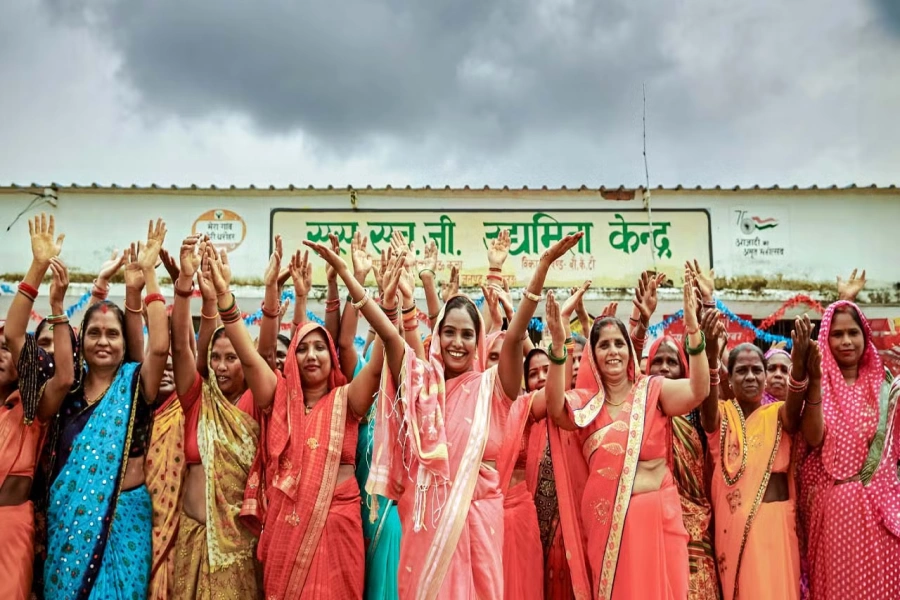
Ten years is a short window in a country as vast and unequal as India. Yet the last decade has delivered a measurable shift in how women access the state, participate in the economy, and shape decision-making at the grassroots. This change has not come through one headline reform or symbolic gesture. Instead, it has emerged through a steady build-up of financial inclusion, health and dignity interventions, enterprise credit, and political representation. Together, these have created new capabilities for millions of women, even as gaps in safety, workforce quality, and social norms remain.
One of the most consequential shifts has been in financial inclusion, the often-overlooked infrastructure of empowerment. A decade ago, millions of Indian women had no independent access to formal banking. Today, according to the National Family Health Survey, more than 80 percent of women report having a bank or savings account that they themselves use. This matters because when a woman controls her account, welfare transfers reach her directly, savings accumulate in her name, and dependence on informal gatekeepers weakens. The fact that women now hold more than half of all Jan Dhan accounts underscores how inclusion has translated into real agency rather than remaining a neutral statistic.
Digital access has reinforced this shift. Nearly seven in ten women now personally use a mobile phone, enabling everything from digital payments and enterprise transactions to safety tools and information access. This digital-financial pairing has quietly expanded women’s autonomy in everyday life, particularly in rural India.
Health and dignity indicators tell a similar story of incremental but transformative change. Institutional deliveries have risen sharply over the last decade, moving from roughly three-quarters of births in 2015 to over 90 percent by 2021. This expansion has helped drive down India’s maternal mortality ratio from 130 to 97 in just a few years. These are not abstract improvements. Fewer maternal deaths mean fewer families pushed into crisis, fewer girls pulled out of school to shoulder care work, and greater economic stability for households.
Celebrating the inspiring stories of women’s courage, resilienc...

Equally significant has been the impact of clean cooking fuel. The Pradhan Mantri Ujjwala Yojana has crossed ten crore LPG connections, largely issued in women’s names. Clean cooking is often framed as an energy or climate policy, but its most direct gains lie in reduced indoor air pollution, time saved from fuel collection, and a tangible improvement in everyday dignity for women.
Economic empowerment has also moved beyond welfare to enterprise. Access to credit determines whether skills translate into livelihoods. Under the Mudra scheme, nearly seventy percent of loans have gone to women, signalling a structural shift in how women-led microenterprises are financed. At the community level, more than ten crore women are now mobilised into Self Help Groups, creating peer networks that combine savings, credit, collective bargaining, and social confidence. These groups have emerged as one of India’s most effective platforms for strengthening women’s economic and social participation.
Political empowerment has followed a similar bottom-up trajectory. At the grassroots, women now constitute about 46 percent of elected representatives in Panchayati Raj Institutions, translating into roughly 1.4 million women in local leadership roles. These leaders shape decisions on water, sanitation, schooling, health centres, and local safety areas, where women’s perspectives have direct developmental consequences. At the national level, the passage of the Women’s Reservation Bill in 2023 has set a new constitutional benchmark, signalling that women’s representation is central to India’s democratic future.
At the same time, empowerment cannot be measured only in participation numbers. India’s female labour force participation rate has risen from around 23 percent in 2017 to about 37 percent in 2023, driven largely by rural participation. While this reflects improved engagement, the next challenge lies in raising job quality, incomes, and security, especially as the economy transitions toward manufacturing, services, and formal employment.
This trajectory also has wider regional relevance, particularly for Nepal—not as a comparison or hierarchy, but as a neighbouring society navigating similar structural transitions. Nepal has made notable advances in women’s political participation, especially at the local level, while facing parallel challenges related to access to finance, unpaid care burdens, migration-related vulnerabilities, and uneven livelihood opportunities. These shared realities create space for cooperation rather than instruction.
India and Nepal can work together through exchange of experience, joint programmes, and institutional collaboration. Platforms such as women’s collectives, enterprise networks, digital payment systems, and community-level financial models offer opportunities for mutual adaptation based on local needs. Cross-border collaboration between women-led groups in Nepal and Indian states such as Bihar, Uttar Pradesh, and Uttarakhand can strengthen livelihoods, cooperative marketing, and skill development in ways that benefit both sides.
Partnerships in maternal health, clean cooking transitions, women-focused skilling, and digital inclusion can further align development priorities while respecting national contexts. For India, such cooperation reinforces its commitment to regional development rooted in shared growth. For Nepal, it adds to an existing ecosystem of reforms by expanding options and connections rather than prescriptions.
India’s strides in women’s empowerment over the past decade are not defined by a single reform or slogan. They reflect a cumulative transformation built through access, agency, and representation. The task ahead is to deepen these gains through better jobs, safer public spaces, and equal participation in growth sectors. When pursued through cooperation rather than comparison, this progress can also contribute to a more inclusive South Asian development narrative—one grounded in partnership, dignity, and shared advancement.


