

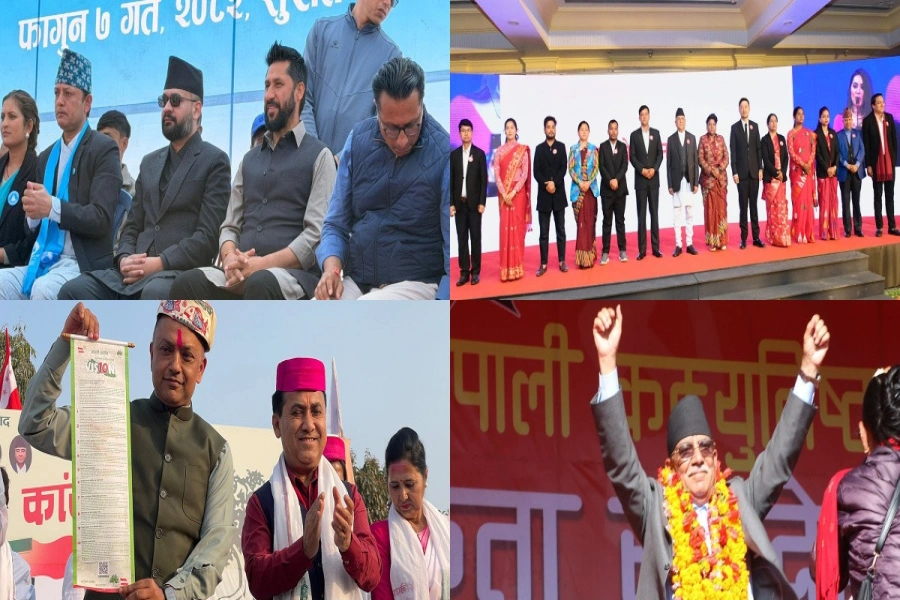
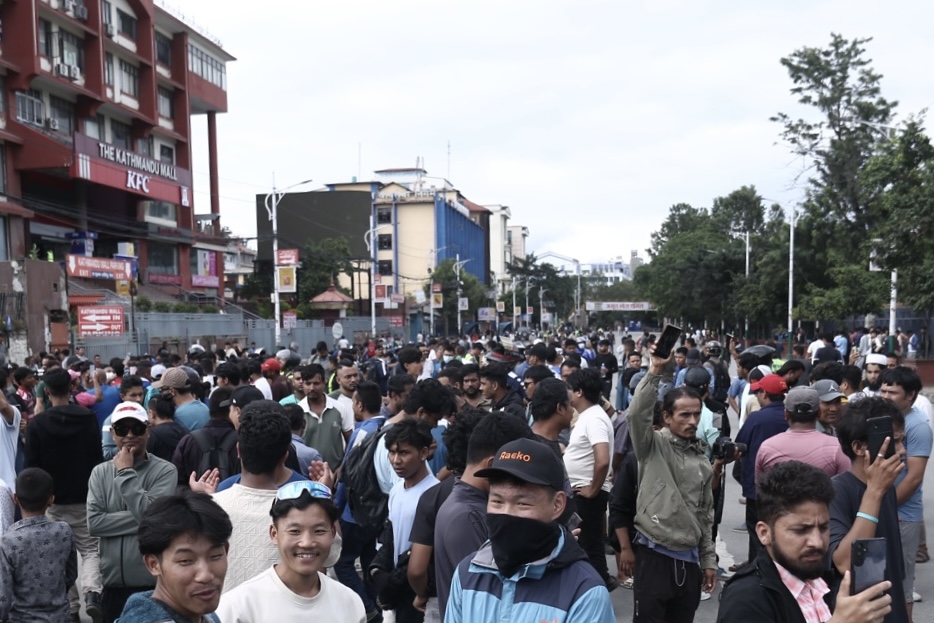
KATHMANDU, Feb 28: As the March 5 election for the House of Representatives (HoR) approaches, Nepal’s major political parties remain sharply divided over how to interpret — and politically position themselves in relation to — the Gen Z movement that surged into national prominence following the September 8–9 protests.
What began as a youth-led outpouring of frustration over social media ban, governance, accountability and generational transition has since evolved into a litmus test for both traditional and emerging political forces. Some parties view it as a warning signal, others as a threat, and still others as an opportunity.
Unlike the three other major parties in the country, the Nepali Congress (NC) has adopted a cautious middle path. The party has neither dismissed the Gen Z unrest as a conspiracy orchestrated by foreign actors nor attempted to capitalize on it for political gain. Its position reflects a strategy of engagement without overt attempts to harvest electoral dividends.
The NC maintains that both denying the legitimacy of the Gen Z movement and taking full ownership of or glorifying the unrest that followed — including arson and vandalism across the country, resulting in the death of at least 76 persons and losses exceeding Rs 85 billion — represent extreme positions.
Echoing the party’s stance, NC President Gagan Thapa, addressing an election rally in Pokhara on Friday, warned that the March 5 election could nurture “two kinds of extremism.” One, he said, trivialises the September 8–9 incidents and refuses to acknowledge the participation and genuine grievances of young people. The other, equally dangerous, exploits unrest to justify destruction — invoking even the spectre of Singha Durbar set ablaze and opportunistic actors evading accountability.
Thai embassy organizing "Journey to Thailand & Top Thai Brands...
While the NC has been cautious, the Rastriya Swatantra Party (RSP) has been markedly assertive. The party has openly aligned itself with the recent Gen Z movement, which has centred on generational transition, anti-corruption, institutional reform and moral accountability.
Several RSP leaders and activists participated in Gen Z-led protests in Kathmandu, reinforcing the perception that the party was behind the movement that aligns with its political identity. As the uprising has placed traditional parties under moral scrutiny, the RSP has sought to position itself as the political vehicle capable of transforming youthful dissatisfaction into electoral change.
For the RSP, the movement is not merely a social phenomenon; it is political capital to be consolidated for electoral gain. Party Chairman Rabi Lamichhane and senior leader Balen Shah have projected the RSP as a force that authentically carries the Gen Z agenda in all their election rallies.
Similarly, the Nepali Communist Party (NCP), led by Pushpa Kamal Dahal, has attempted to align itself morally with the Gen Z movement, seeking resonance with its agenda without formally claiming ownership of the movement.
Dahal has gone further rhetorically, suggesting that the Gen Z movement played a “direct or indirect role” in recent communist unification efforts, in which more than a dozen and half fringe communist parties merged recently to strengthen their electoral prospects. He has urged young voters to place their trust in his party, arguing that it is advancing many of the same issues raised by the Gen Z movement.
Yet the NCP stops short of formally claiming the movement as its own. Instead, it frames itself as a long-standing force for structural transformation that naturally aligns with youthful demands for change — seeking electoral dividends without explicit appropriation.
In stark contrast, the CPN-UML, led by K P Sharma Oli, has largely rejected the framing of the Gen Z protests as legitimate political expression. Oli’s public speeches signal near-total denial of the movement’s political legitimacy, reframing it instead as disorder exploited by destructive elements.
Speaking at the inauguration of the party’s 11th General Convention in December, former Prime Minister Oli described the protests as manifestations of frenzy, anarchy and destruction. He argued that acts of arson and vandalism were being glorified as movements and revolutions, maintaining that the UML alone had clearly labelled such actions as attacks on both the political system and the nation.
Oli has insisted that the current political contest is not between generations, but between those who seek to build the country and those who seek to burn it.
At its core, the Gen Z movement has emphasised youth representation in politics and the urgency of generational transfer of power. It has unsettled entrenched hierarchies and compelled parties to respond — whether by embracing, reframing or rejecting it.
As voters head toward the March 5 election, the question is no longer whether the Gen Z movement matters, but how each party chooses to engage with it. For some, it is a mirror reflecting a moral crisis. For others, it is a ladder to electoral ascent. And for at least one major force, it remains a narrative to be dismantled.












-1782125987.webp)
-1200x560-1782120651.webp)


