

As the March 5 election is drawing near, talks of foreign meddling in Nepali politics have returned to the fore. New players joining the election, allegedly backed by foreign powers seeking political influence, have fueled suspicion of meddling.
Nepal’s history shows that it has never stayed in isolation. During the Cold War, India and Western countries scrutinized Kathmandu to ensure that the Himalayan nation did not align with the then Soviet Union. After 1990, critics accused donor groups from the Western world of their involvement in fixing issues of our government, ‘helping’ the media and journalists, building up local groups, and working to affect elections.
Though these groups claim to offer partnership without political aims, our political choices appear influenced by their desires. These foreign institutions, along with Nepali partners, sometimes referred to as the Deep State, have joined forces to influence the course of our politics. Visibility of foreign partners’ overt activities increased after the 2006 Comprehensive Peace Accord. Foreigners helped set up peace or political dialogues and gave advice on writing our constitution. Everyone know they have been doing this, but it also meant we had less room to make our own decisions. Hence, their doubts persist.
Control of youth anger
Cold wave grips Madhesh, disrupting daily life

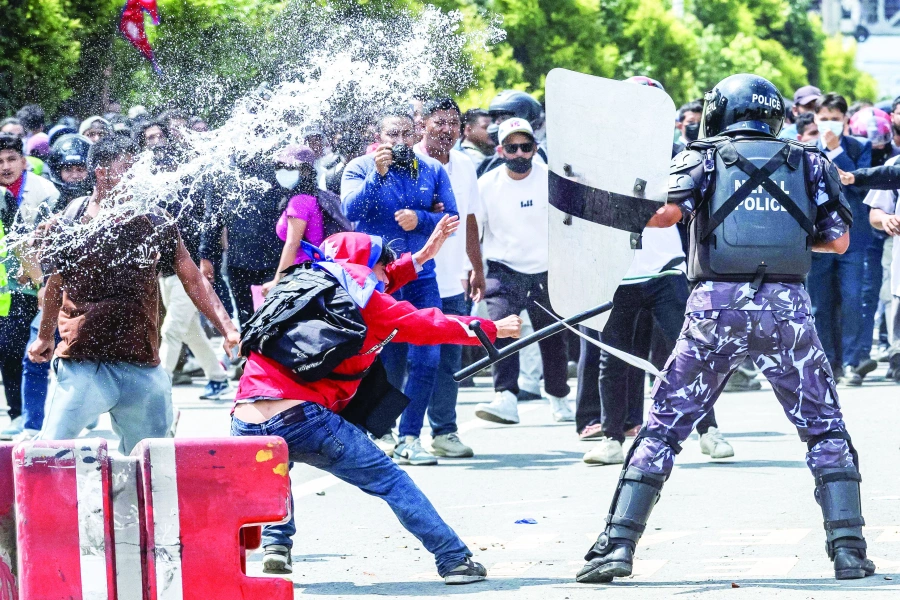
The Gen Z protests on September 8 and 9, 2025, brought these doubts back. Outrage over corruption, inadequate services, and the haughty behavior of politicians drove young people to take to the streets. The state could not explain what happened when things got violent and 74 people died, many of them young. As nobody knew what was going on for sure, people started making up their own explanations. The swiftness of the protests and the seemingly coordinated online messages, some argue, cannot be solely attributed to anger. The youths’ actions on September 8-9, which led to the toppling of the government, deaths and arson, were likely influenced by internal or external powers. Hence, doubts persist.
It has been widely believed that external forces amplified the unrest, allegedly by directing the anger of young people. Though evidence is absent, folks remain distrustful of events unfolding. This situation grew more pronounced because of swift political shifts post-September events. The Rastriya Swatantra Party's rise shook things up. Chair Rabi Lamichhane’s brazen escape from jail deepened this suspicion. The formation of the new government under Sushila Karki surprised everyone. The way Gen Z’s online ballot on Discord app picked her up as the new PM made people wary about foreign meddling.
Meanwhile, several ministers in the new government supported by Gen Z youths, surprised people when they gave up the caretaker government to run in the election, siding with the RSP. Mayor Balen Shah, formerly independent, joined RSP to challenge KP Sharma Oli in Jhapa 5 for PM. It is widely thought that a deliberate plan, involving external actors, aims to oppose Oli. Those who have been backing or encouraging Balen to run against Oli might have thought that the former Kathmandu mayor is the only leader at present who can defeat the powerful UML chair in his Jhapa turf. To change the current course, forces who allegedly assisted Balen might have thought that defeating Oli is one way to bring about changes in Nepali politics as per their design.
‘Heavy investment in candidates,’
Perceiving foreign involvement in encouraging Balen’s challenge to Oli, some view this as beyond mere coincidence. Pushpa Kamal Dahal ‘Prachanda,’ coordinator of the Nepali Communist Party, said foreign countries have invested significantly in getting Balen into power. Speaking at a party event, Dahal said that outside groups are pushing people who get famous from stunts instead of real ideologies and sacrifice. Dahal contended that people these days are involved in stunts to get political attention. He said foreign countries are investing big to push these stuntmen because they do not care about ideology or politics.
Other RSP new entrants such as Jagadish Kharel, Bablu Gupta, and independent Mahabir Pun who quit the government to contest elections, are individuals who want to fix things. Hugely popular Kulman Ghising quit the government to, first, side with the RSP and then to play the role of the chair of the party he had opened. They talk about clean government, getting things done right, and politics without strict rules. These individuals receive support from INGOs, and other institutions raising our suspicion that foreign powers establish connections with them.
Familiar figures such as Balen and Rabi probably possessed a significant edge over rivals. In a similar vein, Gagan Thapa’s recent rise signifies a generational shift that resonates with Western nations. His image as someone who wants to reform things, his ability to connect with people, and his popularity among city voters make him a candidate of liking by foreigners. Many say foreigners are happy to groom a leader like Thapa.Some even say that he has been carefully backed for taking the Nepali Congress’s chair role. Meanwhile, the emergence of Sudan Gurung, a poll candidate from Gorkha-1 and a member of the Barbara Adams Foundation, also made people doubtful. Gurung acted as a fixer, as he brought Balen and Ghising to Rabi’s party.
Meanwhile, the current caretaker government adds another twist to this tale regarding foreign influence or meddling in our politics. An American group, the Barbara Adams Foundation, allegedly placed several of its members in the current government. Our institutions that promote Nepali leaders often receive millions of dollars from liberal George Soros’s Open Society, which therefore faces suspicion. Doubters here see this as Western countries influencing our leaders. While concrete proof is absent, such acts fuel suspicion and provide ammunition for conspiracy theorists and skeptics.
Obvious Roles
The prevailing skepticism regarding foreign involvement in our politics might not be completely justified. The truth is somewhere in the middle. In Nepal, India's influence is the most talked about and widely accepted. New Delhi is said to be willing to see political and economic stability on its northern border, control over trade routes, and to limit China’s influence. When communist groups become too strong or extreme, India is said to have looked for other groups to balance them out. Such involvement may also be interpreted as interference, given the suspicious nature of the circumstances. China and the United States also work to protect their own self-interests through diplomacy, aid, and training and exchange of cultural and visit programs.
International non-governmental organizations (INGOs) too, involve in their own ways to create connections with up-and-coming leaders through training, fellowships, advocacy, and exposure trips. Initially, these actions do not appear political, yet they shape thinking and forge strong connections as time progresses. Outside interference in Nepal is not one coordinated scheme run by one country. It has a complex system of motivations and hidden actions that has grown over many years. Ultimately, foreign meddling proves difficult to counter as it operates through legitimate means. Many believe foreign powers employ soft power through diplomacy and cultural exchanges to influence nations, though some see it as political interference.






