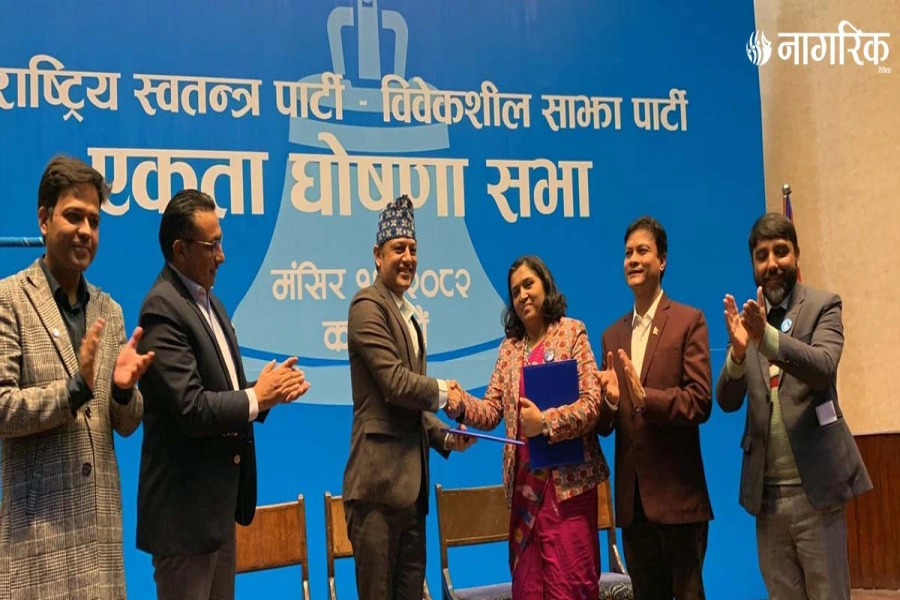
As the election date of March 5 draws nearer, political activities are unfolding one after another. In particular, the polarisation process among political parties has gained notable momentum. Parties are merging in ways they believe will strengthen their position in the upcoming House of Representatives (HoR) election. Similarly, parties are intensifying efforts to consolidate their organisational strength ahead of the electoral contest. Almost all political forces are engaged in manoeuvres aimed at securing positions for themselves and their teams. This suggests that the country is heading into elections in a highly unpredictable manner. While some still question whether the vote will take place on the scheduled date, it is evident that electoral calculations have already begun to shape national affairs. Bibeksheel Sajha was merged into the Rastriya Swatantra Party (RSP) on Sunday. One faction not only joined the party but also transferred the remaining Rs 3.3 million in its bank account. However, some leaders still within Bibeksheel Sajha have chosen to wait, saying they will not be joining any party for now. It is natural that not everyone agrees when parties merge. Convenience appears to be the key factor guiding decisions, while ideological foundations seem insignificant for most parties at the moment. Political actors simply choose the space where they feel most comfortable. Consequently, leaders and cadres often move to whichever party offers them a sense of ease. Yet political polarisation, ideally, should be grounded in ideological alignment and clarity about how these forces intend to lead the country.
Nepal's first digital wallet merger: Khalti and IME Pay to join...

In today’s Nepal, accumulating electoral strength appears more important than political proximity. As a result, politics is increasingly shaped by electoral strategy rather than by political direction or ideology. The Bibeksheel Sajha Party, now merged with the RSP, has its own complex history. It first emerged as Bibeksheel, a party advocating alternative politics. It became Bibeksheel Sajha after merging with Sajha. Later, when Rabindra Mishra—who argued that national interest must take precedence over ideology—left the party, it began losing its original direction. Mishra joined the Rastriya Prajatantra Party (RPP). Bibeksheel Sajha lingered in uncertainty for years. Many of the RSP’s current leaders and cadres were originally from Bibeksheel, making the return to a familiar fold easier. After the untimely demise of Ujjwal Thapa, one of the architects of the Bibeksheel movement, the campaign fell into disarray. For many leaders and cadres, the recent merger may represent a renewed footing. The RSP is expected to attract even more leaders and cadres before the election. As the fourth-largest party in the dissolved HoR, it remains an appealing choice for many. This polarisation process is unlikely to end anytime soon. The democratic and leftist blocs also have their own political dynamics. The Nepali Congress and the CPN-UML, both major parties, were ousted from power following the Gen-Z movement on September 8 and 9, during which incidents of vandalism, arson, and destruction took place. As key forces in the 1990 People’s Movement, these parties have governed in various ways for nearly three and a half decades. Now, both are preparing for their general conventions, which essentially serve as platforms to strategise for electoral victory. They are focused on strengthening themselves by all means available.
Following the 2006 People’s Movement, Maoist chairman Pushpa Kamal Dahal entered mainstream politics and has remained a significant national figure. He has now abandoned the “Maoist” branding and is leading the Nepal Communist Party (NCP). Under his leadership, nearly a dozen leftist parties have come together, believing that Nepal still has a sizable left-leaning voter base that must be consolidated. They describe their current efforts as a “broad left unity undertaken with a commitment to correct past mistakes.” This is a moment when nearly all parties feel compelled to present themselves as reformed. Established parties must show that they have corrected their shortcomings, while newer parties emerging from the Gen-Z movement face the challenge of proving themselves as rising forces in a changing political landscape. As a result, those who can merge are doing so, while others are engaged in strategic polarisation to accumulate strength. Historically, incumbents often lose elections in Nepal. But with an interim government in place solely for election purposes, parties appear more determined than ever to secure their future. In the coming months, polarisation is likely to intensify as parties attempt to rejuvenate themselves and push forward with renewed energy. Let us hope that these political realignments are grounded in ideological clarity and a genuine vision for how these forces intend to lead the country.