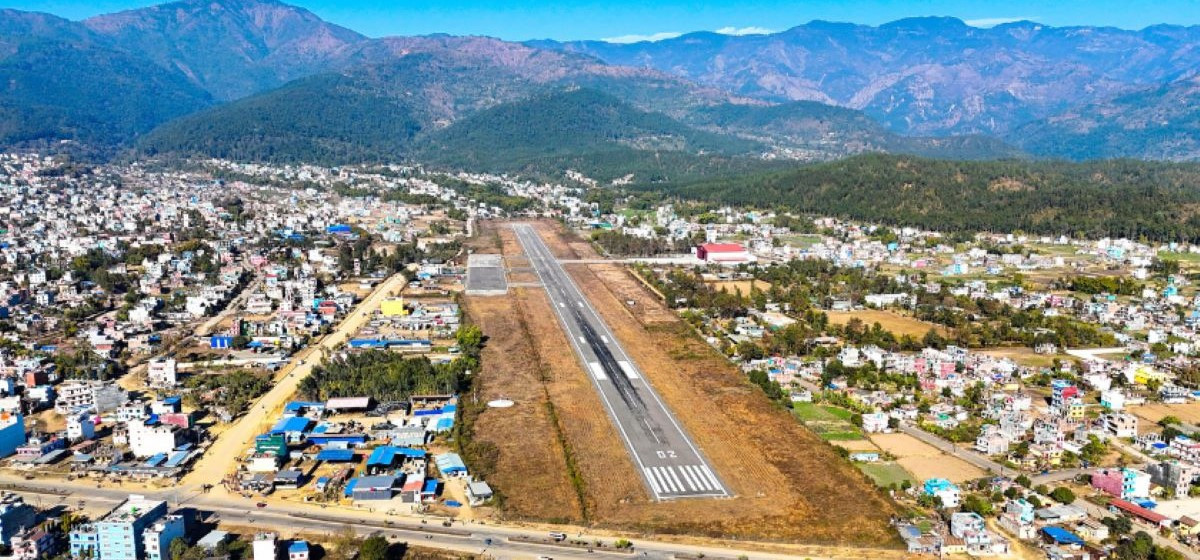
The government has two options to deal with the problem: patch up the potholes without causing disruption in flights as a short term measure or complete the construction of another airport at the earliest. An immediate measure to contain further damage to the runway is requesting airlines with large planes to limit the luggage, fuel and passenger numbers to control the load of operating aircraft. [break]
The Civil Aviation Authority of Nepal (CAAN), aviation sector regulator, issued a circular last week to all international airlines operating services in Nepal, requesting them to stop operating wide-body aircrafts that which carry larger numbers of passengers for the time being if possible. However this is not a permanent solution let alone a practical one as it inflicts heavy losses on carriers and country´s tourism industry.
The government has to go into the root causes responsible for the deteriorating condition of the runway.
Airlines Operator´s Committee Nepal (AOCN), an association of foreign airline operators, has been holding discussions with member airline operators to recommend measures to CAAN to deal with the problems in a ‘win-win way’.
AOCN is preparing to forward its suggestions to CAAN on Friday.
Though news of disruption of flights due to poor runway conditions came to limelight a few years back, the issue this month has drawn widespread attention as potholes were found five times over three weeks.
The problem on the runway started on June 2010, a little over a year after resurfacing was carried out in March 7, 2009. Though renovations were completed on February 8, 2012, the problem did not come to an end and caused problems for passengers as flights got diverted, delayed or even cancelled many times.
“The defect liability period for resurfacing was until February2, 2012. But during this period only, the tarmac developed pothole 11 times. This kind of problem was recognized four times in June 2011,” said Punya Shakya, the project director of the TIA Improvement Project (TIAIP). Though no major problems were detected in the tarmac in 2012, the problem was again reported this year.
Dinesh Shrestha, the general manager of TIA, said the age of the pavement, aircraft load, drainage conditions and weather phenomena have been identified as the possible factors contributing to the early deterioration. The airport, which was meant for smaller planes when built almost 37 years back, has been serving heavy aircraft that can weigh up to 299 tons.
But if it is so, why wasn´t the problem seen before 2010? To find out if there were any anomalies during the resurfacing as the problem has reoccurring since then, four different committees from the government, the Commission for Investigation of Abuse of Authority (CIAA), an independent investigation committee and a CAAN panel were formed to investigate in detail in the past. However, information regarding what caused the problem at the runway just four months after the completion of resurfacing has never been made public.
The Public Accounts Committee (PAC) of the then parliament had a few years back recommended to the government that they develop the runway at par with international standards to avert such problems.
Shakya, the TIAIP project director, said that aircraft movement in 2012 increased by 300 percent as compared to 1995. Add to that the fact that the runway, made back in 1967, had never been resurfaced until 1985. The first resurfacing was done in 1985 followed by a partial resurfacing carried out in 1995. However, complete renovation was conducted during 2009 and 2012.
However, these explanations do not seem justified as the full cause for the current problem at runway as TIA´s data clearly shows that the problems started occurred since the final resurfacing was implemented.
“Even the plaster of Paris in our homes deteriorates when it gets old or exposed to heat and rain. Same is the case of the runway at TIA, but as the CIAA investigation is ongoing, we cannot make the exact reasons public before the report is out,” said Ratish Chandra Lal Suman, the director general of CAAN.
The 3,050-meter-long runway resurfacing carried out jointly by China Railway Engineering Corp and the Nepali Tundi Construction with an investment of around Rs 250 million. However, the quality of work might have been substandard because of use of less cement than required, use of low quality cement or of improper combination of cement and sand. But none of the officials at CAAN dare to speak about the weakness that occurred during the resurfacing.
Worse still, the existing thickness of the runway is only 4 to 5 inches. According to experts, the thickness necessary to be maintained is between 10 to 12 inches.
Related story
Jomsom airport runway being repaired after two decades