KATHMANDU, Nov 5: Nepal’s leftist parties seem stuck in an endless loop — merging one day, breaking apart the next. The pattern of unity and division among those involved in parliamentary politics shows no sign of ending. Even minor disagreements have led to new party “shops” being opened, many of which soon close, sending their founders back to the parent organization.
While the CPN (Maoist Centre) and CPN (Unified Socialist), along with other factions, were holding talks for unification at the Nepal Academy on Tuesday, a new group was being announced in Lalitpur — the Pragatisheel Abhiyan Nepal (Progressive Campaign Nepal).
After the majority of the Unified Socialist’s Central Committee decided to merge with the Maoist Centre, senior leaders Jhalanath Khanal and Ghanashyam Bhusal voiced strong objections and began preparing to form a new party.
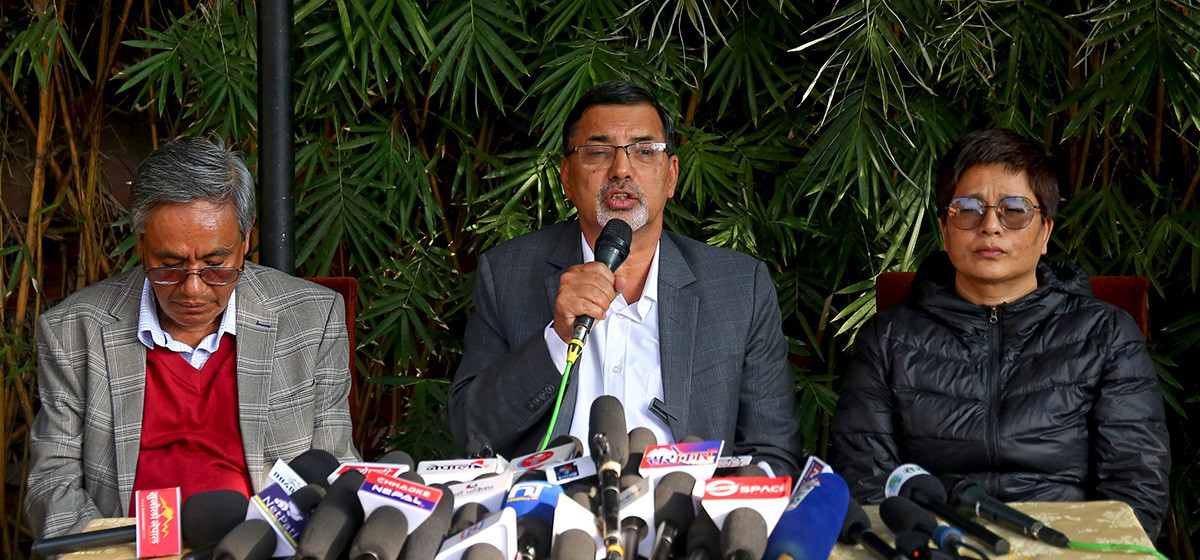
Opposing the merger process, Maoist Centre leaders Janardan Sharma and Ram Karki also announced the creation of Pragatisheel Abhiyan Nepal.
At the Maoist Centre’s National Convention Organizing Committee meeting in Kathmandu, party Chair Pushpa Kamal Dahal (Prachanda) completed all procedures to bring back leaders who had once deserted him, including Madhav Kumar Nepal’s group from the Unified Socialist. But long-time party figures such as Sharma, Karki, Sudan Kirati, and Anjana Bishankhe were notably absent, showing their dissatisfaction with the move.
Democratic alliance essential to check leftist alliance: Leader...

“Comrade Janardan didn’t come today,” Dahal said in the meeting. “Someday he’ll realize the need and return. Leadership isn’t about clinging to a chair until death — revolutions and counter-revolutions worldwide have taught us that lesson.”
Nine communist factions, including the Maoist Centre and Unified Socialist, are set to officially announce their unification on Wednesday. Tuesday’s meeting was meant to finalize preparations for that announcement.
Meanwhile, at a separate press conference in Lalitpur, Deputy General Secretary Sharma unveiled the Progressive Campaign Nepal — describing it as a new political initiative born out of dissatisfaction with the Maoist leadership. He accused the leadership of making a “serious and intolerable mistake” and vowed to carve a “third and new path.”
Paying tribute to the martyrs of Nepal’s political struggles — from the People’s War to the Gen Z uprising — Sharma presented a framework for a renewed movement aimed at socialist unity and the working class. “Rebellion is justified; rebellion is a right,” he declared. “Today’s need is socialist solidarity.”
Sharma clarified that the campaign was not a new party but an ideological and political effort to unite scattered leftist and progressive forces under a single socialist banner.
He criticized the Maoist Centre for losing direction and revolutionary zeal, saying its leadership has become entangled in power games and personal interests. “Joining the peace process was a historic step,” he said, “but the leadership drowned in the parliamentary system of comprador capitalism, betraying the movement’s spirit.”
“Our leadership turned the lack of principle into policy,” he said. “Revolutionary ideals and sacrifices have been eroded. It’s time to equip the new generation with ideological clarity and rebuild the socialist movement.”
Sharma further accused the National Convention Organizing Committee of exceeding its authority by rushing the unification process. “This so-called unification drama isn’t under its jurisdiction,” he said. “Its task was to complete the general convention, not stage political theatre.”
Responding indirectly, Dahal invited Sharma to join the unity meeting. But at his press conference, Sharma retorted that the Maoist Centre lacked both system and sincerity. “Instead of completing the convention, the leadership keeps delaying it,” he said. “Their aim is to block fair procedures and competition-based leadership. The unification being pursued today won’t solve anything.”
Four years ago, when Madhav Kumar Nepal split from UML to form the Unified Socialist, a majority approved merging it with the Maoist Centre — a decision opposed by Khanal and Bhusal. Within the Maoist Centre, leaders like Sharma also resisted, triggering internal disputes on both sides.
The Maoist Centre under Dahal has already seen several breakups. In 2012, Mohan Baidya split to form a new Maoist faction, joined by CP Gajurel, Ram Bahadur Thapa, Dev Gurung, Pampha Bhusal, and Netra Bikram Chand. But that unity too didn’t last.
Today, Thapa is with UML, Bhusal and Gurung remain with Dahal, and Chand has his own party, recently registering it at the Election Commission. Over time, Chand’s party has also fractured — with some returning to the Maoist Centre and others opening new leftist “shops.”
Among them, Gopal Kirati has rejoined Dahal, Bishwabhakta Dulal (Ahuti) continues independently under the Scientific Socialist Party, and Prabhu Shah has formed a regional party in Madhesh. Baburam Bhattarai, once Dahal’s closest comrade, now leads a small but separate party, distinct in name but not in ideology.