



LAHAN, Feb 25: For over three decades, the people of Madhesh—a region known as Nepal’s granary—have struggled with severe water scarcity. Since the establishment of multiparty democracy in 1991, issues surrounding irrigation, canals, and drinking water have been persistently raised, yet the problem of a "dry Madhesh" remains unsolved more than 32 years later.
Since 1991, Nepal has held eight elections for the House of Representatives and Constituent Assembly. During this period, Madhesh has also seen powerful identity-based movements. Throughout these political shifts, water scarcity has been a recurring theme. In essence, "water politics" has long been a dominant issue in the region.
The government is currently working on the Sunkoshi–Marin Diversion Multipurpose Project, which aims to provide year-round irrigation to approximately 122,000 hectares of land in Sarlahi, Bara, Rautahat, Mahottari, and Dhanusha by diverting water from the Sunkoshi River to the Bagmati River. However, the project, which began in 2021, has been delayed due to alleged contractor negligence. Critics say the government has avoided accountability by shifting all blame onto the contractors.
With no clear completion date, the project is not expected to solve the irrigation needs of the entire Madhesh region. The two main irrigation systems currently in place—the Bagmati system (covering 45,600 hectares) and the Kamala system (covering 25,000 hectares)—provide water to parts of Sarlahi, Rautahat, Dhanusha, and Siraha, but they fall far short of addressing the broader need.
Election Season, But No Water Agenda
In the lead-up to the House of Representatives election scheduled for March 5, political parties have released manifestos, yet none clearly address Madhesh's water crisis.
Several prominent national leaders are contesting seats in Madhesh Province, including former Prime Minister and CPN-UML coordinator Madhav Kumar Nepal, Nepali Congress leader Gagan Kumar Thapa, and senior CPN-UML leader Narayan Kaji Shrestha. They are joined by regional figures who built their political careers on Madheshi identity issues, such as Mahantha Thakur, Upendra Yadav, CK Raut, Mahendra Yadav, and Rajendra Mahato.
Despite campaign slogans promising radical national transformation, there is no concrete plan to rejuvenate the "thirsty" Madhesh. With many familiar faces on the ballot, local enthusiasm appears low.
Groundwater Depletion and Drying Villages
For 30 years, the government has failed to develop long-term strategies to solve Madhesh’s water problems. Beyond declaring drought-prone zones and installing deep tube wells, no sustainable solutions have been implemented.
As summer approaches and election campaigning intensifies, many villages across core Madhesh districts are already facing severe water shortages. Hand pumps and wells are drying up; even tube wells drilled deeper than 100 feet have stopped producing water.
Severe water crisis in Chure area calls for urgent action

Uncontrolled extraction of river materials from the Chure region, combined with deforestation and mining, has caused water sources to disappear. In Nawtoli village, located in Ward-7 of Ganeshman Charnath Municipality, Dhanusha, residents are feeling the impact acutely.
Local resident Kamal Mahato blamed uncontrolled riverbed mining in the Chure hills. "Even after pressing the pump handle for hours, the bucket does not fill with water," he said. A well built by the drinking water office in front of his house has also run dry.
"Three years ago, the tube well somehow pumped water, but since last year, it has completely stopped," Mahato said. His family now depends on neighbors south of the highway for their daily water needs.
Similar conditions exist in Siraha’s Golbazar Municipality. Most wards near the Chure hills are experiencing worsening groundwater depletion.
In Dhangadhimai Municipality, located at the foothills of Chure, a severe drinking water crisis has taken hold. Uncontrolled mining and deforestation have dried up traditional wells, affecting residents in Mahuliya, Musaharnia, Mahuwadanda, Tenatole, Khutti, Madyan, and Sarre.
Residents of Mahuliya have resorted to installing water motors to draw water from wells in neighboring Kasaha village. "We have brought water from Kasaha village by installing motors," said Bishwanath Yadav of Mahuliya. "Although more than two dozen motors have been installed, if rainfall does not occur on time, even that well may dry up."
Sharmila Yadav of Mahuliya voiced the community's desperation: "Without drinking water, how can we survive? Water scarcity has caused severe suffering."
Mahuliya settlement alone has 60 households, the vast majority of which are Yadav families, alongside a few Mahato, Ram, and Sonar households.
More than three dozen settlements in northern Siraha, near the Chure region, face severe drinking water problems annually. For about four months each year, residents struggle to access water. Even during the monsoon, they rely on muddy river water.
Since early February, wells and tube wells have begun drying up, forcing residents to turn to rivers and streams for drinking water.
In Lahan Municipality, groundwater levels are also falling. Residents must now use motors installed in deep pits to extract water. Five years ago, water could be found at around 40 feet when installing tube wells in Lahan. Now, drilling must go below 120 feet. Locals warn that if this trend continues, the crisis will worsen each year.
"Temperatures are increasing to unbearable levels. Water scarcity is rising every year. If Chure conservation and river protection work are carried out, people in Madhesh can be saved from severe water crisis," said Bhagwat Mahato of Dhanusha's Nawtoli.
Chure Degradation: The Root Cause
Experts say the Chure hills are the main water reservoir for Madhesh, but encroachment is increasing rapidly. Forests cover only 24.78 percent of Madhesh’s total area, and most of these forests are located in the Chure region. Of the 136 local units in the province, 84 have no forest areas at all.
Although the government acknowledges forests as the backbone of agriculture, tourism, water resources, and industry, practical implementation of conservation efforts has been weak, worsening the water crisis.
According to Chure expert Dr. Bijay Kumar Singh Danuwar, increased government encouragement of riverbed mining, combined with population growth, has accelerated Chure degradation and caused water scarcity.
"From farmers’ experiences, it can be concluded that the disappearance of spring and river water is due to Chure exploitation," he said.
Data from the Madhesh Province Ministry of Forests and Environment shows that 5,692.15 hectares of forest land were encroached upon during fiscal year 2080/81 BS. The highest encroachment was in Rautahat, with 3,190.52 hectares.
While all 136 local units of Madhesh depend on forests, forest coverage is uneven. In Saptari, 8 of 18 local units have forests; in Siraha, 11 of 17; in Dhanusha, 4 of 18; in Mahottari, 2 of 15; in Sarlahi, 7 of 20; in Rautahat, 5 of 18; in Bara, 3 of 16; and in Parsa, 7 of 14.
Failed Promises and Unfinished Projects
The government had previously announced emergency action plans for eight districts of Madhesh. A high-level task force report, prepared by the Ministry of Energy, Water Resources, and Irrigation, was submitted to then-Energy Minister Deepak Khadka, but it has never been implemented. Although the minister directed immediate action on July 31, nothing has happened.
The task force, led by then-Ministry Joint Secretary Sushil Chandra Acharya, included senior officials from agriculture, livestock, water supply, and irrigation departments.
Former Prime Minister KP Sharma Oli also promised to build 500 deep tube wells in Madhesh and provide farmers electricity at Rs 3 per unit for irrigation. However, no implementation timeline was provided.
Deep tube well drilling is ongoing but without standard guidelines. Work is often influenced by political connections, leading to inefficiencies. In some places, tube wells are drilled only 50 meters apart, while in others, water cannot be found even after drilling thousands of meters apart.
According to the Ministry of Energy, Irrigation, and Water Resources, about 400 deep tube well drinking water projects exist across the eight districts of Madhesh. However, these programs have not been implemented. More than 300 federal projects and 80 provincial deep tube well projects remain incomplete.
A Crisis Ignored
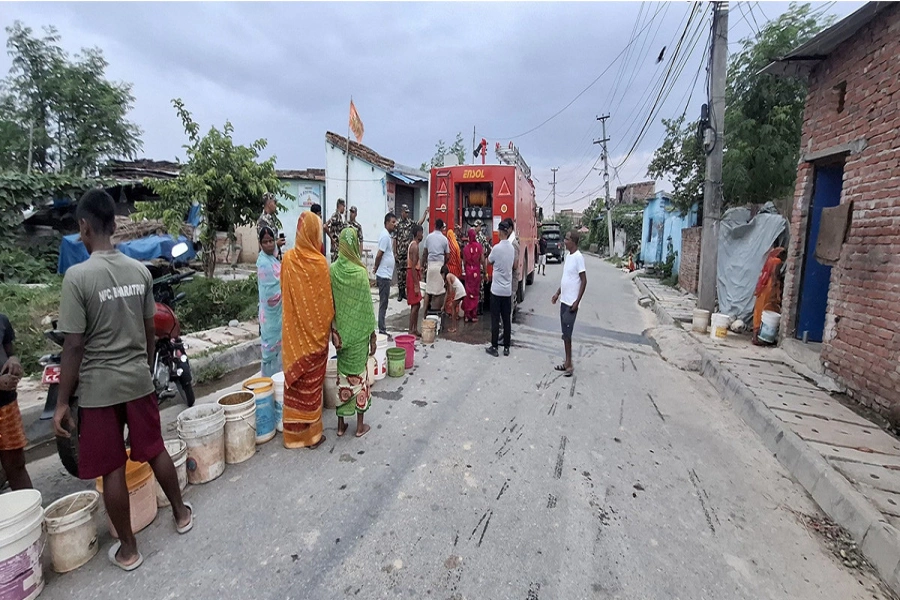
The federal government declared Madhesh a crisis-prone area on July 23, 2025. The Madhesh Province government followed suit on August 11, declaring the province drought-affected. Provincial and local governments, with army support, have been distributing drinking water, but this is a temporary fix for a chronic problem.
Despite Madhesh being the country's granary, water scarcity has rarely been a priority in political manifestos. The region continues to suffer from drought, with water shortages affecting both drinking supplies and irrigation.
Currently, many local governments are resorting to supplying water using fire trucks and tankers. According to the Madhesh Province Economic Survey 2080/81 BS, while irrigation coverage is reported at 85.36 percent of irrigable land, the reality on the ground is far different.
The vast majority of Madhesh’s population depends on groundwater. Data shows that 830,219 households use tube wells and hand pumps for drinking water, while only 729 households depend on rivers and streams. As the Chure region is destroyed, those tube wells and hand pumps are drying up, leaving millions in a perpetual state of thirst.


