With Nepal’s public debt crossing Rs 2,800 billion, the government stakeholders are required to address the situation sooner than later. Faced with rising expenses and limited income, the government turns to borrowing as the easiest option. At the same time, capital spending remains weak. Year after year, development budgets go unspent or are spent poorly. Delays in project completion because of poor planning and weak policies and poor administrative work processes have led to borrowed funds failing to create assets that could support future growth. A large share of public borrowing goes to recurrent expenses. Our annual national budget is eaten up mostly by recurring expenditures such as salaries, pensions, social security allowances, and interest payments. Unavoidable as they are, they are of no help for raising productivity or giving a boost to the economy. As the economy faces a rough time, debt keeps on rising without solid income to repay it. Meanwhile, external pressures also create a difficult situation. Similarly, the rise in inflation across the world and other factors, such as the rise in the dollar’s value, keep our debt increasing. An increase in the government’s domestic borrowing has also reduced credit for the private sector.
Public debt hits Rs 2.8 trillion mark
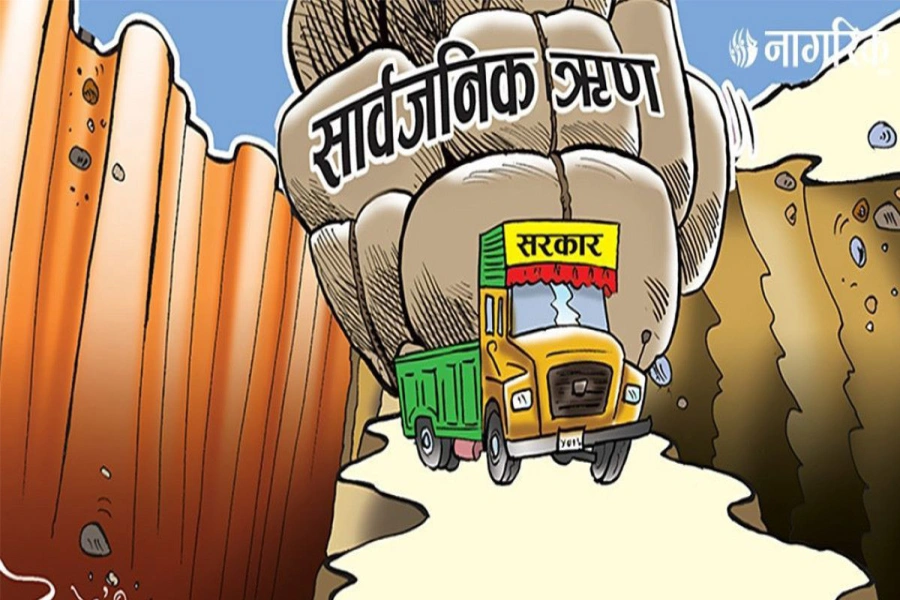
At the start of the current fiscal year on July 17, 2025, public debt stood at Rs 2,674.40 billion. By mid-January 2026, it increased by Rs 132.34 billion to reach Rs 2,806.39 billion. In just six months, the government added a large amount of fresh borrowing. Public debt now equals 45.95 percent of gross domestic product, a worrying ratio for a small economy that relies heavily on imports and remittances. The structure of this debt raises further concern. External borrowing makes up Rs 1,408.26 billion, or 53 percent of the total, while internal debt stands at Rs 1,319.13 billion, or 47 percent. In GDP terms, internal debt accounts for 21.60 percent and external debt 24.35 percent. The government plans to raise Rs 595 billion in public debt this fiscal year. By the mid-term budget review, it had already raised Rs 214.55 billion, about 36 percent of the annual target. These figures show that borrowing has become a regular way to manage public finances, rather than a limited tool used with care. This trend reflects deeper problems in the economy. Government spending has grown faster than revenue for years. The tax base remains narrow and depends largely on imports. When imports slow due to weak demand or policy tightening, revenue drops almost immediately.
When the value of rupees goes down, the cost of repayment goes up. Rising debt without visible economic gains also affects investor confidence. For an economy with limited export earnings, this path increases risk over time. The solution lies in discipline and clear choices. Any borrowing must go to projects that boost economic growth. Investments must be made in the energy, roads, irrigation, and digital service sectors because they can bring in long-term financial benefits. Revenue reform is equally important. Broadening the tax base, reducing leakages, and bringing more activity into the formal economy can raise income without increasing tax rates. Capital spending needs stronger planning, quicker execution, and close monitoring so borrowed money creates real assets. Nepal is in urgent need to cut its dependence on imports. Expanding exports, reviving tourism, and raising agriculture products can ease pressure on public finances. Stable policies and predictable rules can attract private and foreign investment. Though debt itself is not the problem, borrowing without growth gives the economy serious problems. Nepal can address the situation if it acts in time because any delay will only deepen the crisis.