Nations fail when they remain trapped in extractive institutions—structures designed to concentrate wealth and power in the hands of a few.
The Muluki Ain of 1854 codified caste hierarchy into law, ensuring that exclusion was not incidental but structural. Unlike America’s 1776 revolution, which—despite deep flaws—expanded political rights over time, Nepal’s founding moment institutionalized inequality. From its birth, corruption was embedded as the operating principle of the state.
“Nations fail not because of their geography or culture, but because of their institutions.” — Acemoglu & Robinson, Why Nations Fail
Revolutions Without Reform
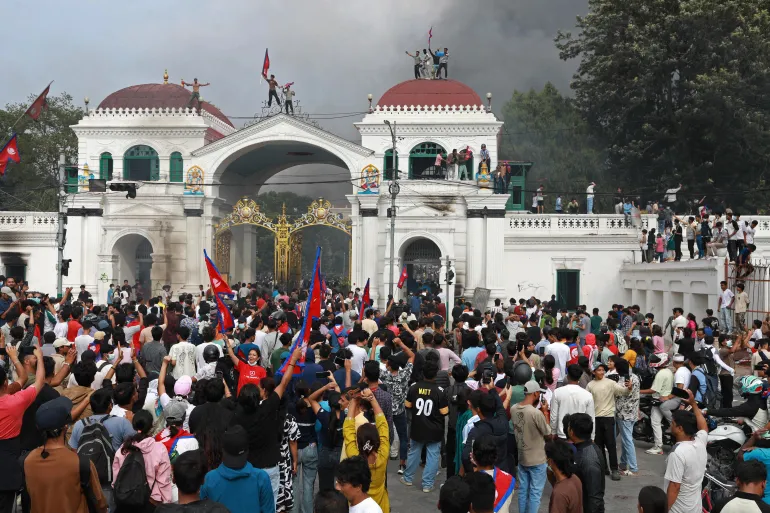
Nepal is once again in revolt. Young people—angry at unemployment, corruption, and statelessness—have filled the streets demanding change. Yet history warns that this uprising, like all those before it, will likely end in disappointment. Since the 18th century, Nepal has cycled through unification, Rana oligarchy, Panchayat monarchy, multiparty democracy, civil war, federal republicanism, and countless promises of reform. Each time rulers have changed, but the architecture of corruption has remained.
The framework of Why Nations Fail explains this pattern with clarity. Nations prosper when they create inclusive institutions—systems that limit elite capture, expand opportunity, and reward innovation. Nations fail when they remain trapped in extractive institutions—structures designed to concentrate wealth and power in the hands of a few. Nepal has never escaped this trap. Its institutions are not malfunctioning; they are functioning exactly as designed—to exclude, to exploit, to extract.
The Founding Sin: Why Prithvi Narayan Shah United Nepal
Prithvi Narayan Shah, ascending the Gorkha throne in 1743, sought to control the Kathmandu Valley and its lucrative trade routes. His unification, completed in 1769, was strategic: customs duties, taxation and tribute would enrich the center. His poetic metaphor of a “garden of four castes and thirty-six ethnicities” masked a hard truth. Power was monopolized, citizenship stratified and opportunity restricted. The Muluki Ain of 1854 codified caste hierarchy into law, ensuring that exclusion was not incidental but structural. Unlike America’s 1776 revolution, which—despite deep flaws—expanded political rights over time, Nepal’s founding moment institutionalized inequality. From its birth, corruption was embedded as the operating principle of the state.
3,742 fugitives still missing a year after Gen Z uprising

The Rana Century: Why They Revolted and How They Ruled
The Rana seizure of power in 1846 was less a revolution than a hostile takeover. By sidelining the monarchy and consolidating control, the Ranas converted the state into a hereditary oligarchy. Why did they do so? Because centralizing rents within one family cartel ensured unrivaled access to offices, taxation, and land. The result was 105 years of patrimonial corruption. Education was restricted, trade closed, and bureaucratic offices auctioned.
Globally, the contrast is damning. In 1868, Japan launched the Meiji Restoration, dismantling feudal privilege and investing in universal education and industrialization. By the mid-20th century, Japan had laid the foundations of an economic powerhouse. Nepal, by contrast, remained mired in illiteracy and isolation. The cost of that century of missed opportunity is visible in today’s metrics: Nepal’s GDP per capita is US$1,447 (2024), while South Korea—poorer than Nepal in the 1950s—now exceeds US$33,000.
The Multiparty Revolts: Why 1951 and 1990 Failed
The 1951 revolution toppled the Ranas, but corruption endured. Power shifted back to the monarchy and aristocrats. The bureaucracy remained loyal to patrons, not the public. By 1960, King Mahendra dissolved parliament and imposed the Panchayat system. This system distributed patronage more widely but centralized power at the top, keeping corruption intact.
The 1990 Jana Andolan was a revolt against this suffocating order. Multiparty democracy and constitutional monarchy were restored, but without independent courts, watchdog institutions, or transparent procurement. Political parties became syndicates. Ministries were auctioned to the highest bidder, contracts turned into electoral slush funds, and postings into commodities. East Asia, during the same years, democratized while investing in meritocratic bureaucracy and export-driven growth. Nepal liberalized corruption instead.
War, Federalism and the Revolts of the Excluded
The Maoist insurgency erupted in 1996 because the promises of 1990 democracy never reached the villages. Landlessness, caste oppression, and rural neglect created fertile ground for rebellion. After a decade of war and 17,000 deaths, the monarchy was abolished in 2006, and Nepal declared itself a federal republic. Federalism, secularism, and republicanism promised a new dawn, but again corruption adapted. Patronage was decentralized rather than dismantled. Provincial budgets became new arenas for rent-seeking; local governments multiplied extraction without oversight.
The Madhesh Andolans of 2007 and 2015 and Janajati movements exposed the superficiality of inclusion. Despite constitutional language, Madhesis were denied citizenship, Janajatis remained marginalized, and federalism became symbolic. Dr. C. K. Raut’s Madhesi independence campaign was a radical articulation of exclusion. His eventual co-option into mainstream politics exemplified the state’s strategy: absorb dissent, promise reform, preserve the status quo.
The Structure of Corruption
Corruption in Nepal has never been accidental. It has been structural, maintained through elite gatekeeping, fiscal opacity, selective enforcement, and narrative control. Political parties, monarchs, and oligarchs have acted as gatekeepers, ensuring loyalty, not competence, decides appointments. Fiscal systems have been opaque, budgets treated as political spoils rather than public resources. Watchdogs like anti-graft commissions or audit bodies have existed but lacked autonomy, becoming weapons against opponents rather than guardians of accountability. Development projects, from roads to hydropower, have enriched contractors and politicians far more than communities.
The metrics reveal the consequences. The Asian Development Bank projects Nepal’s growth at 4.4 percent in FY2025 and 5.1 percent in FY2026—numbers that may look respectable but are insufficient to meet the aspirations of a young population. Inflation remains at 5.2 percent, eroding household incomes. Remittances constitute over 26 percent of GDP, making Nepal one of the most remittance-dependent economies on earth, a model that exports youth rather than opportunity. Youth unemployment exceeds 20 percent, while more than 500,000 Nepalis leave annually for foreign labour. The World Bank’s Worldwide Governance Indicators place Nepal at –0.81 for government effectiveness (2023), reflecting bureaucratic inefficiency. Transparency International’s Corruption Perceptions Index ranks Nepal 107 out of 180 countries, with a score of 34/100, confirming entrenched corruption. These are not temporary setbacks; they are structural symptoms of institutional failure.
The Gen Z Revolt and the Interim Government
The Gen Z revolt of 2025 erupted because of unemployment, statelessness, and disgust at elite corruption. It represents a generation unwilling to accept exclusion. Yet the interim government installed under pressure from the streets has avoided inclusion. It reshuffled elites rather than empowering citizens. The judiciary remains weak, anti-corruption bodies lack prosecutorial independence, procurement remains opaque, and citizenship laws continue to disenfranchise. This is not reform; it is a survival strategy by a system designed to extract.
Unless Gen Z converts protest into institutional power—through independent courts, transparent fiscal systems, empowered watchdogs, and inclusive citizenship—their revolution will fail like those before it. Outrage alone is not enough. Without institutional redesign, even the bravest movements are absorbed and neutralized.
The Last Chance Before Collapse
At every historical juncture, Nepal had choices. In 1769, it could have abolished caste hierarchy and created equal rights. Under the Ranas, it could have embraced education and industrialization. In 1951, it could have embedded independent institutions. In 1990, it could have regulated campaign finance, professionalized bureaucracy, and strengthened watchdogs. In 2006, it could have coupled federalism with fiscal accountability and transitional justice. At each moment, elites chose continuity.
The consequences are stark. Nepal’s GDP per capita is stagnant, youth unemployment high, remittances the lifeblood of the economy, governance indicators negative, corruption perception entrenched. These are the hallmarks of a failing state. They are not indicators of hardship alone but warnings of collapse.
Aristotle called corruption the perversion of polity. Rousseau described it as slavery by another name. Marx defined it as class exploitation. Weber called it patrimonialism. Sen and Stiglitz warned it steals development. Acemoglu and Robinson remind us that nations fail because they exclude. Nepal has revolted for centuries, but it has never reformed.
The Gen Z movement is perhaps the final chance. If it too is co-opted, if outrage once again fades into continuity, Nepal’s descent into state failure will not be hypothetical—it will be reality. The tragedy of Nepal is not that it revolts too little, but that it revolts without reform. The question is no longer whether Nepal can protest corruption. The question is whether it can, at last, build inclusive institutions before it collapses.
The author is a medical doctor with a degree from Texas Tech University Health Sciences Center and a Global Clinical Scholar Research Training (GCSRT) certification from Harvard Medical School, Boston, US.