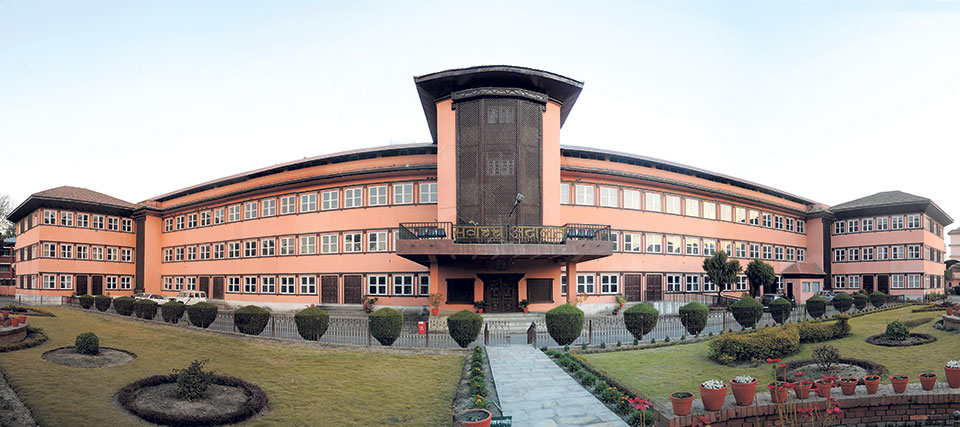
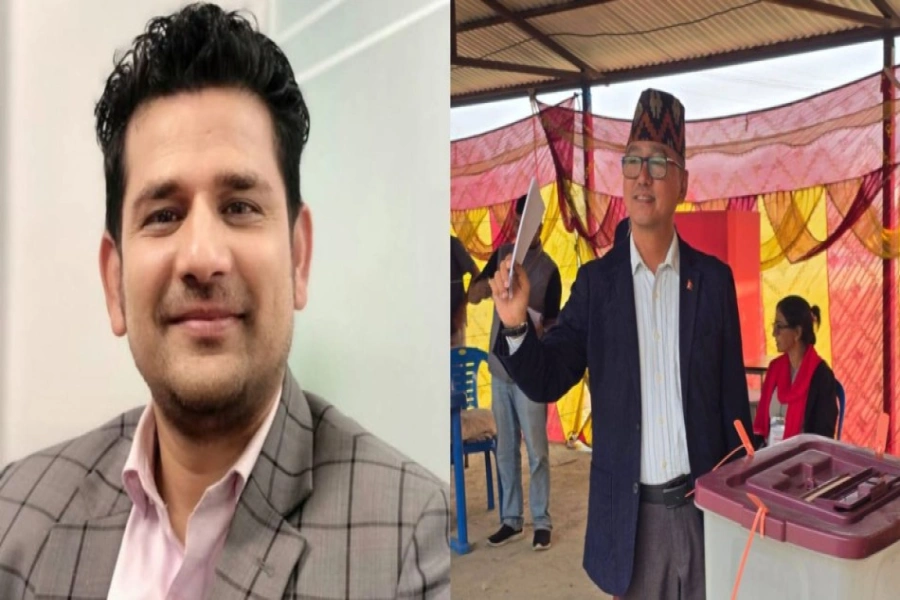
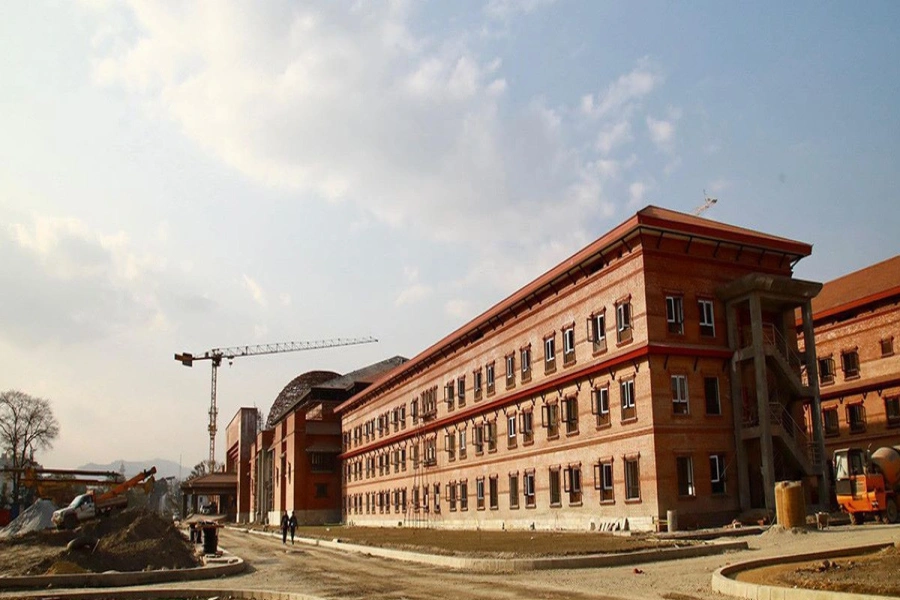
In August 2015, the government appointed Tirth Raj Khaniya as the 18th Vice-Chancellor of Tribhuvan University (TU), one of the 10 largest universities in the world in terms of student enrolment. In the first address at his new office, Khaniya said, "TU is a public university but it is losing credibility by the day. Thus my first priority will be to develop public faith in public education."
 Following his appointment, a series of criticisms appeared in various news media and social networks with regard to one of his journal articles published in 2006, which had plagiarized content from a Turkish scholar. Similarly, Kedar Nath Ghimire, blacklisted by the University Grant Commission (UGC) for plagiarism, was appointed as a member of the TU Service Commission. In addition, half a dozen professors have been proven plagiarists by UGC. They either plagiarized others' creations or self-plagiarized previously published works.
Despite an abundant media campaign and activities to shame these officials in public, they remain intact in their nominated positions due to a mutual syndication of major political parties. As a result, nearly 400,000 students of TU are guided by proven plagiarists. These incidents have resulted in a wave of pessimism among professionals and academicians in Nepal. They feel political loyalty, rather than integrity, is the strongest armor of Nepali academics.
But plagiarism is not a new issue in the university system of Nepal. In TU, there is neither a clear policy against plagiarism nor a strict mechanism to check plagiarized content and to encourage students to produce original work. In many countries, students are taught from school level about how to avoid plagiarism in their writing, presentation and academic works.
In Nepal, students seldom discuss such issues until they complete their undergrad levels. Moreover, we can observe advertisements on streets and news media outlets for readymade theses and research papers for Masters- and PhD-level students. There is no mechanism to check against such academic malpractices.
Why attribution?
Attribution to the original source is one of the most important ethical standards in academia and other professional fields. Again, non-attribution is called plagiarism. It occurs when a person copies someone's creative work such as painting, music, movie, art or writing without permission, falsely claims others' creativity as his/her own, and presents others' ideas without due recognition of the original creators. Non-attribution, therefore, is unethical and is also considered a crime if it violates a creator's intellectual property rights.
People often say that non-attribution can be excused if such an act is for social good. Moreover, a large number of digital documents are available in the Internet, without any attribution, and proper attribution is not always easy. Indeed, it is difficult to attribute a particular person for a collaborative content produced through crowd-sourcing. American film producer and critic Jim Jarmusch insists that nothing is original, everything is already there, and people just recollect and reinterpret it. For him, many novels, movies, or pieces of art have knowingly or unknowingly influenced some other creations. These arguments, however, cannot justify non-attribution of someone's creation in any context.
Though originality is a complex issue, the significance of attribution to the source has increased since human knowledge is built on what others have already done. Proper attribution leads to broader readership as researchers can see what others have done in a given field, and this encourages them to generate and expand on previous research by agreeing, disagreeing or challenging existing ideas.
Attribution to the original source is not only the recognition of the creator's contribution in a given field, but also an indicator of quality, originality and authenticity of their creative works. Unlike in copyrights, there is no extra cost for crediting an original source when distributing information for social good. Proper attribution habits can save a user from moral questioning and legal challenges.
Every profession has a code of conduct. One of the core values of such codes of conduct is to properly attribute others' creations. Using others' words or ideas, and expressing them as one's own is a dishonest act. Therefore professional and academic institutions, which usually have zero tolerance on plagiarism, must make attribution mandatory for their members and students.
The consequences
The consequences of plagiarism are serious. They are not limited to financial, academic and dignity-related losses, but can also lead to social disorder. When a person gets a medical doctor's certificate through plagiarized efforts, it puts the life of his patients in danger. And if a person plagiarizes rather than researching and writing herself, she is depriving herself of the opportunity to learn and practice desired skills and knowledge needed for a particular career.
Many professionals across the world have resigned from their posts on moral grounds due to lack of proper accreditation in their documents. For instance, two German ministers Karl-Theodor zu Guttenberg and Annette Schavan resigned in 2011 and 2013 respectively over plagiarized content in their doctoral theses.
In an article published on Setopati.net, Pratyush Onta, a noted researcher, writes, "plagiarism is a problem in Nepali academia. It is rampant at the university student level even for a research degree such as the PhD. To tackle this, the sanctions have to be tougher. Students who plagiarize should be told that this kind of academic dishonesty comes with a price." Now I wonder: who is left there to pass this message to students when senior leadership of TU is itself accused of plagiarism?
So the question is: Can a figure like Khaniya increase public faith in TU under his leadership? Mockery of academic values is an old tradition in our education system. Let's not forget the sins against these values committed by our educational leaders.
The author is a researcher on media ethics and accountability and is affiliated to University of Ottawa, Canada
bacharya@uottawa.ca
Related story
NHRC seeks copy of investigation on irregularities in NCO land