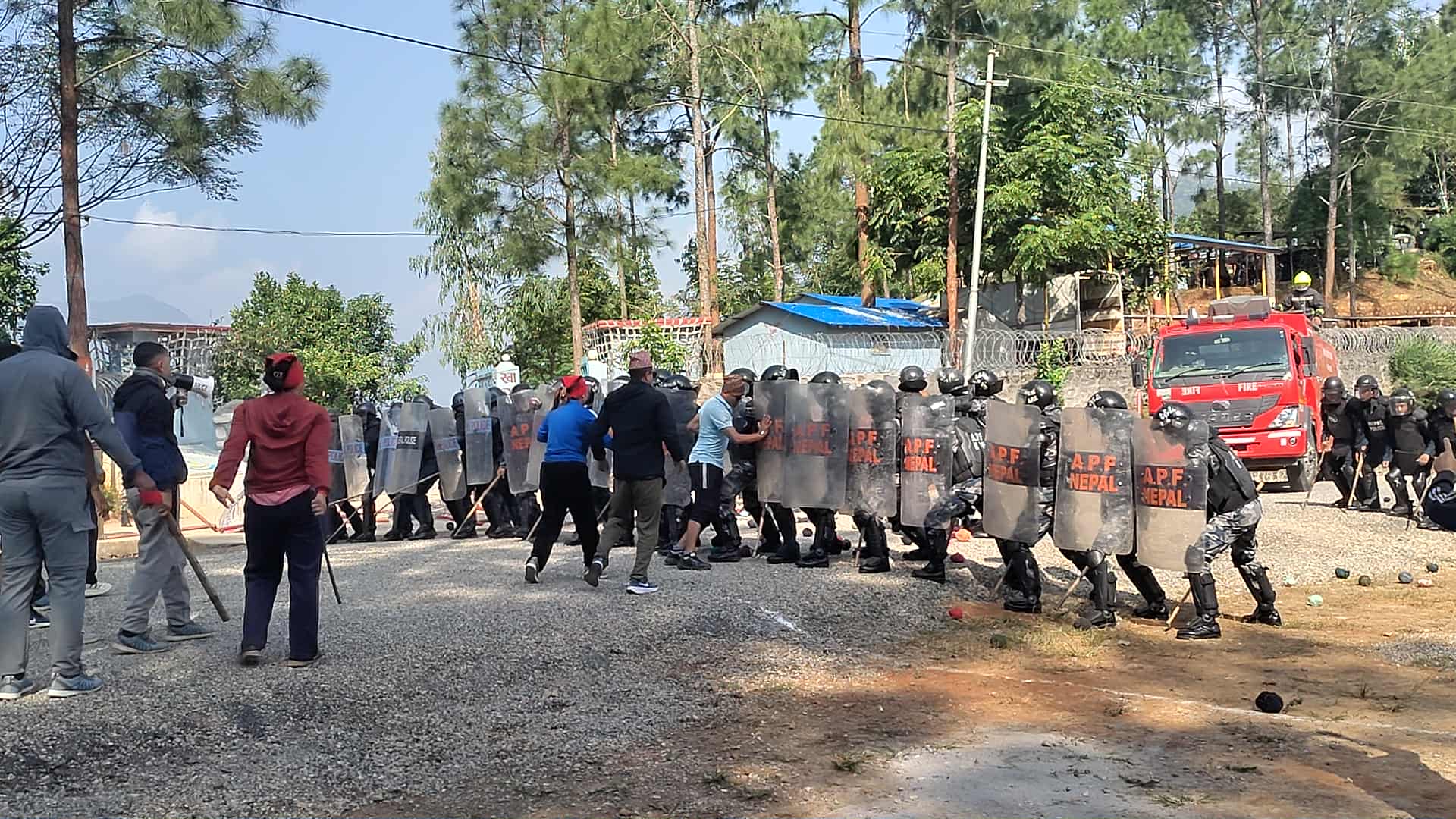
SINDHUPALCHOWK, Nov 5: Shouts rippled through the quiet hillside area as protesters hurled stones at security personnel in the Bandeu area of Sindhupalchowk on Wednesday. Police sirens blared and five sharp gunshots echoed across the valley as security forces moved forward, batons raised and water cannons ready.
At first glance, the Bandeu area looked like a town on edge — a tense confrontation between angry locals and heavily armed police personnel over the expansion of the Arniko Highway. Tear gas shells — 18 of them — exploded one after another. Officers rushed to rescue “injured” protesters and colleagues.
But it was all a drill.
The Armed Police Force (APF) Battalion No. 16 and the Sindhupalchowk District Police Office staged a high-intensity mock exercise designed to test crowd-control tactics, election-period readiness and crisis-response coordination. The drill mirrored real-life conflict situations seen during public unrest in Nepal.
Nepal-China military drill won’t affect Nepal-India military ti...

“It looked real, but this was a planned exercise in the presence of our provincial heads,” said APF Battalion Chief SP Achyut Kumar Majgaiya. “We practiced every phase of riot and curfew control, from warning crowds to aerial firing and emergency rescue.”
The simulation began with protest chants and police warnings. As the “crowd” intensified, officers advanced — first with shields, then with water cannons and tear-gas launchers. Finally came controlled aerial shots, followed by medical response teams rushing in.
The drill even included staged injuries — one APF personnel member and two demonstrators “wounded,” underscoring the unpredictable nature of real-world unrest.

Officials say the timing of such exercises is no coincidence. With parliamentary elections approaching and social tensions rising nationwide, security agencies are sharpening their readiness to tackle potential challenges.
Sindhupalchowk Chief District Officer (CDO) Bandhu Prasad Bastola described the operation as a strategic necessity. “Police and APF are not rivals — they complement each other,” he noted. “We must be capable of managing crowds effectively even with limited resources.”
CDO Bastola noted that Nepal Police should take charge of controlling situations from the front line, with the APF mobilized as a supporting unit when required.

Bagmati Province Police Chief Arun Paudel emphasized proportional force and continuous training, while Brigade Commander Anjani Kumar Pokharel of APF No. 3 Brigade, Gadhimai, underlined the importance of learning through simulation: “Real incidents may not unfold exactly like a drill, but this prepares us for any situation.”
All heads of security agencies in the district were present at the program.