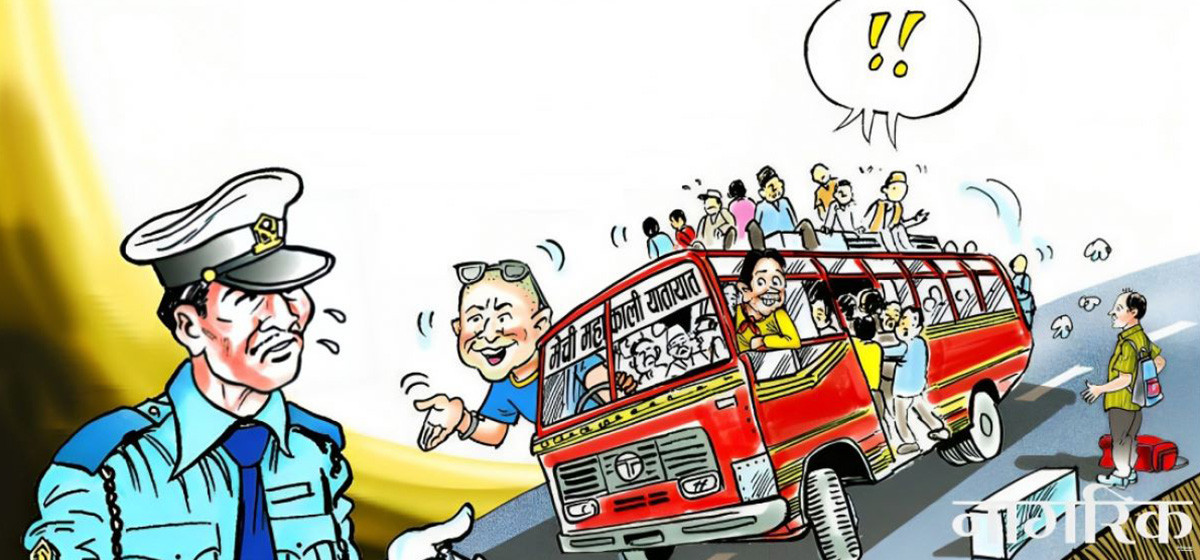
You read about them almost daily. Most of the time, you shrug them off, and they disappear from your mind in the blink of an eye. Yet for each of them, lives are lost, and thousands of citizens in Nepal mourn silently.
The cause of this suffering is not an uncontrollable viral pathogen wreaking havoc. These deaths are not inevitable; each of these tragedies could be prevented. Yet some individuals and institutions are in control of these risks and can ensure they are avoided—while countless others end up paying the price.
Recently in Ramechhap, dozens of citizens experienced this type of tragedy firsthand. Sadly, such incidents are not uncommon in Nepal, nor in many other developing nations. At least five people were killed, and the number is likely to rise. This incident was soon overshadowed by another avoidable tragedy when a bus carrying Nepali citizens and foreign tourists fell into the Trishuli River.
Road accidents are one of the most fatal, human-induced causes of mortality in Nepal. The Trishuli River accident gave a particularly bad image of the country, as many international news portals covered it. According to the National Road Safety Council of Nepal, road accidents were the 10th leading cause of death, claiming more than 2,400 lives in 2017/18 and over 2,700 in 2019/20.
From July 2014 to July 2019, there were a total of 54,000 road accidents in Nepal, resulting in 12,000 deaths, mostly among people aged 15–40 years. On average, 40 people are injured daily across the country. In 2019 alone, nearly 13,000 accidents occurred, resulting in 2,736 deaths and 10,731 serious injuries. Survivors often face traumatic brain and spinal cord injuries, requiring long-term or lifelong rehabilitative care. The estimated economic loss from road accidents was 1.52% of GDP, or USD 122.88 million, as of 2017.
Road safety draft gathering dust at the Ministry of Transport f...
Paradoxically, these deaths act as an equalizer. They do not discriminate between citizens in developed urban areas and those in remote rural regions. They affect people across income levels and caste—wealth or privilege offers no immunity. Unfortunately, this problem is not taken seriously. The state, at all levels, seems incapable of meaningful action. Despite rhetoric, little is done. Awareness campaigns alone have proven insufficient.
Recent trends worsen the situation. Drivers of luxury cars are often seen absorbed in phone conversations while driving—one hand glued to the phone instead of the wheel. Such shortsightedness puts not only the drivers’ lives at risk but also those of passengers and other innocent road users.
The Kathmandu Post recently reported that, according to Nepal Police, there are on average 75 road accidents daily, with around seven fatalities. Poor road conditions contribute, but human error is a major factor. Serious accidents could often be prevented if drivers adhered to traffic rules and exercised common sense. Yet, reckless driving, ignoring lane discipline, and not using seat belts remain widespread.
The disregard for safety is so severe that even air-bags—engineering marvels that have saved millions of lives—can become killers when misused. Many passengers sit on the front seat holding small children on their laps, creating a near-certain fatal risk in collisions. This reflects either sheer ignorance, negligence, or both.
What can be done to prevent these tragedies?
1. Strict Enforcement of Existing Laws: Road rules must be applied literally, without ambiguity or leniency. Prioritization of road safety by the state, from federal to local levels, is essential. Road accidents are a clear indicator of dereliction of duty. Punishments for traffic violations are disproportionately small. For instance, crossing a single or double line incurs a fine of only NPR 500, doubling to NPR 1,000 if repeated. Using a mobile while driving carries only NPR 500, and there is no fine for placing a child on the front seat.
2. Stricter Regulations and Mindset Change: Implementing stricter laws requires not just policymakers but also enforcement officials to take responsibility seriously. Modern technologies like drones can aid monitoring, but lack of equipment cannot justify inaction.
3. Awareness Campaigns: Initiatives such as Road Safety Week (9–17 January 2026), organized by Nepal Police and Kathmandu Valley Traffic Police, are welcome. Activities included safety checks, counseling, distribution of informational materials, school and college sessions, walkathons, rallies, road marking, zebra crossing painting, and traffic light inaugurations. Involving students in pedestrian safety awareness is important, but the ultimate responsibility for safety lies with drivers.
4. Private Sector Participation: Driving schools must focus on teaching safe driving rather than shortcuts to pass tests. Vehicle showrooms could mandate brief road safety sessions for new vehicle owners.
5. Long-Term Cultural Change: A road safety ecosystem requires partnerships across government, private sector, and civil society. Changing attitudes and behaviours is essential to complement law enforcement and infrastructure improvements.
Imagining a better, more developed Nepal means the nation cannot afford to lose so many lives to unsafe roads. Behind each statistic is a story—dreams of youth, hopes of families, and expectations of communities vanish in a fraction of a second. The pain of families affected by road accidents is irreparable.
Whoever forms the next federal government must commit to making Nepal’s roads truly safe for all.