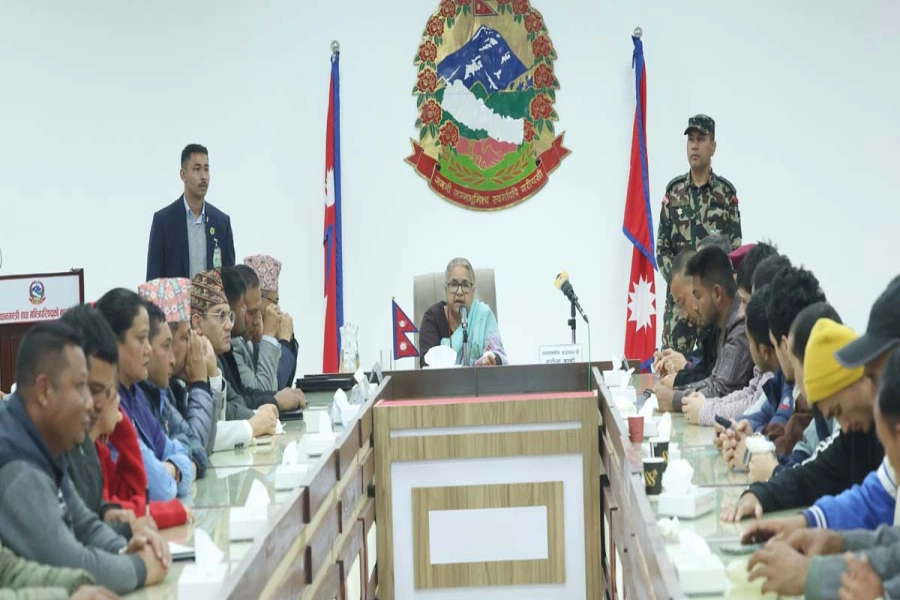
Prime Minister Sushila Karki’s agreement with representatives of Gen-Z on Wednesday has cast doubt on the fragile trust that had been developing between the political parties and the government. Any agreement made by the government must rest on a clear foundation; without it, implementation becomes difficult. This does not mean the government cannot sign agreements, but since it was formed with the consensus of major parties—and with a limited mandate—it carries the responsibility of fostering trust. The current government emerged from the vacuum created after the Gen-Z protests of 8 September and the subsequent attack on the Parliament building that evening, the deaths of civilians during the security response, and the destruction, vandalism and arson on 9 September. It has been mandated to conduct elections on 5 March 2026, to take action against corruption and to investigate the events of 8 and 9 September. The constitutional body responsible for corruption cases—the Commission for the Investigation of Abuse of Authority (CIAA)—is the proper mechanism for such work, as Prime Minister Karki herself has stated. Against this backdrop, serious political questions have arisen after Karki signed a ten-point agreement with the Gen-Z group three months after the formation of her government. Former Prime Minister and CPN-UML Chair KP Sharma Oli has criticised the move as an “artless drama”, while other political parties also appear unenthusiastic.
State to gain more than Rs 4 billion from Gokarna Forest Resort...

The agreement described as historic by Gen-Z activists includes issues from constitutional amendments to property investigations. Signing an agreement is one thing; implementing it is quite another. Did both sides merely want a document for public display? If not, how realistic are these commitments? The government has only about three months remaining, during which elections will dominate its agenda. Beyond routine administration, it cannot make major decisions. Even in ordinary circumstances, it could not fulfil all such commitments alone. The only political footing it has is the Gen-Z campaign—yet those involved in it are themselves sharply divided. Moreover, due to the extensive destruction carried out in its name, the movement’s leaders cannot credibly assume responsibility for the violence, even if they claim ownership of the protest. The Gen-Z campaign began to falter the moment attempts were made to burn down the executive, legislature and judiciary. Private and public properties were also torched and looted, discrediting the movement entirely. There is no reasonable justification for arson at Singha Durbar, the courts, Parliament, police offices or any other institution. These acts were neither noble nor revolutionary. Given such conduct, it is inappropriate for the Prime Minister to present this as a “people’s movement”. Nepal has witnessed genuine people’s movements in 1950/51, 1990 and 2006. While the Gen-Z movement may have sought reform, it was overtaken by disruptive forces. The country incurred losses exceeding Rs 80 billion within two days. For this reason as well, it cannot be considered an ideal people’s movement.
If the destructive acts committed under the Gen-Z banner—which left the country in chaos—are to be recognised as a people’s movement, such recognition must have broad political consensus. Even if the government grants that status now, it may not stand in the future. The agreement also contains provisions related to constitutional amendments, which this government has no authority to undertake. If constitutional change is the goal, consensus among political parties is essential before any such agreement is signed. This government will not continue after the elections, so major political parties must be ready to take ownership for the agreement to hold in the long run. If the agreement is an attempt to shield those involved in the vandalism and arson of 9 September, it will fail. A serious investigation is required into both the acts that attempted to dismantle democratic institutions and the failures of state mechanisms in responding to them. Only the events of the first half-day of the Gen-Z campaign can be acknowledged. Those responsible for the subsequent destruction must be held accountable. If the campaign aimed at systemic reform, that intent can be recognised—but the violence that threatened the foundations of democracy cannot be framed as a people’s movement. Even though Prime Minister Karki has signed the agreement on behalf of the government, provisions contradicting the constitution cannot be implemented. Any actions taken now without broad political consensus will not be legitimate in the future. An agreement extracted through sustained pressure on the Prime Minister has no durable future. It will only deepen uncertainty in national politics.