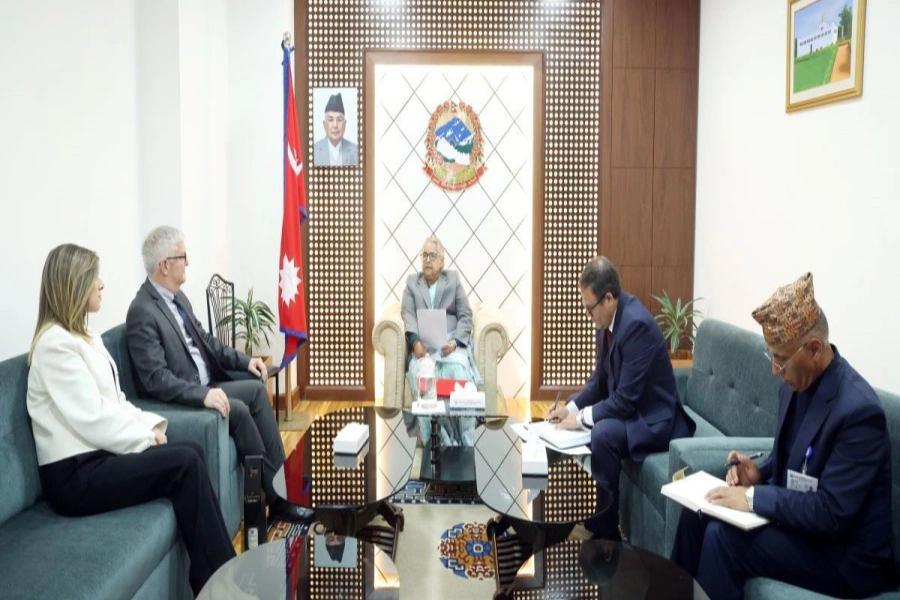
The government is reported to be actively considering filling vacant ambassadorial positions. This may trigger the usual rat race among the aspiring candidates to secure the most lucrative positions, by hook or by crook. The race may become all the more intense as the CA election is round the corner. This is the opportunity every big political party would surely want to seize to reward their faithful, in return for their undiminished and sustained loyalty. Clearly, this would keep the government on tenterhooks. It is impossible for it to go against the wishes of the political bigwigs. Sure enough, it will be literally inundated by the names of a large number of political candidates for the open positions, at the expense of experienced and professional diplomats. [break]
A taskforce has reportedly been created within the Ministry of Foreign Affairs to develop appropriate criteria for new appointments. Any comment on the rationale behind the creation of the taskforce would be rather premature for lack of information on its need, TOR and appropriateness. Nevertheless, it is hoped that in preparing the criteria, the taskforce draws on the reports of its predecessors, which contain a wealth of practical recommendations to bring ambassadorial appointment process in line with international practice. In fact, all past attempts at making diplomatic assignments more profession- oriented and result-driven failed to get off the ground for the obvious lack of political interest. The post-1990s democratic governments were not keen on implementing the well thought out recommendations. Forced to protect their democratic facade, they selectively implemented them. The reason was clear: implementing the recommendations wholesome would negate the possibility of appointing their cronies as ambassadors.

fundraisingincubator.com
Currently, there is no effective institutional mechanism to scrutinize the competence and caliber of prospective candidates. This would surely make the selection process all the more difficult. During the last CA, there was at least a “Parliament Hearing Committee” to hear on all constitutional appointments. Although it was ill-prepared to inquire into the competence of candidates in a comprehensive manner, it did, nonetheless, work as some kind of a rudimentary vetting mechanism. The taskforce, therefore, could suggest a broad-based “Committee of Experts” comprised of seasoned and reputed former ambassadors, experts on international economic and security relations as well as experts from the business community. The Institute of Foreign Affairs (IFA) may play host to the Committee, with its Executive Director as member-secretary of the Committee.
The Committee would assess and scrutinize, among other things, the integrity, intelligence and information-sourcing capacity of each candidate through oral interviews, question-answer sessions and by requiring them to submit written papers and make presentations. Fluency in English language, clarity of expression, content management and information on multilateral and international financial organizations, including their direct implications for Nepal, may be some of the important areas for examination. A candidate’s performance on these issues may be sufficient for committee members to make an objective judgment on his/her overall competence.
This kind of competence assessment is extremely important to dispel the widely perceived notion that ambassadorial assignment is free pleasure trip. On the contrary, diplomats, as representatives of their countries abroad, have enormous responsibilities. They have to be imbued with “integrity in character,” which, among other things, would entail placing national interests above personal or party interests. Needless to say, diplomacy is all about knowledge and intelligence. There is a saying that “information is power”. A highly intelligent and well-informed diplomat can understand and interpret the subtle and intricate issues that characterize contemporary international relations. We must bear in mind that only such diplomats can enhance national prestige and protect and promote our national interests abroad. Appointing ambassadors without scrutinizing their intelligence, integrity and information capacity is tantamount to unleashing “a bull in a china shop”.
The current Foreign Minister is a talented former bureaucrat, also known for his penchant for professionalism in bureaucracy. This is the right time to test his integrity and passion for professionalism. It is not my intention here to suggest that he should recommend all names from among career diplomats. Harnessing talents from outside is equally important. The Foreign Minister should thus not prevent the political party leaders from recommending names. However, he should persuade them that it is in the country’s interest to select only intelligent, informed, honest and professional candidates to salvage Nepal’s otherwise sagging international prestige and image. His being able to convince recalcitrant politicians all by himself is an uphill task. He needs the support of the Foreign Ministry, his cabinet colleagues and most importantly, that of the Chief of the Council of Ministers.
Nepal also has to find a suitable candidate for the next SAARC Secretary-General. It is an opportunity that has come Nepal’s way after nearly two decades. SAARC is all about regional economic and social development. Thus development dimension has always been at the heart of regional cooperation. Regional security issues, important as they are, are perceived by some member countries as too sensitive to be discussed freely and formally at the SAARC Summits. It is development issues where all the SAARC countries have more or less convergent views. Furthermore, a SAARC Secretary-General does not need to engage in any serious and sensitive bilateral or regional diplomatic negotiations.
This is the responsibility best carried out by mainstream diplomats. The SG’s main area of focus is to continuously push member countries for rapid socio-economic regional development. The ability to do so would call for in-depth knowledge of regional economic issues and problems, including ability to tackle them efficiently. This is something only an experienced development expert can manage. To reiterate, Nepal must select a development expert with long working experience and international exposure, one who is articulate and stands head to head with any of regional and international development experts and diplomats. Only such a person can promote Nepal’s image in the region and help create a favorable environment for the progress of the SAARC project. Hence, selecting from among former ambassadors or security experts may not make much sense in this case.
The author is former joint secretary, Ministry of
Foreign Affairs
Bhimsen29@gmail.com
Related story
Rich pickings