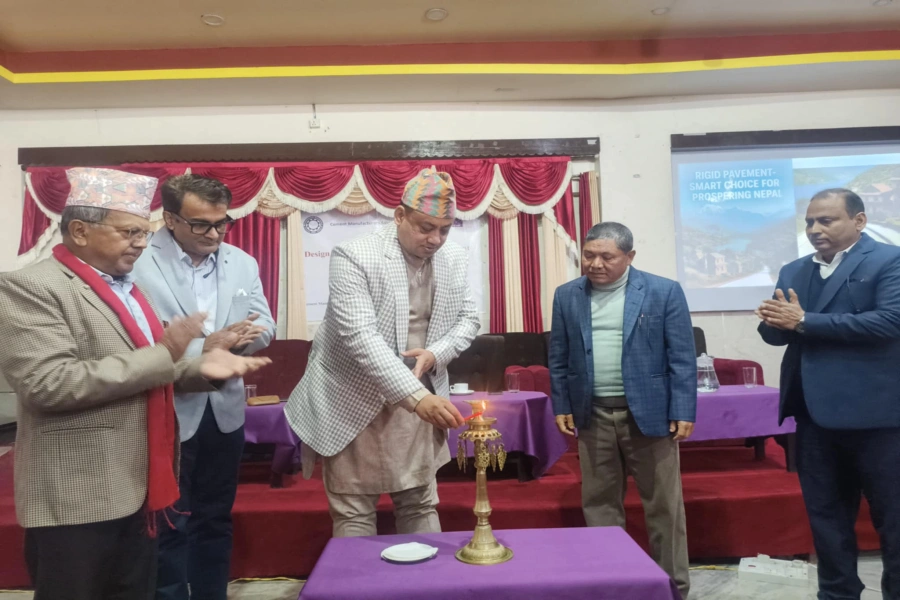
Speaking at a daylong seminar on 'Envisioning Nepal 2030' organized by National Planning Commission (NPC) and Asian Development Bank (ADB) in Kathmandu on Monday, they also stressed the need to focus on key competitive and comparative advantage sectors for structural transformation and acceleration of economic growth.Addressing the seminar, Prime Minister K P Sharma Oli said that Nepal needed a long-term strategic development plans and policies to graduate to the status of a developing country from the current LDC status.
Stressing on implementation of those mechanisms to achieve Sustainable Development Goals (SDGs) by 2030, he said that the country has to double annual investment, and build essential infrastructures like strategic road and railway networks, communication, and electricity.""We have shifted our attention and efforts and are gearing toward economic development and prosperity after promulgation of the new constitution"" he said, adding that Nepal's unique geographical locations, abundant natural resources, biodiversity and landscapes that widen connectivity across the borders toward a self-reliant economy has been able to reduce poverty, achieve most of the Millennium Development Goals (MDGs) and make significant social development particularly in health and education.
After the promulgation of constitution, the main task before Nepal is to empower the people through implementation of economic and social agenda enshrined in the constitution, he said, adding that it would only be possible through structural transformation of existing economic and social institutions, production relations, and social values."
"However, focus must be on addressing the crippling energy crises that hold key to unleash rapid growth of many industries, as well as on connectivity to reach all Nepali villages within the country, and the vast markets of the neighboring countrie"," Oli added.
The seminar provided a platform for all stakeholders to contribute and work for climate change, sustainable development activities and renewable energy resources.
Speaking at the seminar, ADB Vice President Wencai Zhang hailed Nepal's intent to graduate from LDC status by 2022, and become a middle income country by 2030, while achieving the sustainable development goals. However, this calls for a credible vision and a strategy to achieve it by setting out policies, prioritizing public expenditure and investments to build physical and human capital, improving governance and the business environment, building a competitive industrial base and enhancing regional cooperation and integration, he said.
Welcoming the guests, Yub Raj Khatiwada, vice chairman of the National Planning Commission, said that Nepal needs higher economic growth to reduce poverty by 2030. "We have to learn how to accelerate the growth from our neighbors," he said, adding that the government will formulate Development Strategy 2030 by incorporating inputs from the seminar.
At the program, participants and panelists suggested to the government to chalk out a national development strategy on the basis of Nepal's competitive and comparative advantages. They also said that Nepal has been trapped in poverty due to lack of diversification from subsistence agriculture to commercialization. "The government should provide first movers incentive to encourage entrepreneurs to venture in new areas that can provide impetus to economic growth and create employment," they suggested.
On the occasion, Minister for Finance Bishnu Poudel accepted that the government has a challenge to develop sufficient infrastructures that could propel economic growth.
Related story
India committed to enhancing connectivity: Indian envoy