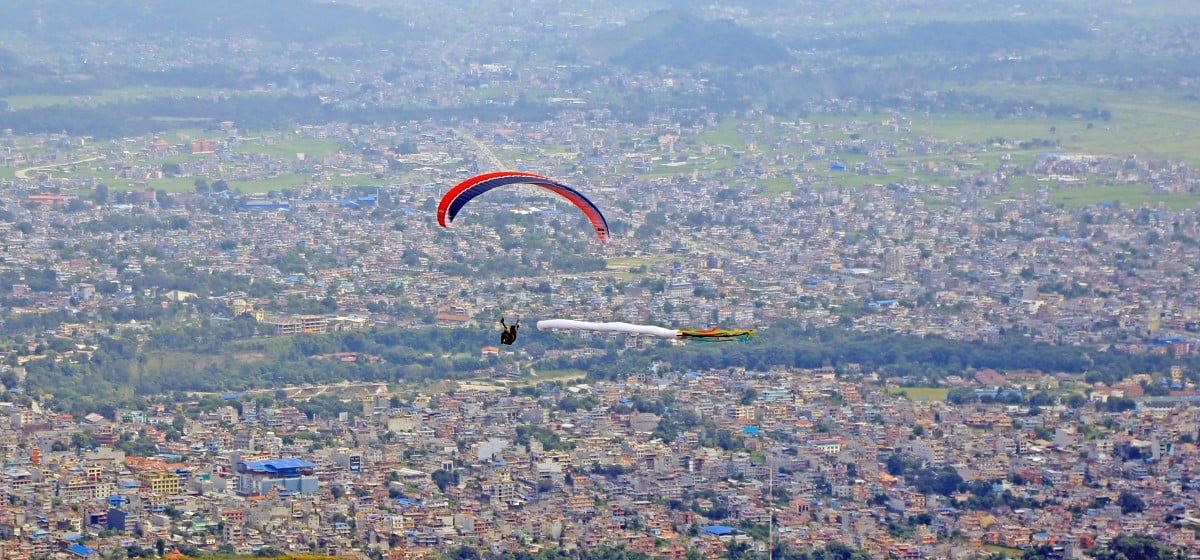
POKHARA, July 12: Solo paragliding flights, which had been suspended for nearly three years, have officially resumed. The Civil Aviation Authority of Nepal (CAAN), the country’s aviation regulatory body, has reopened solo (individual) paragliding flights.
According to the CAAN, the decision aims to enhance the professional skills and competence of both domestic and international paragliding pilots, while also promoting tourism through solo flights.
Gyandendra Bhul, Chief of CAAN’s Recreational Aviation Division, said that solo flights have been allowed under newly formulated operational procedures. “Solo flights had been suspended in the Pokhara area for almost three years. But now they are open again. Individual pilots can fly,” said Bhul. “However, it must be done in a more organized and regulated manner than before.”
Solo paragliding was halted following a fatal accident in Sarangkot nearly three years ago. CAAN had imposed a blanket ban on all types of paragliding flights at the time. While tandem (commercial) flights were later resumed, solo flights remained suspended due to the absence of a proper regulatory framework. Operators had repeatedly requested that solo flights be reopened, but CAAN held back, citing the need for better regulation.
According to Bhul, solo flights are now allowed strictly within designated paragliding zones. The flights must be conducted under the direct supervision and monitoring of the Nepal Air Sports Association (NAA), the umbrella body of paragliding operators.
“Solo flights have been resumed under strict regulatory conditions. Pilots are not allowed to fly beyond the zones designated by CAAN,” he said. Bhul added that CAAN has developed a separate operational guideline specifically for solo flights. The guideline prohibits flights outside the designated area, as unsanctioned solo flying in the past was reported to have interfered with helicopter and aircraft operations.
The CAAN has also imposed strict restrictions on the use of drugs and alcohol and pilots will now be monitored through technological means. “If any human casualties, incidents or accidents occur during a solo flight, the pilot and the associated company will bear full responsibility,” the guidelines state. “Failure to comply with CAAN's conditions will result in the cancellation of solo flight permits, suspension of pilot licenses, and revocation of company certifications.”
According to entrepreneurs, Pokhara is considered one of the top five paragliding destinations in the world. However, the suspension of solo flights in recent years had affected the industry’s momentum. Many international pilots were unable to fly, which in turn impacted tourism. The ban also slowed the entry of new pilots into the sport.
Operators said that nature-loving tourists, many of whom come specifically for solo flying, were deterred from visiting Nepal due to the ban. Solo paragliding offers a unique way to enjoy nature, and the lack of access had a direct impact on business. According to paragliding pilots, October and November are considered the best months for flying in Nepal. During these months, foreign pilots used to travel long distances with their gliders just to fly in Pokhara.
Anil KC, President of the Nepal Air Sports Association, said that the new guidelines are intended to bring more structure and safety to solo paragliding. While CAAN’s rules apply to solo flights nationwide, stricter measures are required in Pokhara because of the international airport located there. “In the case of Pokhara, solo flights need to be managed even more strictly. Compared to tandem flights, solo flights require greater regulation,” he explained. “Tandem flights are time-bound and include passengers, so they follow a fixed schedule. But solo pilots fly independently, which makes stricter regulation necessary.”
With the resumption of solo flights, foreign pilots will now be able to fly solo in Nepal once again. “Foreign pilots who had been restricted from flying solo can now return for the upcoming season,” KC said. “This will provide a boost to the tourism sector.”
Operators estimate that around 1,000 foreign pilots used to visit Pokhara each year solely for solo paragliding. With the suspension in place, many had stopped coming altogether. These tourists typically stayed in Pokhara for 15 days to two months. “Solo flights used to drive tourism activity. Now that they’ve resumed, the path has reopened for high-spending tourists to return,” KC added.