KATHMANDU, Nov 27: Prime Minister Sushila Karki has urged the private sector not to take the social security of their workers and employees as a burden.
Addressing a ceremony organized at the Office of the Prime Minister and Council of Ministers in Singha Durbar on Thursday on the occasion of the Eighth Social Security Day, she requested that social security for workers be taken as a matter of dignity.
Stating that social justice is not possible without comprehensive social security, Prime Minister Karki said that in a country like Nepal, contribution-based social security programs must be implemented effectively to balance inter-generational costs and ensure equity. “Through successful implementation, those who ‘have’ will systematically support those who ‘do not have,’ the rich will support the poor, and the healthy will support the sick. This creates a productive society based on the principle of social solidarity,” she said.
She informed that discussions are underway to address the concerns raised by stakeholders in order to build an integrated, sustainable, and capable social security system. “The enforcement of mandatory enrollment in the formal sector, determining how much the federal government will contribute in the required co-contribution for informal sector workers, and ensuring that contract employees under government mechanisms feel included in the Social Security Fund—these issues will all be addressed,” she said.
Minimum wage for private workers reaches Rs 15,000 per month

Highlighting the need for homework on how the rapidly expanding Social Security Fund can be utilized in nation-building, the Prime Minister said that the savings contributed by each worker and employer must be invested in sectors that provide meaningful results.
Secretary of the Ministry of Labor, Employment and Social Security, Krishna Hari Pushkar, stated that the Fund was established in the interest of workers and employees, adding that the ministry is committed to increasing enrollment, ensuring continuity, and raising public awareness on social security schemes.
Chairperson of the Joint Trade Union Coordination Center (JTUCC), Jagat Singh Khada, stressed the need to further refine the social security schemes and make them more contributor-friendly. He pointed out that due to the incomplete implementation of the schemes, many workers have been deprived of social security, and said the government must be ready to share the contribution amount for workers in the informal sector.
President of the Federation of Nepalese Chambers of Commerce and Industry (FNCCI), Chandra Prasad Dhakal, said bringing informal sector workers into the social security system remains a major challenge, and urged stakeholders to think seriously about it. Emphasizing the need to channel the collected contribution funds into proper sectors, he called for attention to digitizing the services of the Fund and expanding its coverage.
ILO Nepal Director Numan Ozcan said the organization has been working to create an environment for good labor relations in Nepal. Executive Director of the Fund, Kaviraj Adhikari, reported that 649,511 workers in the formal sector, 1,996,579 workers in foreign employment, 799 workers in the informal sector and 582 self-employed individuals have already been enrolled in the schemes.
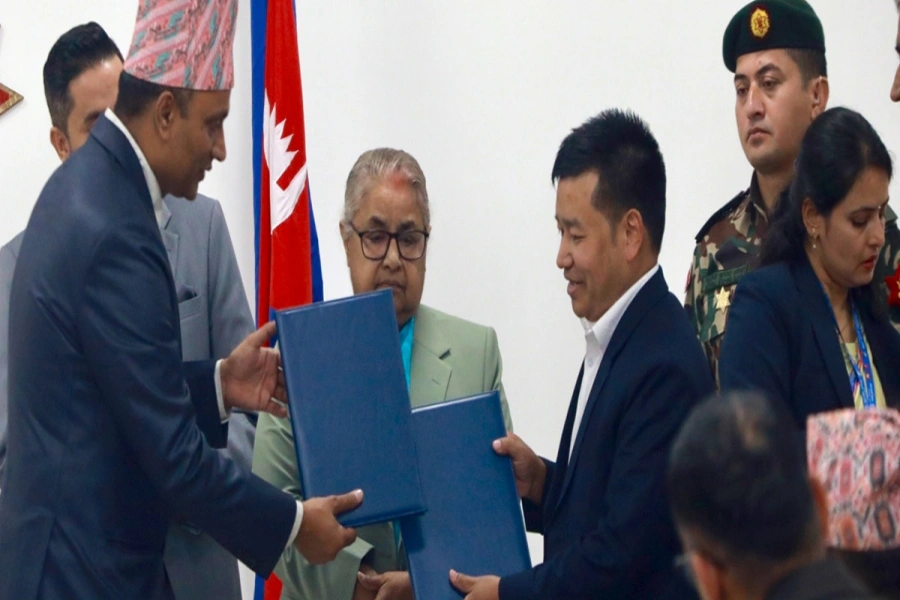
On the occasion, a memorandum of understanding was reached among the National News Agency, Gorkhapatra Corporation, Public Broadcasting Service Nepal, Press Council Nepal, and the Social Security Fund to enroll employees under their institutions into social security.
According to the Fund, as of Wednesday, 2.6 million citizens have been included under contribution-based social security. The Fund is operating schemes for medical treatment, health and maternity, accident and disability, dependent family security and old-age protection. It stated that workers and their families have been receiving various benefits under these schemes.
So far, the Fund has collected Rs. 95.68 billion as contribution-based savings. A total of 253,143 workers have received claims worth Rs. 17.72 billion. In addition to health benefits, the Fund has been providing contributors with interest on savings, monthly pensions after a fixed period, home loans, and educational loans.


-1200x560-1774606010.webp)
-1200x560-1783685616.webp)