KATHMANDU, Dec 18: A group of blue uniforms are lined up in front of the installation work, ‘Jamara Might not Exist’, by Nepali artist Sadish Dhakal at the Kathmandu International Arts Festival (KIAF). Attentively listening to the artist explain his art work, the students let out ‘ehhs’ and ‘ahhs’ of understanding after a concept has been clarified by the artist.
Sadish Dhakal, who is mostly present at the site of his installation in Mulchowk, Patan Durbar Square, has interacted with a lot of students who come to the venue to observe the exhibitions.[break]
“Amongst the people who come to look at the exhibitions, I’ve found that it’s the students who are genuinely curious about my art work,” shares Dhakal.
He explains that one of the main objectives of his art work is to present something very scientific but in ways that even laymen are interested in and can understand it. Dhakal says that KIAF has a lot of educational value to school students but suggests that students could get more out of the art work if they got a chance to interact with the artists themselves.
To help people access the concepts and ideas of art work, some of which might not come through to common people just by looking at the work, KIAF has been providing guided tours around the exhibition venues, focusing especially on school student groups.
Though many school students have come to the exhibition informally, KIAF has given guided tours to a recorded 250 students from six different schools.

During one such scheduled tour for school students, the A-Level students of Trinity International College are being guided around the Patan Museum venue. This particular group belongs to the management field of studies, and KIAF has been a new experience for these students, most of whom haven’t had the chance to visit art galleries and experience such art.
“It’s up to the students whether they understand the art work or not. But the most important thing about KIAF is that it informs. Students usually think of art in terms of just drawing and paintings. KIAF has provided these students with exposure and new experiences [of art],” shares Vijay Raj Tandukar, Guidance Counselor at Trinity International College.
Stopping from one art work to another, the students come up with different questions for the volunteer who is giving the tour and for their teacher. Be it a simple question of what an oxygen mask is called in Nepali, after observing the ‘Oxygen Tree’ installation by French artist Soazic Guezennec, or the thought-provoking question of why Japanese artist Takehito Shiina is seen planting melon seeds in his body, the first reaction towards the art works mostly is in form of queries. After receiving the answers from the guiding volunteer, the students express their amusement at the concept that the artists have behind their work.
“I hadn’t thought that one can think in such innovative ways to bring out a message,” expresses Sabitri Basnet, 17, who is currently in her second year of A-Levels. “I feel that not everyone can understand these artworks on her own, that we need to think differently and deeply to get into them,” she continues.
Basnet also shared that she was surprised to see the quality of work of artists from Nepal. “I was stunned at the fact that Nepali artists were able to match the level of international artists,” says Basnet.
Her favorite art work in the whole exhibition was the ‘Neelkanth: Posion/Nectar’ installation by Sheba Chhachhi. “I understood that we humans are the sole cause [of climate change], taking in poison from all around. According to the ancient tale, Lord Shiva swallowed the poison to save the universe, but now no one can save us,” says Basnet.
She also shares that she’s been introduced to new mediums of art. “I’m not good in painting,” says Basnet. “But now I know that paintings aren’t just art,” she adds, sharing how she’s inspired to explore the ideas in her head with the help of other mediums of art apart from paintings.
Another student in the same group, Archana Shakya, 17, is an art enthusiast. Shakya shares that she learnt a lot from the exhibitions; for example, the use of recycled materials to create art.
“Art is all about the message,” says Shakya who feels that these works should also reach the grassroots level of people and that the ideas and out of the box thoughts of the artists should be explained to these people as well.
“The main goal behind the festival has been to introduce contemporary arts in Nepal,” says Sharareh Bajracharya, Festival Coordinator. Bajracharya believes that contemporary art is an important educational tool.

“The heart of contemporary arts is about individual expression but it also focuses on sharing [the idea],” Bajracharya continues, adding that when it comes to arts and education, the focus should be on fostering creativity and out of the box thinking in schoolchildren. The point of contemporary arts, Bajracharya says, “…is to make children question.”
Back at the exhibition tour at Mulchowk, one of the students from the groups asks what the skeleton-like display of one of the images from ‘The Utopian Museum’ by Bangladeshi artist Imran Hossain Piplu is all about.
A structural relief and digital print work which demonstrates different weapons in the form of archaeological fossils, as belonging to the ‘Warrasic Period’, or according to the artist, the time when weaponry was invented.
A moment later, she happily announces that she has figured out the image, “It’s a rifle! Like the ones they use in ancient times,” she concludes, moving on to the next art work.
Related story
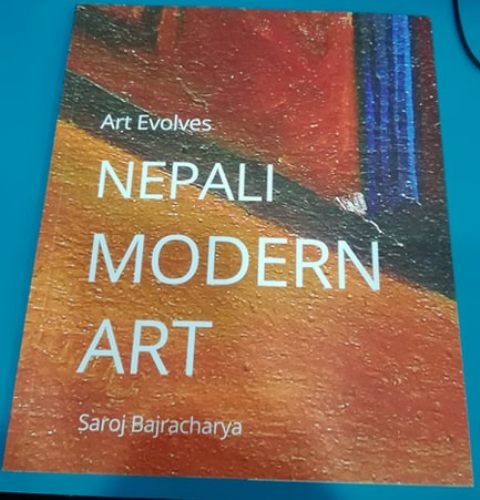
‘Art Evolves: Nepali Modern Art’: Review


-1200x560-1773818828.webp)





-1773673205.webp)