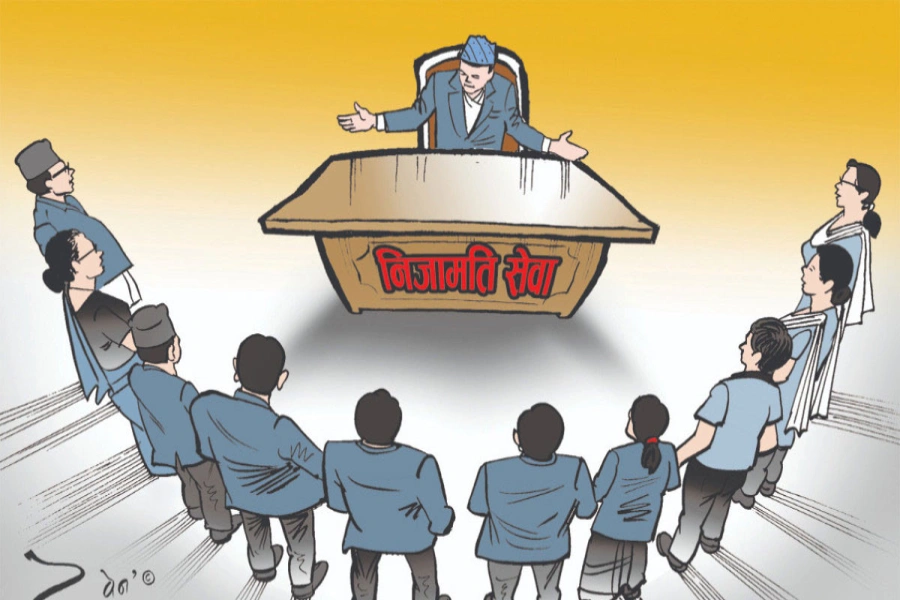
KATHMANDU, Nov 24: The reservation quota (inclusive recruitment system) under various examinations conducted by the Public Service Commission (PSC) has been found to be heavily misused. Although the reservation quota is required to be reviewed every 10 years, no review has taken place for 18 years. PSC officials say that due to the lack of timely review, the reservation quota has not been effective, and some reserved positions have remained unfilled.
Because the quota has not been reviewed, remote, influential, wealthy and urban communities have dominated the reservation category, while the system has failed to reach the target groups.
According to the PSC, no review has been conducted since 2064 BS regarding the inclusive recruitment mechanism. More than 26,000 people have benefited from this system so far. In 2064 BS, the Civil Service Act, 2049 BS, was amended to introduce reservation quotas. Subsection 11 of Section 7 of the Act clearly states that the reservation distribution must be reviewed every 10 years.
Misuse of reservation quota rampant

The Supreme Court, in two separate rulings, ordered the government to review the reservation quota to align it with the groups listed in Nepal’s Constitution of 2015. The apex court issued these directives in December 2020 and February 2023. However, even after nearly 17 years, the government has not conducted a review.
In its annual reports submitted to the President, the PSC has repeatedly expressed dissatisfaction, stating that although the government must review the reservation quota, it has failed to do so. “We have repeatedly requested the government through our annual reports to review the reservation quota. Reviewing the reservation system is not our responsibility; it falls under the Ministry of Federal Affairs and General Administration,” said PSC Spokesperson Geeta Kumari Humagain.
Due to the lack of review, 38 positions announced in the fiscal year 2024/25 received no applications at all. After the Interim Constitution of Nepal was issued in 2007, the Civil Service Act was amended to introduce reservation quotas in PSC exams. Six groups—women, Madheshis, Dalits, persons with disabilities, Indigenous nationalities (Adiwasi Janajati), and candidates from backward regions—were included. The 2015 Constitution later added Khas Arya, Tharu, Muslims, and minority groups to the reservation list. However, due to the absence of a review, the reservation system has failed to reach these constitutionally mandated groups.
The amendment draft of the Federal Civil Service Act, which the government has repeatedly attempted to introduce, includes a provision allowing candidates to use reservation benefits only once within a year of employment. Since the act has not been passed, PSC officials say that a single individual can repeatedly claim reservation benefits. Cases have been found where individuals who previously claimed disability-based reservation benefits continue to use the same certificates even after they are no longer disabled.
Similarly, the Nepal Inclusion Commission has also pointed out widespread misuse of reservation quotas and recommended that children of ministers, lawmakers, and civil servants at joint-secretary level and above should not be eligible for reservation benefits.
In its report, the PSC has drawn the government’s attention to the domination of wealthy, upper-class, and urban communities in reservation quotas. It has also expressed concern over increasing distortions in the name of reservation. Since reservation eligibility often depends on surnames, many from Indigenous, Madheshi, and Dalit communities frequently change their surnames or manipulate documents to fit into certain categories, including using post-marriage surnames to claim reservation benefits.
The PSC’s report further states that due to the lack of a clear disability measurement standard, people whose physical or mental conditions are not significantly affected have also been included under the disability quota based merely on medical definitions.