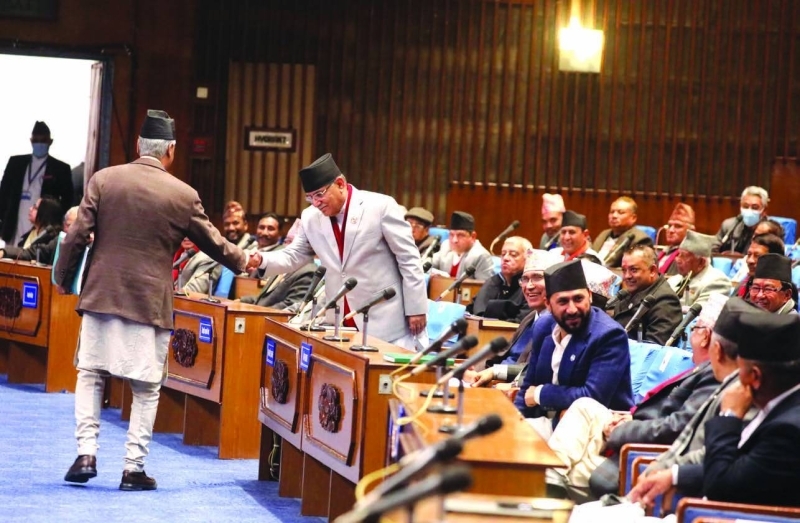
The Budget Session of Parliament commenced on Friday. This session is particularly significant as it coincides with the 10th anniversary of the devastating 7.8 magnitude earthquake that struck Nepal on April 25, 2015. The earthquake claimed around 9,000 lives across 31 districts—14 of them severely affected—injured over 20,000 people, and left behind a harrowing trail of destruction. According to a Post-Disaster Needs Assessment conducted shortly afterward, more than half a million houses were destroyed, resulting in losses exceeding NRs 700 billion. As the country marked the 10th anniversary of this national tragedy, CPN (Maoist Center) Chairman and leader of the main opposition, Pushpa Kamal Dahal, was in Gorkha. Prime Minister KP Sharma Oli, who was scheduled to address the opening session of Parliament, canceled his appearance at the last moment—reportedly because Dahal, his political rival, skipped the session to visit Barpak, the earthquake’s epicenter and his electoral constituency. While Dahal’s visit can be understood given the context, his absence from Parliament suggests that the main opposition is not fulfilling its legislative responsibilities either. Similarly, Nepali Congress President and leader of a ruling coalition partner, Sher Bahadur Deuba, was also absent as he was returning from Thailand on the day of the session. Parliament is convening at a time when lawmakers face the urgent task of not only deliberating and unveiling the upcoming budget but also passing new legislation to address the demands of protesting teachers, civil servants, and other groups who have taken to the streets. Prime Minister Oli’s decision to cancel his address due to the absence of key political leaders highlights the indifference of major parties toward the pressing challenges confronting the country.
The opening meeting of the budget session, which was called in part to address the demands of agitating public school teachers, should have featured in-depth discussions on this issue. Unfortunately, no such serious debate took place on Friday. Instead, several third-rung leaders from both the ruling coalition and opposition parties spoke during the session. Their speeches, however, were largely abstract, rhetorical, verbose and repetitive—lacking the gravitas and focus required to tackle immediate concerns, such as the ongoing teachers’ agitation in Kathmandu and the protest of civil servants. The teachers’ protest, ongoing since 2018 and now entering its fourth week, calls for the swift passage of an Education Bill. Drafting and passing laws is the fundamental duty of Parliament. Yet, the winter session of the federal parliament was prorogued without endorsing key bills necessary for the full implementation of the Constitution of Nepal. Of the 13 bills registered during that session—including one private bill—only five bills and an equal number of replacement bills for ordinances were passed. Crucially, the Parliament failed to endorse legislation on the federal civil service and school education—both essential for constitutional implementation.
Govt decision to withdraw Bill to Amend Political Parties Act f...

The lack of seriousness among political parties in addressing national issues is deeply regrettable. As the budget session will primarily focus on policy discussions and fiscal planning, it is imperative that political parties also prioritize the swift enactment of new legislation. While the ruling parties have the primary responsibility to introduce laws, opposition parties must remember that they are also governance partners. They share an equal responsibility to ensure the smooth functioning of the government. All political forces must collaborate to resolve the grievances of agitating groups and restore public trust. Failing to do so will only embolden anti-establishment elements already challenging the current system and could push the country into yet another cycle of political instability. Top leaders of major political parties should acknowledge this fact before it is too late and act accordingly.