THE INTOLERANT CULTURE
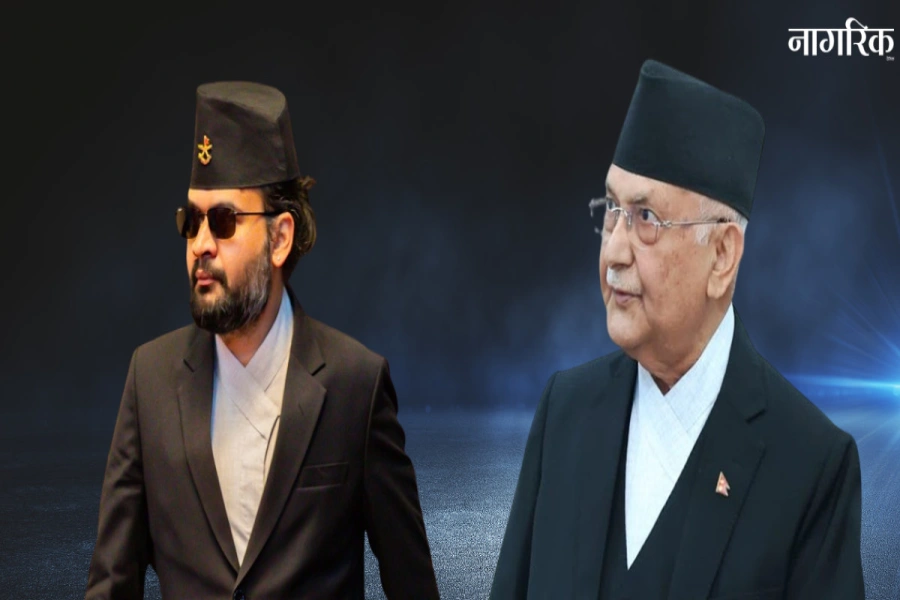
PM’s intolerant and arrogant attitude is best reflected in his recent statement against ex-king Gyanendra Shah. Commenting on the situation of the country, as a concerned citizen, Shah had urged the people to care about nationalism, democracy and development. Shah is a citizen of this country and he has every right to express his opinion, as much as the prime minister. Apparently in the “new democracy” that the PM has in his mind, only his party and its members have the right to speak on problems facing the country. This logic cannot be accepted since it is nothing but an expression of one party authoritarian culture where it is the party that is seen as holding the "ultimate truth." The people of Nepal have always rejected this sort of arrogance and dictatorial culture in the past.
The government is wrong to threaten Shah as long as his statements do not violate the boundrylines of the constitution. In fact, it is unbecoming and regrettable that the PM feels so insecure that he sees the need to threaten a citizen who is pleading for stability and democracy in the nation. The best way for the PM to respond to the concerns of citizens like Shah’s is to prove that he and his party are capable of good governance, peace and constitution. But sadly, the PM has failed in all three. But when someone raises concern about the need for peace and stability, he is quick to adopt the tactic of bullying and intimidating so as to divert the attention of the people. As a citizen of this country, the PM should be clear that his “conspiracy” theories against Shah are nothing but a veil to hide the utter failure of his party and its leadership in managing the transition in the nation.
It is unfortunate that the general outline of Maoist political culture is still based on threat and intimidation. Maoist journals are now openly branding intellectuals, Constitution Assembly (CA) members and journalists who refuse to toe the Maoist line as the “enemies of the people.” Normally, this is a term the Maoists had reserved for the people who were to be physically eliminated, when they were fighting against the state during the insurgency. The use of the phrase at this point of time has this ulterior motive: If you are against us we can eliminate you. Going one step further our “democratic” prime minister has now started warning the nation that if the constitution is not ready by May 28, over fifty thousand people may die in the country. This is outrageous and reflects a sense of irresponsibility of the PM. The PM belongs to the Maoist party which has 238 members in the parliament.
Caught between two contradictory positions of “commitment to democracy” and “state capture,” the prime minister has adopted the strategy of threatening the people to either support him or face dire consequences.
Therefore, it is his responsibility to work for a consensus. However, he projects a desperate situation of political turmoil and massacre and then uses it to frighten the people and other political parties to accept the dictatorship of the Maoist party. It is highly objectionable and irresponsible that the PM, who is the leader of the government, should openly threaten the nation that if things do not go his way the nation will have to shed the blood of over fifty thousand people. It reflects the mindset of dictatorial personality that sees all differing opinions as threat to his leadership.
THE HYPOCRISY CONTINUES
On governance and the delivery of services to the people, the PM projects an image of hypocrisy that is simply astounding. When he speaks at a function organized by anti-graft body like CIAA, he talks with passion about good governance and zero tolerance to corruption. He says, without batting an eyelid that unless the top leaders are honest we cannot expect to control corruption. But he himself leads the government that is probably the most corrupt in the history and is increasingly taking the form of roving banditry—a situation where those who wield power engage in loot and plunder knowing full well that the leader of the team is willing to close his eyes and indirectly supports their activities. He talks of his commitment to democratic values and yet one of his close colleagues, who has been sentenced by the supreme court of the country for murder charge, takes part openly in the functions attended by the PM and makes sure that he sits in the front row with the AIG of the armed police. The police can do nothing except accepting the situation with a sense of resignation and helplessness making complete mockery of the rule of law.
Similarly, the PM speaks with seriousness about the need to control expenditure to maintain fiscal discipline in the country. And yet if we look at the figures, regular expenditure of the government is rising in an unsustainable manner and the PM himself has taken the lead in ignoring norms in the public use of money approved by the parliament. There are too many other instances of our leaders flouting the law if it benefits their party or their private interests. An old Nepali saying goes: Actions speak louder than words. A political rhetoric that is devoid of even minimum commitment to the norms and values that it demands degenerates over time into hypocrisy reinforcing the rot within the system.
RISE IN TRUST DEFICIT
In spite of his repeated attempt to form a national government under his leadership, PM’s sense of self righteousness bordering on arrogance has further complicated attempts to forge a consensus and reduce the trust deficit among the main political parties in the parliament. One such example is the government decision not to hold any formal program to commemorate Falgun 7 as Democracy Day. It must be recalled that the Falgun 7 has been marked with respect for sixty years, even during Panchayat era. It is an event that has always been officially recognized as an important milestone in the march of the Nepali people from subject to citizenship.
The government´s decision has deeply hurt the sentiments of all non-Maoist political parties and the common people since it carries two very powerful messages. First, it tries to belittle all past political struggles carried out by non-Maoist parties to transform the political and economic landscape of the country. Second, it conveys the message that it is only the Maoist rebellion against the state that deserves to be the occasion for celebration. There was serious opposition to this move in the parliament and the government at the end of the day had to apologize for its folly.
There are, of course, some positive signs that need to be mentioned. We have made some progress in the peace process. The regrouping of combatants has been completed and those opting for voluntary retirement are leaving the cantonments. This is good. However, recent attempt of the PM to fire the ambition of some generals for eventually implementing the "state capture " doctrine has again muddled the situation and damaged the atmosphere of mutual trust and confidence between the Maoists and other non-Maoist political parties so vital for the success of ending the present transition.
Ultimately, the progress in the constitution drafting is going to be related to progress in the peace process. Non-Maoist political parties openly say that they are not going to repeat the mistakes of the past when election to the CA was held without completing the peace process. It is now widely believed that the presence of thousands of Maoist combatants in cantonments gave the Maoists a significant psychological leverage in influencing the voters to their side. So non-Maoists political parties want to make sure that this time the integration of Maoist combatants is complete before the promulgation of the new constitution. This explains partly the delay in completing the constitution drafting process. In fact, the one agenda that the three leaders of three big parties have agreed on is postponing discussion on difficult constitutional issues on one ground or another.
INTROSPECTION NEEDED
As a PM, Baburam Bhattrai cannot wear both hats: That of hard line ideologue of the party committed to authoritarian rule and the "state capture" doctrine and of a politician committed to democratic norms and values. Criticizing and threatening Gyanendra Shah or threatening the civil society figures to establish his revolutionary credential is both sad and pathetic. It is time for him to engage in a serious introspection as to where he stands. Time is not on our side. We have less than 90 days to complete the twin tasks of peace process and constitution drafting.
The author is the co-chairman of Rastriya Janasakti Party and a member of the Constitution Assembly
prakash_dr@hotmail.com
Related story
Destiny and Destination