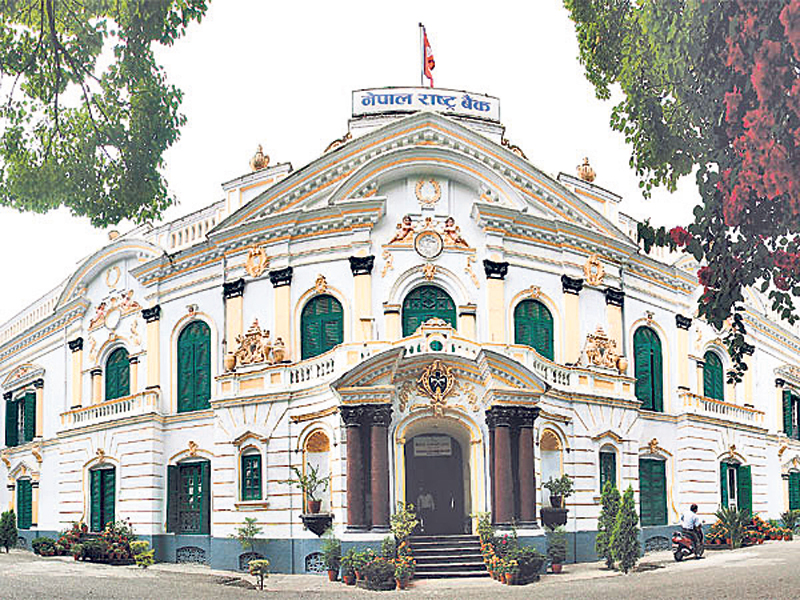
Around two months ago, Citibank had asked Nepali embassy in the US to shop for other banks to maintain its accounts after Nepal couldn´t come up with adequate legal tools to fight activities that aid terrorism and other illegal activities. After that the embassy moved its accounts to WashingtonFirst Bank. Now, WashingtonFirst Bank has also issued similar instruction to Nepali embassy, an official of Nepali embassy in the US told Republica on condition of anonymity. [break]
“Although both banks have not explicitly mentioned Nepal´s half-hearted approach to controlling financial crimes as the reason for sending circulars to close down the accounts, their veiled remarks clearly suggest they are not interested in dealing with a country that has weak legal structures to criminalize financial crimes,” a high-ranking official of the Ministry of Finance told Republica on condition of anonymity.
This also suggests other banks in the US may also follow suit and restrict Nepali embassy from maintaining its accounts in their institutions, the official said, warning, similar instructions may be issued by other banks in the UK and euro zone, as they have close links with the US and share similar regulations.
“That´s why we have been asking our politicians to act fast because snowballing of the problem could create problems for our diplomatic missions in various countries around the world,” the official said.
In order to avert being labeled as a country providing fertile ground for financial crime, the Financial Action Task Force (FATF) -- an intergovernmental body that creates standards to fight financial crimes -- last October asked Nepal to comply with 49 recommendations.
In this regard, Nepal was asked to criminalize acts of money laundering, develop mechanisms to identify and freeze terrorist assets, and confiscate funds related to money laundering. The body at that time had also prescribed that Nepal enact a law on mutual legal assistance to enable international authorities investigating financial crime to legally exchange information with Nepal.
To complete these tasks, Nepal was given a deadline of mid-Feb. In this regard, Nepal had already taken steps to amend Acts on Anti-money Laundering and Extradition, and enact laws on Mutual Legal Assistance and Controlling Organized Crime. However, Nepal could not amend or enact the laws on time, due to opposition from the radical faction of the UCPN (Maoist). Yet Nepal averted being demoted to the ´high risk´ zone of the FATF due to intense lobbying by top political leaders and bureaucrats.
Nepal now has been given until June to complete these tasks. “The politicians know we cannot escape like we did in the past, so it is recommended they better act fast,” the official said, warning, carelessness in this regard “may make it difficult for individuals to acquire banking services in the US in future”.
Related story
Sushant Singh Rajput’s sister Shweta is back on social media, s...