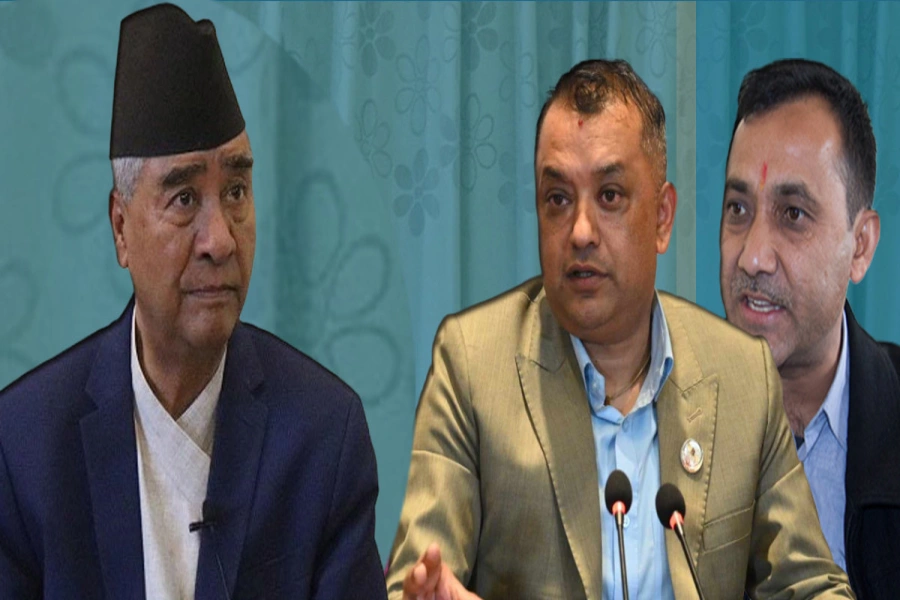
KATHMANDU, March 9: “The present government is an unholy alliance and there is need of a government that is a natural coalition. A government of national consensus is the need of the hour. He [Sher Bahadur Deuba] will initiate the forming of such a government under his own leadership.”
Related story
Desperate search for missing girls as nearly 80 dead in Texas f...
Lawmaker Balkrishna Khand said this immediately after the announcement of Deuba’s victory as Nepali Congress president, Monday night. Khand was speaking for the newly-elected party president as the latter did not himself appear at Rastriya Sabhagriha, where the vote counting was held.
Another NC lawmaker, Ramesh Lekhak, said at the same venue that change of government has become necessary as the present government has utterly failed in resolving the present crises. He saw chances of forming a new government soon under Deuba’s leadership.
These remarks by the two NC leaders, who are close to Deuba, come at a time when there is a widespread perception that Deuba, immediately after being elected NC chief, will put in all his efforts to become prime minister for a fourth time.
Some leaders argued that Deuba, as head of the largest political party in parliament, can’t remain outside the government for long.
The election of Deuba as NC president has also sparked curiosity as to what impact this may have in the NC’s future course and in overall national politics.
As the NC has been led continuously by Girija Prasad Koirala and his cousin Sushil Koirala for the last two decades, the party leadership’s working style and decision making process have remained basically the same all these years.
Many believe Deuba may steer the party in a different fashion.
Can switch from aggressive to flexible
Leaders from major political parties who have observed him as prime minister and during interparty negotiations described him as a leader who can be ready for both an aggressive as well as a flexible approach to rival political forces.
It was during his first tenure as prime minister that the Maoists launched their insurgency and both the rebel Maoists and Deuba took radical positions against each other during the 10-year-long conflict.
During his different stints as head of government, major decisions and steps were taken to fight the Maoist insurgency. It was Deuba who first declared a state of emergency and announced a bounty on the top Maoist leaders. It was Deuba himself who declared the first ceasefire and held talks with the Maoists.
“Deuba has taken both aggressive as well as flexible approaches in dealing with the Maoist conflict,” said former Maoist lawmaker Khimlal Devkota.
The Maoists reciprocated in the same way. They targeted him in their attacks when relations soured and at other times Deuba had very good relations with them.
The underground Maoist leaders had actively lobbied to help Deuba win the NC parliamentary party election, he recalled.
Devkota, a regular interlocutor in interparty negotiations, found in the former prime minister a leader who formed a team of aides, assigned responsibilities to them and trusted them fully. He would only talk on broader themes around any issue and never entered into details. Once there is a broad understanding on certain issues, he would never dispute about the details and the wording.
During the talks on constitution making, he would take part only on certain issues that were of direct concern to him, such as whether or not to divide the two far-western districts of Kailali and Kanchanpur.
Integration of the former Maoist combatants remained one of the most disputed issues for years.
When then NC President Girija Prasad Koirala and CPN-UML leaders were strongly objecting to the proposal to integrate the former Maoists into the national army, Deuba was ready to accept the Maoist proposal if the Maoists would help him become prime minister.
“He used to say ‘What’s wrong in integrating the Maoists in the national army since they are also sons of Nepali mothers,” said Devkota.
Influence of right-wing leaders
CPN-UML Secretary Pradeep Gyawali sees positive aspects in Deuba as a leader. He has a wide knowledge of Nepali politics and the corridors of power, he has experience of heading coalition governments, can take action, make decisions and own responsibility.
Gyawali said the major concern over his leadership is what approach he will take with regard to implementing the new constitution.
“We can see that some right wing leaders who are against some key features of the new constitution such as secularism have an influential role in his team. It is a major concern whether or not he can reject their opinions on the constitution,” said Gyawali.
Election of Shashank Koirala as the party’s general secretary has further added to the apprehension as Koirala recently said in public that the constitutional provisions on republicanism and secularism can be issues for review.
When King Gyanendra reinstated him as prime minister, Deuba proudly announced that he had gotten justice from a Gorkhali King. After his removal from the post for a second time by the same king, he said he was a leader who has suffered the most at the hands of the king.
A seasoned politician, Deuba has undergone several ups and downs in his long political journey. It is yet to be seen how mature the politics of the three-time prime minister is in his first stint as party chief of a united NC.