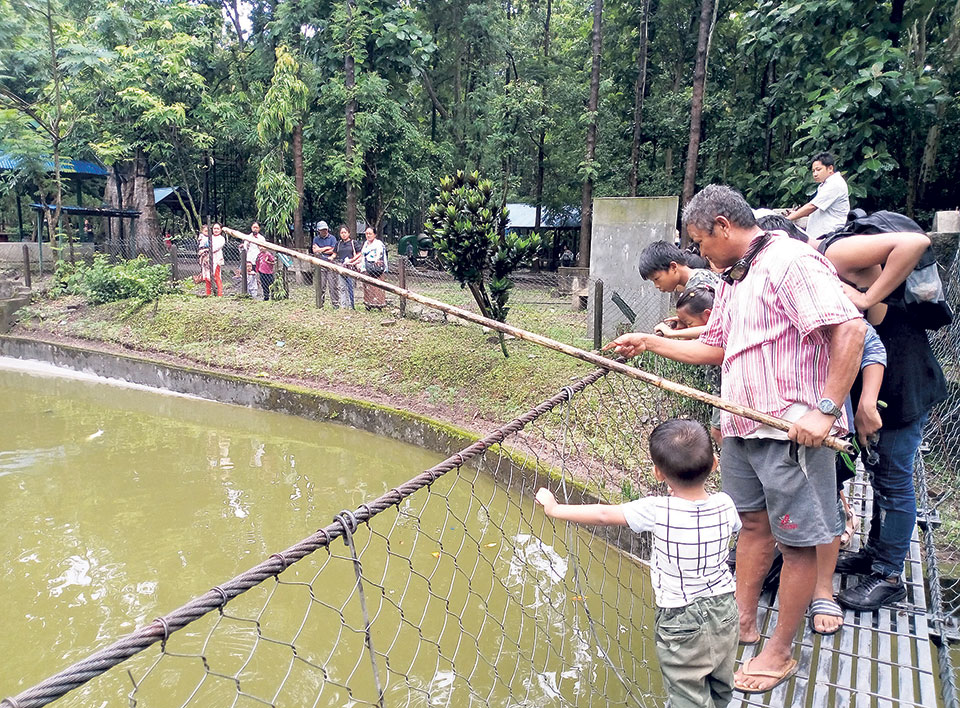
His flared button nose tapered and fell flat across those intelligent eyes, breathing warm, fuzzy air that often accompanied me during the tiresome nights, when I worked my way through Darwin and Mendel. I had an eerie feeling, it reeked of decaying algae. I didn’t know what to make of this strange world – the world of monkeys and peas. [break]
For the most of it, I wasn’t happy how ruthlessly we were being indoctrinated with the idea that we, after all, were evolved monkeys. The sudden spurt of soft manes all over my recently pubescent body was beginning to make a clear but disturbing sense. I struggled with both facts equally, denying the truth of their existence, until one fine day I caught the guy I had a crush on looking quizzically on the soft, grey hairs that spread over my legs in plentitude.
That was when I first shaved my legs.

MY.OPERA.COM
•••
I wasn’t ready to live on with the legacy of that monkey, the rebellious one, who pushed his boundaries. But during my high school, the truth of his existence was as recurrent and as unavoidable as the fresh batch of whiskers that sprang out from my waxed legs every week.
So, the best thing about studying Mass Communication was how little it had to do with that monkey.
I was happy how it had gradually disappeared from my life, like a fading billboard on a dusty road.
Naturally, I was taken off guard, when it visited me again, yesterday.
•••
Luck, like monsoon, has a season and when it comes, it rains abundantly. I was nineteen when I landed the job of my dreams. I was hired as an art and literature correspondent for an esteemed English national daily. Like all fruits of season, luck too nourishes you in the ways you never thought possible. During my early days as a reporter, I dream-walked into the private lives of writers, artists and poets whom I adored distantly like the make-believe creatures who existed only in bylines.
“This is the room where Parijaat spent her last, sick days.” I remembered how my heart skipped a beat when Sukanya, the younger sister of the famous Nepali writer Parijaat said, ushering me into a damp, fungus-infested room. I remember how I hurriedly drank the musty smell in such lovelorn reverence.
I remember with fondness how Ratna Shumsher Thapa, the poet-lyricist, had given me access to his private notebooks, explaining me animatedly the scene of the birth of each poem there. When I had told how much it had meant for me to see him in person, I remember how he had broken into that warm, toothless smile.
And then there was Uttam Nepali, poised, grey-haired, who hesitated to respond to my smile when I first saw him at an art exhibition. The same idiosyncratic painter would invite me for a lunch in his house and take me on a tour of his most prized paintings. As I said earlier, I was dream-walking through the roads that took me to Ramesh Bikal, Govinda Bahadur Malla Gothale, Krishna Chandra Singh Pradhan, Shashi Kala Tiwari, Durga Lal Shrestha, Kali Prasad Rijal, to name a few.
For someone who grew up devouring Garima and Madhuparka, to see these writers, poets and artists in person entailed luck one refuses to believe in. When I met Dhruba Chandra Gautam in his house on an inclined end of Maharajgunj in Kathmandu, I couldn’t tell in enough words how much I had loved his works. And when he asked me to name one, all I could think of was an erotic short story “Hellus,” at which he burst into a fit of laughter. Coming to think of it, I can’t believe I said that, but such enigmatic was the time when it all happened.
•••
So when I suddenly decided to quit my job there, five years ago, people warned me. Luck, like monsoon, had a season, and if you let go, it will leave you barren and desolate. A few, who resented the imprecision of the metaphor, warned me I was not even an undergrad and only as much educated to remain unemployed.
While the work took me to fairylands, the management of the newspaper agitated me. Yes, we lived on ideals and ate words like truth, impartiality, responsibility at regular doses. I would’ve perhaps survived my stay there if we weren’t on this staple. But the irony of the management’s falsehood, partial treatment and irresponsible responses questioned my rationality everyday. So when it failed my rationality to a dead end, I decided to quit.
•••
I hadn’t really realized that luck had abandoned me until, two months after quitting my job I woke up to an empty toothpaste tube. I tried to squish the meager paste to no avail. After realizing the vain effort, I put the toothbrush on a table and squished the neck of the tube with both my thumbs. A meager lump, the size of a peanut, came through. The next day, I cut the tube into two halves and swept the inside with my toothbrush. The third day, I simply mourned the death of luck.
My small savings had finished up and here I was, broke, jobless with an empty toothpaste tube cut in two!
The acrid aftertaste of my morning milk tea coagulated on my tongue. The palate of my tongue thickened with curry and breads. Everything I seemed to love until yesterday left an unhappy aftertaste.
For some reason, since then, every time I had to imagine poverty, I imagined it as the acrid aftertaste of milk tea.
The next morning I still woke up to the halved toothpaste tube. I had decided to use the bark of some tree outside to brush my teeth like my grandfather did, or maybe even salt, like Kismis, the toilet cleaner in our school, did. And why not! Kismis, against her pitch dark complexion, had the most remarkably white teeth I had ever seen.
It was between these thoughts I opened my door to see a giant plastic bag outside my room. “For Mudita,” a pale sticky note read. Mudita is my name of initiation. Osho Commune, where I had been living for the last three years, knew me by that name. The note, among many other things, said “I am leaving for Germany today, and my luggage is full. So I thought I might as well leave them for you.”
A German sanyasin, who had lived with us for a month, had apparently left that day. The bag had a Biotique sunscreen and a face pack, a Body Shop moisturizer, a Himalaya Herbal Shampoo and a large, plump, unused tube of Sensodine toothpaste.
And that was when miracle started happening in my life.
Until that day, when my savings sufficed for my simple living, existence never really interfered in my life. But when my sources were depleted and left me helpless, the unknown source started taking care of me. A person would miraculously appear and pay my rent in the commune and refuse to be paid back. Someone would volunteer to pay for my tickets for India trip. Or the strangest of them all, when I would choose to stay inside the train because I couldn’t afford to eat anything outside, the ticket controller would come and give me a dozen ripe, aromatic bananas!
Against the prediction of everyone, who thought I would regret my decision to listen to my intuition and quit the job, I had never been happier all my life. I realized, later, after the sequence of similar decisions occurred, I hadn’t merely been lucky. Miracle is the way existence responds to courage.
If luck was seasonal, miracles were evergreen.
•••
It was the second time I had been lucky. The second time I quit my job on intuition. The second time someone reminded me my education only succeeded to keep me unemployed or low paid, at its best.
And the second time they had been wrong.
Every time I listened to intuition and acted on seemingly bizarre impulses, I’ve always, always been rewarded. Despite my academics, despite my age, despite it all, I did always land in a better place, with better people. Without a single exception.
•••
“You’ve just been lucky again,” a friend of mine was telling me over the phone when the monkey appeared in my room. The air was thick with humidity and the mauve blots of clouds were frozen in the arms of the Annapurna. A swirling tunnel of moths was hanging below the incandescent yellow bulb in whizzing pilgrimage. I was smiling over her words, flattered, my head tilted earthwards, drafting a humble response in my mind when I saw him there.
He wasn’t even looking at me. He was regarding the fanatic pilgrims in a blithe adulation. He hadn’t changed a bit, the same old eyes, the same tapering nose, and the same reclusive presence. And I hadn’t changed, either, the same routine waxing, the same fright of body hairs, the same fear his presence inspired.
And yet, something had changed. I had to hang up. I knew he didn’t exist on the physical plane as the rest of us did, and I knew he wouldn’t talk to me in words. But something said we were in for a special discourse, or something like it.
His was a funny story. He was just another monkey, scratching his back, lampooning in the trees, eating lice when he had one thought that changed it all. And when it struck him, it was so strange that it almost sounded impertinent. “Of course not,” he kept telling himself.
Impregnated with the thought, for a few days, he tried to hide it from all. Meanwhile, it kept swelling inside him like a melon in monsoon. Soon enough, the thought was mature enough to jump out and confront him as a creature of its own will.
That thought was to walk on the earth with his feet.
Not surprisingly, he became an outcast overnight. His peers looked down upon him, literally, as the strange land beckoned him like a possessed man, when the “man” as a species hadn’t come into existence yet. He slept on the earth, drank its wafts and crawled over it. His pudgy toes bled and his weight dwindled over his tiny feet, like a pendulum.
That was when the miracle started happening to him. The trees were extending their generous vines that taught him the first few steps on his two limbs instead of four. The birds would bring him food, when his pudgy toes failed to grapple anything.
So slowly, as his vertebrae evolved and his intestines reshaped, he realized what had put him into the process of the Homo sapiens – Courage.
In the slow process of a kind of osmosis, his thoughts revealed to me why his courage had reshaped the history of evolution.
“Miracle is the way existence responds to courage.” Yes, that was his. “And it does so, because the courageous ones, through their non-conformism, help existence evolve.”
So let’s imagine the world is full of docile, yea-saying creatures who never questioned the education system or dropped out, paid taxes and hanged on to their corporate jobs. Wouldn’t existence remain stagnant? And even though such a man might be functional and an asset to the conforming structure of society and nation at large, would existence really value it over the process of evolution?
So the people, who decide to look for more than is offered on their platter, expanded their arena, and in doing so, expanded the possibility of existence as a whole, too. Be it Van Gogh, Bob Dylan, Anais Nin, Frida Kahlo, Steve Jobs, Osho, the Buddha, despite their idiosyncrasies, actually because of it, they provoked our psyche deep enough, to awaken a new understanding to the world we live in. While the yea-saying, tax-paying bunch slept cozily in their comfort zone, these crazy ones, like the monkey, who first walked on the earth, decided to look for more than was offered inside it. If you think existence has been far too generous to them, it’s only because you haven’t been as courageous.
So any act of courage, may it be jumping off a tree or a job that doesn’t ring a bell for you anymore, is always paid back with equal generosity. And if it’s too hard to take it from a monkey, Steve Jobs said it for us too:
“Here’s to the crazy ones, the misfits, the rebels, the troublemakers, the round pegs in the square holes… the ones who see things differently — they’re not fond of rules… You can quote them, disagree with them, glorify or vilify them, but the only thing you can’t do is ignore them because they change things… they push the human race forward, and while some may see them as the crazy ones, we see genius, because the ones who are crazy enough to think that they can change the world, are the ones who do.”
The author is a Communication Associate at ComForm Project/ Institute of Forestry
appadipobhava@gmail.com
Related story
Tree house and fishing in Yalambar