

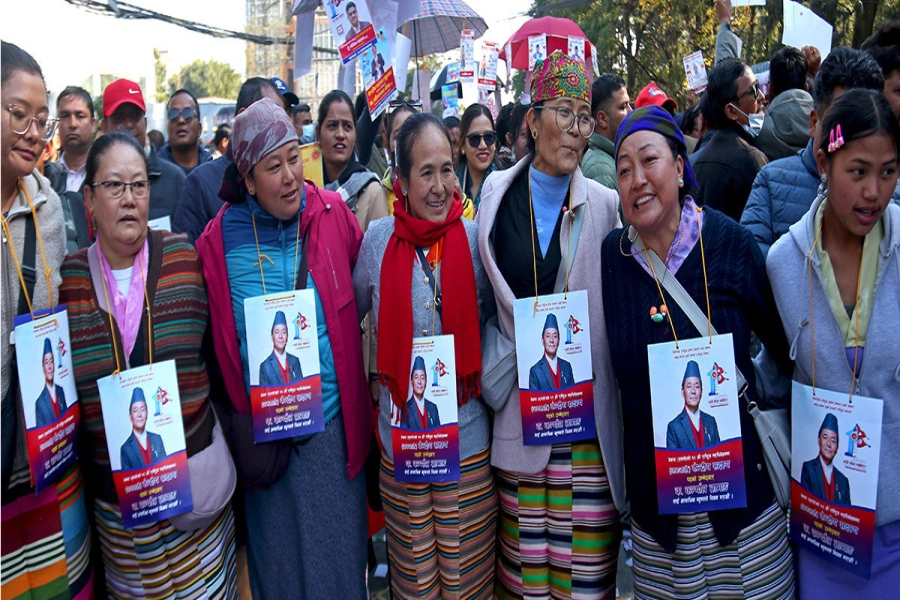
KATHMANDU, Dec 17: At one corner, the rhythm of Deuda echoed. At another, eastern folk tunes filled the air. Somewhere feet moved instinctively to the beat of Tamang Selo, while elsewhere heads swayed gently to the melody of traditional bhajans (devotional songs). For a moment, the scene felt like a cultural festival. But culture was not the only force drawing people together here—politics was equally at play.
Amid the charged atmosphere of the 11th National General Convention of the CPN-UML, the Bhrikutimandap premises on Tuesday appeared like a miniature version of Nepal itself. While votes were being sought by rival individuals and panels, voices, attire, and faces from the mountains, hills, and the Tarai converged in a single space.
Some wore traditional Western Nepali caps, others Limbu dhaka. Some were dressed in Madhesi dhoti-kurta, while others appeared in Tamang attire. Languages differed, and appearances varied, but the enthusiasm and pride reflected on their faces were strikingly similar. They might not have fully followed the internal debates of party leaders, but to any outsider who asked, their answer was uniform:
“I am a delegate attending the UML General Convention.”
Among these smiling faces was Pratima Lama, a delegate from Simikot in Humla. Internal party factions, she said, had hardly touched her. What mattered to her was the country’s future. “I hope the new leadership will take the country in the right direction,” she said. “That hope is what brought me all the way to Kathmandu to cast my vote.” Differences of opinion might exist internally, she added, but in the end, everyone here is a UML supporter.
Like her, supporters of different factions were present across the venue. Some backed chair candidate KP Sharma Oli, others stood firmly behind senior vice-chair Ishwar Pokhrel. Some were busy campaigning for general secretary candidate Shankar Pokhrel, while others spoke openly in favor of Surendra Pandey.
Slogans rose from different corners—“KP Oli: Long Live,” “Ishwar Pokhrel: Long Live,” “Shankar Pokhrel: Move Forward,” “Surendra Pandey: Our Leader.” Yet above all these chants, one slogan echoed loudest, binding everyone together:
“ Long Live CPN-UML”
“We are UML members and are above factionalism,” said delegate Devnarayan Chaudhary from Bara. “Whoever wins, UML wins.”
Bhrikutimandap Management Office calls for tender to prepare DP...

Chaudhary, who is also a provincial assembly member, stressed that UML now needs to move forward in a more refined and mature manner. Despite differing views, he said, the party was cultivating a shared sentiment. There was competition and disagreement, but no hostility. There was criticism, but no hatred. The scene sent a clear message: internal competition is not opposition to the party.
Praise even for rivals
One striking feature of the convention was that delegates were not only praising their own candidates—many were openly appreciating rival contenders as well. Representatives from the Tarai could be heard saying, “We belong to another side, but Mahesh Basnet has done good work for the party.”
Politics is often dominated by backbiting. But here, delegates were openly acknowledging the work, capability, and conduct of leaders from opposing factions. This turned the convention into not merely a contest for positions, but also a space for evaluation and debate.
Bodies covered in campaign material
Delegates from districts walked around carrying bags, greeting others with folded hands. Activists following them had campaign materials plastered across their necks, chests, and backs. Bags, badges, stickers, scarves—everything carried the same faces and slogans. The scene of vote-seeking closely resembled a general election campaign.
Another curious sight stood out: although it was neither raining nor harshly sunny, some people carried umbrellas—not for protection, but to display campaign materials. Candidate photos were fixed inside the umbrellas, slogans written outside. It was a vivid example of how politics and creativity intersect.
“I feel very happy carrying campaign materials,” said Mahesh Bakhurel from Sindhuli. “Look at my head—it’s full of leaders’ pictures. And all of them are UML members.”
Campaign materials were even hung from roadside tree branches. Watching this, some joked, “Looks like next time they’ll campaign for votes on trees, in alliance with the Congress.” The tree is a party symbol of the Nepali Congress.
Alongside votes, business thrived too
Bhrikutimandap was not just about politics—it was also about business. From shops selling ceremonial scarves to carts selling peanuts, vendors lined the area. Some bought scarves for leaders, others chanted slogans while munching peanuts. Footpaths were dotted with bookstalls as well.
Books ranging from Karl Marx to Mark Zuckerberg were displayed on the same shelves. Biographies and political works—from Jung Bahadur Rana to KP Sharma Oli—were available side by side. Ideological diversity was visible even in printed pages. Tea from Ilam and rabadi (a sweet) from Nepalgunj could be found in the same place. Over tea, debates about leaders’ futures unfolded; over snacks, party history was recalled. Bhrikutimandap truly felt like a small Nepal.
Voting day
Voting at the national convention was scheduled to begin Tuesday afternoon, but technical issues caused delays. Yet neither leaders nor cadres appeared frustrated. Even if only for votes, hands from the west clasped hands from the east. Hands from the north greeted those from the south. The dense gathering of 2,263 delegates was a captivating sight.
Candidates and their supporters sought votes from delegates who had come from across the country—some with folded hands, some with a hand on the shoulder, others by recalling shared struggles.
Top-level contest
The main contest for party chair is between incumbent chair KP Sharma Oli and incumbent senior vice-chair Ishwar Pokhrel. Oli represents continuity, banking on his experience, national influence, and firm grip on the party. Pokhrel, meanwhile, speaks the language of change and management, emphasizing organizational strengthening and collective leadership.
For the general secretary post, Shankar Pokhrel and Surendra Pandey are in the race. Both are seasoned leaders with their own bases of support. The outcome of this contest will also signal the party’s future direction. Unsurprisingly, their images dominated rallies and displays.
This convention is not merely about selecting leadership—it is also a test of democratic practice within UML. Whether the party can remain united amid differing views, factions, and candidates is a question being answered here.
What the scenes at Bhrikutimandap offer, however, is hope. Despite competition, mutual respect remains. Despite criticism, loyalty to the party is strong. That loyalty is what has brought UML this far.
Overall, as soft sunlight spread over Bhrikutimandap on Tuesday morning, it felt as if the whole of Nepal was smiling. Who emerges victorious will be known after voting. But the sights of Deuda, Tamang Selo, bhajans, slogans, books, tea, and peanuts have already made one thing clear:
CPN-UML is not just a party—it is a shared platform of many voices, many faces, and many dreams.
Perhaps that is why leader Hikmat Karki from the east appeared unconcerned about the outcome. His words summed it up simply:
“Whoever wins, UML wins. Whoever loses, UML still wins.”





