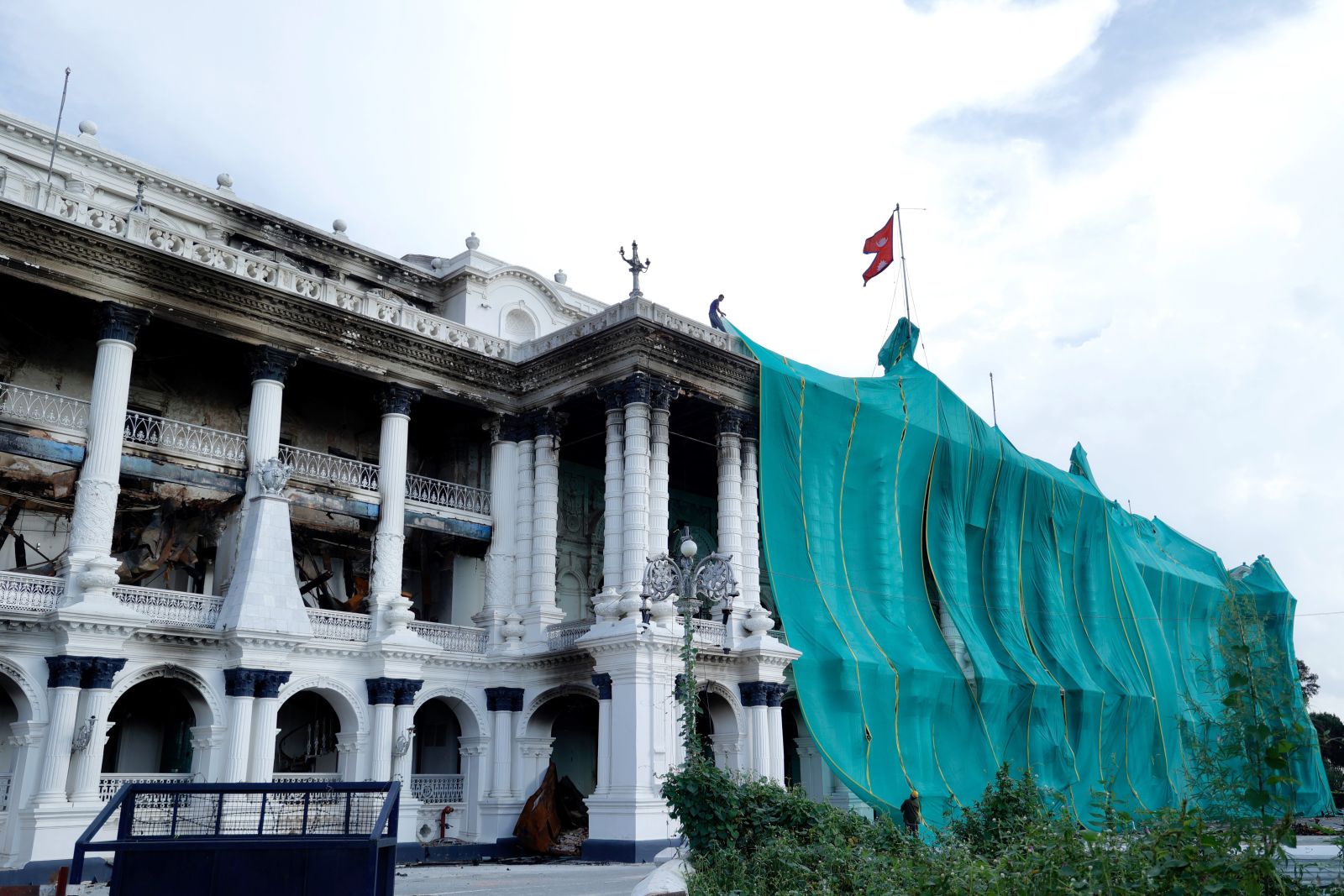
KATHMANDU, Oct 6: Individuals involved in setting fire to key government buildings, including Singha Durbar, the Supreme Court (SC), and the Parliament, during the Gen Z Movement on September 9, were released from custody, reportedly under direct pressure from the Home Ministry.
According to officials, the detainees were released September 30, coinciding with the Maha Ashtami, raising widespread concerns about political interference in law enforcement.
Despite video footage-based arrests and ongoing investigations by the Police, nearly 60 individuals were released from custody on Ashtami. According to SP Pawan Bhattarai, spokesperson for the Metropolitan Police Range, Kathmandu, “Some were released on condition that they appear before the police on specific dates. Releasing them on summons does not mean they are free, and the investigation is still ongoing.”
Sources within the police revealed that senior officials were pressured to release those involved in arson, looting, and vandalism during the protests. Sources told Republica that the Police Headquarters issued instructions to local units not to detain individuals involved in the Gen Z movement.
Helipad to be constructed inside Singha Durbar

As a result, over 100 people were released within five days—more than 40 before Ashtami, and an additional 60 during public holidays.
The protests, which began as part of the Gen Z Movement, escalated into widespread violence targeting several high-profile government sites, including Singha Durbar, the Office of the President, the Commission for the Investigation of Abuse of Authority (CIAA), district courts, and private institutions such as schools, colleges, and businesses.
The apparent impunity granted to those involved has led to increased public fear and criticism of the government's handling of the situation.
A police officer, speaking on condition of anonymity, claimed the Home Ministry ordered police not to pursue arrests against Gen Z activists. Home Minister Om Prakash Aryal reportedly directed Inspector General of Police Chandra Kuber Khapung to refrain from taking action against those involved in the protests. Subsequently, the ministry issued both a confidential circular and a public statement instructing law enforcement agencies not to act on certain cases until further notice.
In response to growing criticism, the Home Ministry stated on September 25, announcing the formation of a judicial commission to investigate the incidents. The ministry said no immediate action would be taken by government agencies on matters under the commission’s jurisdiction, but any illegal acts would be addressed in accordance with the law. “The commission has the mandate to collect and analyze complaints and information related to physical and human damage, and to recommend further actions,” the statement read. It was signed by ministry spokesperson Anand Kafle.
The commission is chaired by former Justice Gauri Bahadur Karki and includes former AIG of Nepal Police Bigyan Raj Sharma and legal expert Bisheshwar Bhandari, who has experience in transitional justice in post-conflict countries. The commission has already begun its work and will investigate the use of force during the protests, including the alleged use of lethal weapons. It plans to begin taking statements shortly after the Dashain holidays.
So far, not all detainees have been released. Police have continued to hold suspects involved in more serious offenses, including the murder of a police officer at Maharajgunj Police Station and the theft of police weapons and uniforms during the protests. Investigations are also ongoing into individuals who encouraged arson on social media, including calls to burn down police stations.
The commission has reportedly recommended a travel ban on five individuals, including former Prime Minister KP Sharma Oli and former Home Minister Ramesh Lekhak. According to sources, these individuals must now seek permission from the commission before leaving Kathmandu.