

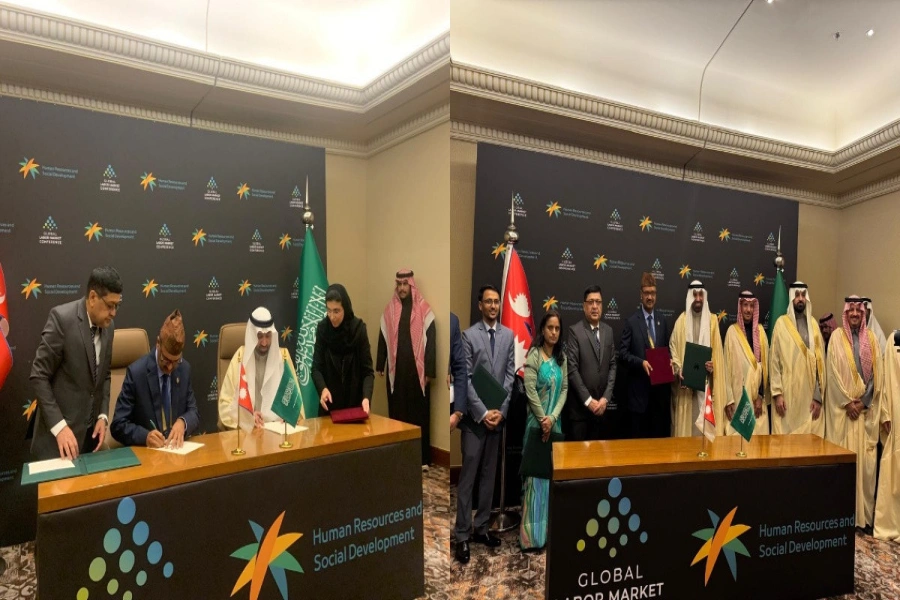
KATHMANDU, Jan 27: After more than a decade of negotiations, Nepal and Saudi Arabia have finally signed a bilateral labour agreement, raising hopes for safer, more organised and dignified foreign employment for Nepali workers. The agreement was signed on January 25 in Riyadh, the Saudi capital.
The deal was inked on behalf of Nepal by Minister for Labour, Employment and Social Security Rajendra Singh Bhandari, and on behalf of Saudi Arabia by Minister of Human Resources and Social Development Ahmed bin Suleiman Al-Rajhi.
Ahead of the signing, the labour ministers of the two countries held bilateral talks focused on institutionalising workers’ rights, services and employment security. According to the Embassy of Nepal in Riyadh, Minister Bhandari expressed confidence that the agreement would make labour cooperation between Nepal and Saudi Arabia more systematic, transparent and robust.
The minister also said the agreement would play a key role in ensuring a fair, cost-effective and worker-friendly recruitment process for Nepali general workers, the Embassy of Nepal in Riyadh stated.
The agreement covers a wide range of issues, including working conditions, wages and benefits, social security, health services, implementation of labour contracts, grievance handling and protection of workers’ rights. It aims to safeguard workers’ interests in line with the laws of both countries and the standards of the International Labour Organization (ILO).
Nepal to sign Labour Agreement with Saudi Arabia in January

An official at the Embassy of Nepal in Riyadh said the agreement is expected to bring stability to employment security and service benefits for Nepali workers in Saudi Arabia. The deal also addresses human trafficking prevention, control of manpower fraud and the establishment of a transparent recruitment system, the official added.
Despite these provisions, Nepali workers in Saudi Arabia say the agreement has so far remained confined to paper. Subash Silwal, a Nepali worker based in Saudi Arabia, raised serious concerns over wages, treatment, facilities and the role of the Embassy of Nepal in Riyadh. “The treatment of Nepalis, the facilities provided and even the wages are not good,” he said. “The cost of living here is very high. The basic salary is not enough to manage anything. Signing an agreement alone is not enough. Many provisions mentioned in labour agreements never make it into practice.”
Echoing the sentiment, long-time worker Roshan Thapa told Republica, “I have been in Saudi Arabia for many years. The rules and laws here change frequently. Labour agreements between Nepal and Saudi Arabia look good on paper, but they are rarely implemented.”
In 2018, the Nepali government decided through a Cabinet meeting to fix the minimum wage for Nepali workers going to Saudi Arabia at 1,300 riyals, including a food allowance of 300 riyals. The decision was primarily aimed at unskilled workers.
However, Saudi Arabia does not officially set a minimum wage, and salaries are generally determined through agreements between employers and workers. As a result, the Embassy of Nepal in Riyadh has received complaints from workers who have not been paid even the minimum wage set by the Nepali government.
Currently, the minimum basic salary for unskilled Nepali workers ranges from around 1,000 to 1,300 riyals. Depending on experience, skills and the nature of work, wages can go up to 2,500 to 3,000 riyals or more.
Another worker, Ramesh Nepali, expressed dissatisfaction with the existing wage structure. “The basic salary of workers in Saudi Arabia should not be less than 2,000 riyals. A basic salary of 1,000 riyals should be abolished,” he said. “The cost of living here is very high. Even food expenses cannot be managed with 500 riyals.” He added that the labour agreement has brought little improvement so far.
Ramesh also pointed to the unequal treatment of foreign workers. “Compared to workers from other countries, the attitude toward Nepalis is shameful. This is direct evidence of the state’s failure,” he said. “With the salary we receive, it is difficult to support our families. We are deprived of facilities that companies are supposed to provide.” He further claimed that cases of workers dying due to lack of medical treatment are increasing, while responsible authorities remain silent.
He demanded that the minimum wage for workers in Saudi Arabia be raised to at least 2,500 riyals, along with written guarantees for health services, insurance, accommodation and medical treatment.
Workers have also voiced frustration over the role of the government and the Embassy of Nepal in Riyadh. “Officials come here, take photos, shake hands and leave. They do nothing for workers’ rights,” said another Nepali worker. “The priority should be direct engagement with workers—listening to grievances and resolving problems.” He accused the Embassy of Nepal in Riyadh of intimidating workers and being unwilling to listen to their complaints.
Overall, Nepali workers in Saudi Arabia are demanding effective implementation of the labour agreement, a review of the minimum wage, a more worker-friendly Embassy of Nepal in Riyadh, and assurance of a dignified life.
Nepal had been trying for nearly a decade to sign a labour agreement with Saudi Arabia. With this deal, the number of countries with which Nepal has labour agreements has reached 13. Among Gulf countries, only Kuwait remains without such an agreement, while a draft agreement with Oman has already been finalised.






-1781882999.webp)


