

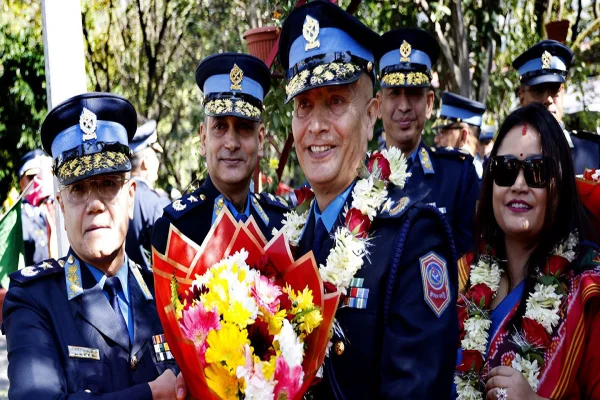
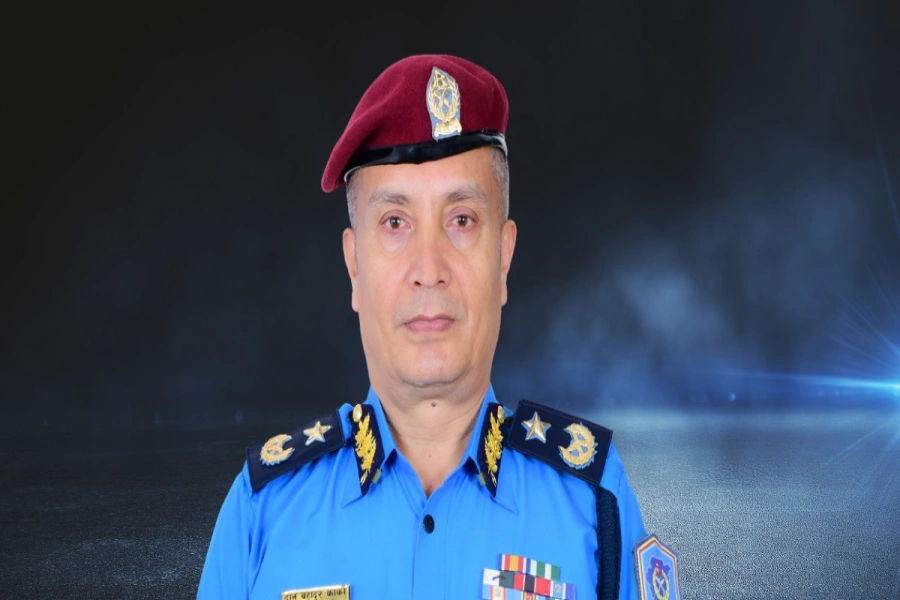
KATHMANDU, Nov 14: Nepal Police’s 79,000-strong force has a new commander. Dan Bahadur Karki of Gulmi was appointed the 33rd Inspector General of Police (IGP) on Thursday, taking charge for the next two years and five months.
Karki outpaced three contenders—Rajan Adhikari, Dr Manoj KC, and Siddhi Bikram Shah—while still serving as a DIG. The senior-most candidate now assumes leadership at a moment when the government itself emerged from the heat and upheaval of the Gen Z movement. That context shaped the Cabinet’s decision earlier this week to elevate him.
His appointment comes with heavy shadows from recent history. On September 9, the second day of the Gen Z protests, Karki reached the Kathmandu Valley Police Office (KVPO) to take command. Within hours, Kathmandu plunged into unprecedented violence. Protesters attacked police officers across the city. Three officers were killed. Scenes of policemen being stripped, beaten, and police offices set ablaze left a stigma that still lingers.
During the fire at the Metropolitan Police Circle in Maharajgunj, Karki told Nepali Army Headquarters that he would rather take his own life than fail to rescue trapped officers. Outgoing IGP Chandra Kuber Khapung then sought help from the Nepali Army, which airlifted the officers to safety.
Karki is no stranger to crises. Having begun his career amid the Maoist insurgency, he has carried its scars throughout his 27-year service. On September 8, he witnessed students being killed by police bullets during the Gen Z uprising; the next day, he saw colleagues being brutally attacked. As an AIG, he confronted mobs attempting to burn police personnel alive inside their own offices.
IGP Thapa retires, Khapung to assume command from Thursday
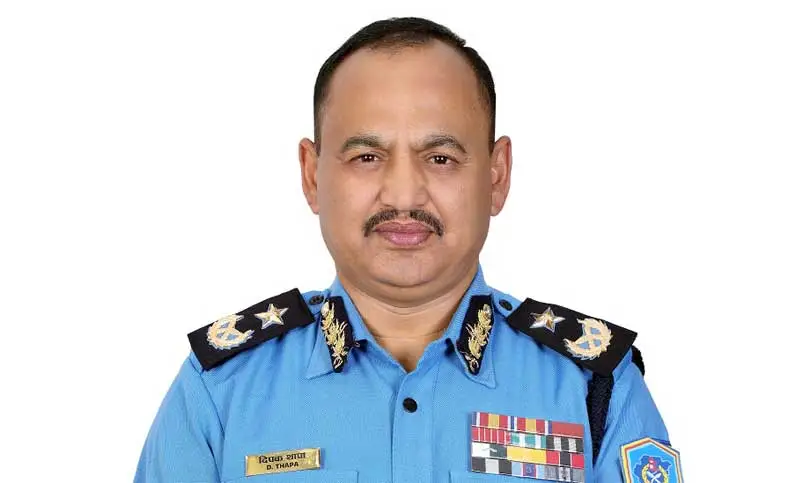
On Thursday at the Ministry of Home Affairs, while addressing the ceremony after receiving his IGP insignia, his voice broke. Memories from the insurgency and the recent uprising—of colleagues lost and institutions under siege—overwhelmed him. Over 26 years, he has served in 25 police offices, facing both upheavals and moments of resilience. Now, all eyes are on how he will steer the institution through its most fragile phase.
His test as IGP starts now. For the next 29 months, his decisions will be judged not only from within the force but by citizens across the country. Fairness, impartiality, and merit-based leadership will test his resolve. If he sidelines AIGs who were once his competitors, his own support system could crack—something he is expected to understand well, having worked earlier inside the IGP Secretariat.
He steps in when morale within the Nepal Police is at its lowest. Questions about the value of joining the service are rising. Resources are scarce. Police officers are compelled to carry lethal weapons provided by the army because the Nepal Police has long been unable to procure its own. Political interference and middlemen have repeatedly stalled arms procurement.
After the Gen Z movement, the government continues to assign heavy responsibilities, but with limited tools. Ensuring peace and security during the upcoming elections—an agenda the interim government calls its top priority—will test the force’s capacity. Many within the institution say the police morale is weaker now than ever in history.
The losses from the September 8–9 protests remain staggering: three police personnel killed, 450 police offices vandalized or torched, uniforms looted, weapons seized, and 98,000 rounds of ammunition still missing.
The entire security apparatus, not just the police, has been shaken. The uprising exposed major security lapses, prompting scrutiny and blame. The interim government formed afterward appears intent on holding police accountable—sometimes with an undertone of revenge. Investigation bodies have begun summoning security officials, pushing a narrative that the police institution failed.
The damage extended far beyond law enforcement. The Supreme Court, Singha Durbar, district courts, the Attorney General’s Office, government buildings, Bhatbhateni supermarkets, political leaders’ homes, and vehicles were torched or destroyed. Human casualties added to the national trauma.
Those involved in the violence of September 8 and the criminal acts of September 9 are gradually being identified. At the KVPO, Karki’s team had arrested more than a hundred suspects based on evidence. But many were later released under pressure from the Home Ministry and individuals aligned with the Gen Z movement. If this continues, law enforcement risks becoming meaningless. If the firing on the 8th is defended as law enforcement, then those responsible for the violence on the 9th must also face legal scrutiny.
Prime Minister Sushila Karki and Home Minister Om Prakash Aryal have publicly stated that the government will not interfere in policing. That leaves no room for hesitation for IGP Karki, who must navigate investigations on both sides.
A government-formed commission led by former Special Court head Gauri Bahadur Karki will attempt to summon former Prime Minister KP Sharma Oli and former Home Minister Ramesh Lekhak for statements. But Oli has already declared he will not testify. If he refuses to appear, police may be ordered to arrest him—something the current leadership must be mentally prepared for.
Meanwhile, CPN-UML has begun forming its own neighborhood-level security squads to mobilize supporters to Kathmandu should an arrest attempt be made. Their goal is clear: shield party chair Oli. If such confrontations erupt, the police will face severe security challenges.
On top of that, thousands of looted police weapons remain missing. More than 5,000 inmates—including sharpshooters—are still at large. If fresh unrest unfolds, these fugitives and stolen weapons could resurface, presenting yet another grave challenge for the new IGP.







-1782782519.webp)


