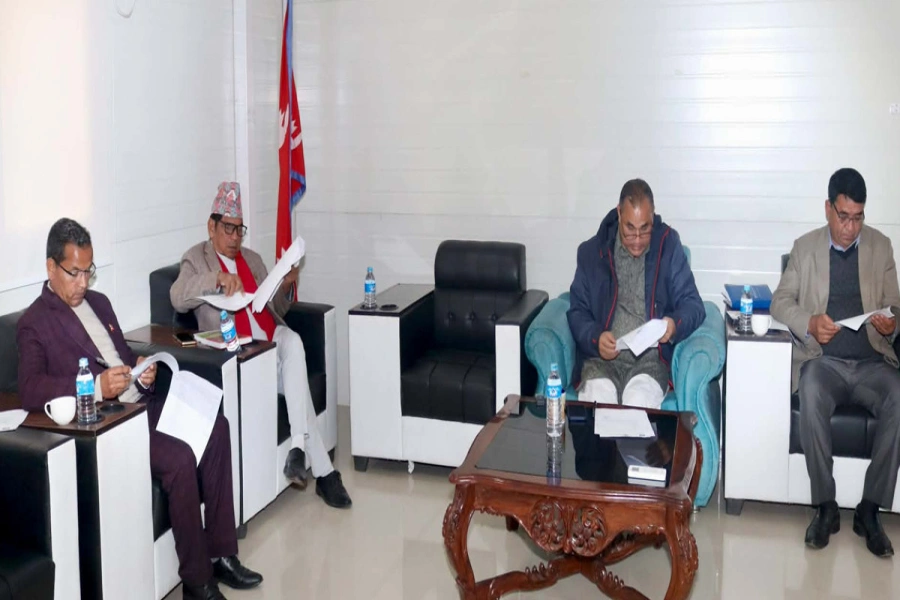
Prime Minister Jhalanath Khanal and Nepal Army chief Chhatra Man Singh Gurung jointly pressed a switch to detonate the last landmine at a function in Phulchoki, Lalitpur Tuesday. [break]
Destroying the explosives laid and used during the conflict time is a commitment under the Comprehensive Peace Agreement (CPA), which marked the end of the ten-year long Maoist armed conflict.
With the detonation of the last minefield, Nepal became second country after China to be declared free of minefields.
International community, including the UN, had provided technical and financial support to the government to clear the anti-personnel landmines.
As per the CPA, both the government and then CPN (Maoist) were required to inform each other about demarcation and storage of ambush or mines laid during the insurgency within 30 days and help each other to defuse or dispose of the explosives within 60 days since the date of the signing of the CPA.
The army had laid 12,070 landmines at 53 places and planted 1,078 IEDs during the conflict. The Maoists had laid no landmine though they had IEDs. Their IEDs were destroyed after their combatants were cantoned in 2007. But anti-landmine campaigners say that there still are scattered and unattended IEDs.
Following the detonation, the UN Mine Action Team (UNMAT) gave the “handover certificate” to the Nepal Army, which then handed it over to the Chief District Officer of Lalitpur Ratna Raj Pandey.

Though Nepal is free from minefields, it is yet to be free from mines. Anti-land mine campaigners have continued to urge Nepal to sign anti-landmine treaty, also known as Ottawa Treaty.
"I urge the government to remember the victims of explosions these past few years and agree on two words -- Never Again," said UN Resident Coordinator Rebort Piper, adding, " While we are celebrating the clearance of all minefields in the country, it would be a fitting to translate such words into deeds by fulfilling the last few remaining requirements and signing the Ottawa Land Mine Treaty, and becoming the 157th country to commit to the prohibition of the use, stockpiling, production and transfer of anti-personnel mines and on their destruction."
Meanwhile, the international community has welcomed the removal of minefields. British Foreign and Commonwealth Foreign Office Minister Jeremy Browne said, “I congratulate Nepal on this remarkable achievement, and pay tribute to the brave work of the demining personnel. I now urge the government to build on this success by joining the Ottawa Convention to ensure that these terrible, indiscriminate weapons never again blight Nepali soil and the lives of its people.”
UK is a key donor which contributed over two million pound sterling toward demining activities that started from October 2007.

Specially trained 180 Nepal Army personnel were involved in clearing the mines.
International community through the UN invested over $ 8 million for mine clearance in Nepal. This figure excludes the cost of the labor contributed by the Nepal Army.
Related story
The struggle is real