

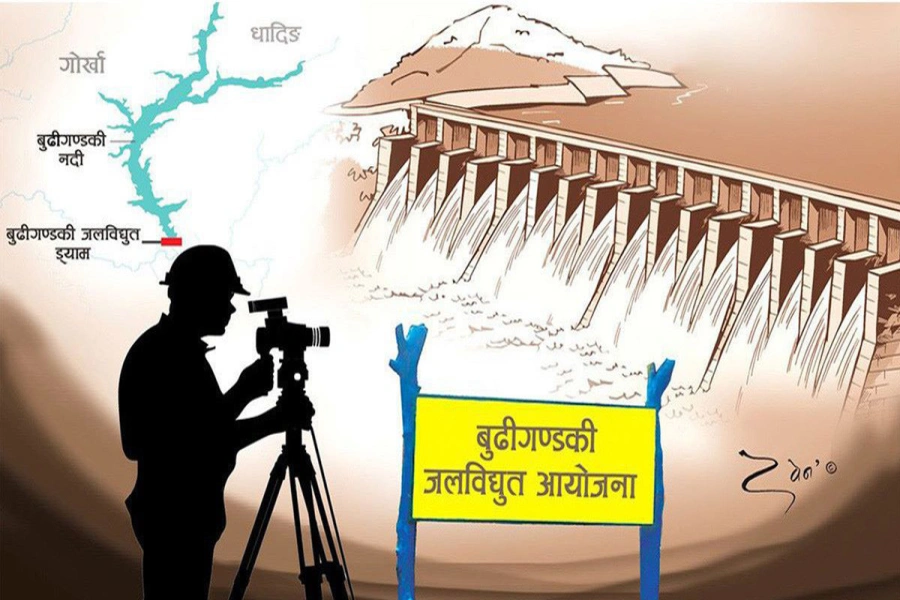
KATHMANDU, Feb 6: Local stakeholders have stepped up pressure on the government to move forward the reservoir-based Budhigandaki Hydropower Project, a national pride project that has remained stalled for years.
The Dhading Chamber of Commerce and Industry has launched a signature campaign to push for the implementation of the project by setting up a dedicated stall at the 10th Dhading Festival, which began on January 29 in Dhading Besi, the district headquarters. The festival will continue until February 8.
The campaign aims to draw the attention of the state and build public pressure for the long-delayed project. Federation of Nepalese Chambers of Commerce and Industry (FNCCI) President Chandra Prasad Dhakal inaugurated the campaign by signing the petition while attending the festival’s opening ceremony.
Dhading Chamber President Ram Kumar Dallakoti expressed concern over delays in the project that he said would significantly impact not only Dhading and Gorkha districts but the national economy as a whole. “Budhigandaki is Nepal’s largest reservoir-based, multipurpose hydropower project. It must be advanced without further delay,” he said, adding that the signature campaign was launched precisely to intensify pressure on the government.
Govt’ll build Budhigandaki on its own: Energy minister

Dallakoti said completion of the project would promote employment and various businesses, stressing that the project should no longer be left in uncertainty. He also noted that local residents along key northern trade routes of Dhading and Gorkha have been displaced for years in anticipation of the project as construction is yet to begin.
Local resident Navaraj Timilsena said the dream of seeing the project materialize has yet to be realized. “People agreed to leave their ancestral land believing this national pride project would be built. The initiative taken by the Dhading Chamber to apply pressure is commendable,” he said.
The Budhigandaki Hydropower Project, with a planned capacity of 1,200 megawatts, was deemed feasible at an estimated cost of Rs 331 billion. Key preparatory works, including compensation distribution, have largely been completed. More than Rs 45 billion has already been disbursed as compensation in affected areas.
Around 50,000 residents from 23 former Village Development Committees in Dhading and Gorkha districts had agreed to relocate, expecting the project to bring transformative economic change. However, frustration has grown as construction remains stalled. “We were ready to leave our homes for a national pride project, but the prolonged delay has deeply disappointed us,” said local resident Raj Kumar Shrestha.
While uncertainty persists, the Cabinet on January 16 approved the investment modality of the Budhigandaki project. Despite being listed as a national pride project in 2011, nearly 14 years were spent primarily on land acquisition and compensation.
Following approval of the modality, the base construction cost is estimated at approximately USD 2.77 billion (Rs 374 billion). Including interest during construction, the total cost is projected to reach nearly Rs 400 billion. The project, with an eight-year construction timeline, will be developed under a public–private partnership (PPP) model.
Under the shareholding structure, the Ministry of Energy, Water Resources and Irrigation will hold 50 percent ownership, the Ministry of Finance 30 percent, and the Nepal Electricity Authority 20 percent. While shares will later be allocated to affected locals and the general public, government ownership will not fall below 51 percent.
Once completed, the project is expected to generate an average of 3,383 gigawatt-hours of electricity annually.
Meanwhile, a board meeting of the Press Council Nepal, held in Salantar, Dhading, on Saturday, also urged the government and concerned agencies to expedite the project. In a statement issued on Tuesday, the Council expressed solidarity with the signature campaign launched by the Dhading Chamber of Commerce and Industry.
-1200x560-1781083488.webp)








