

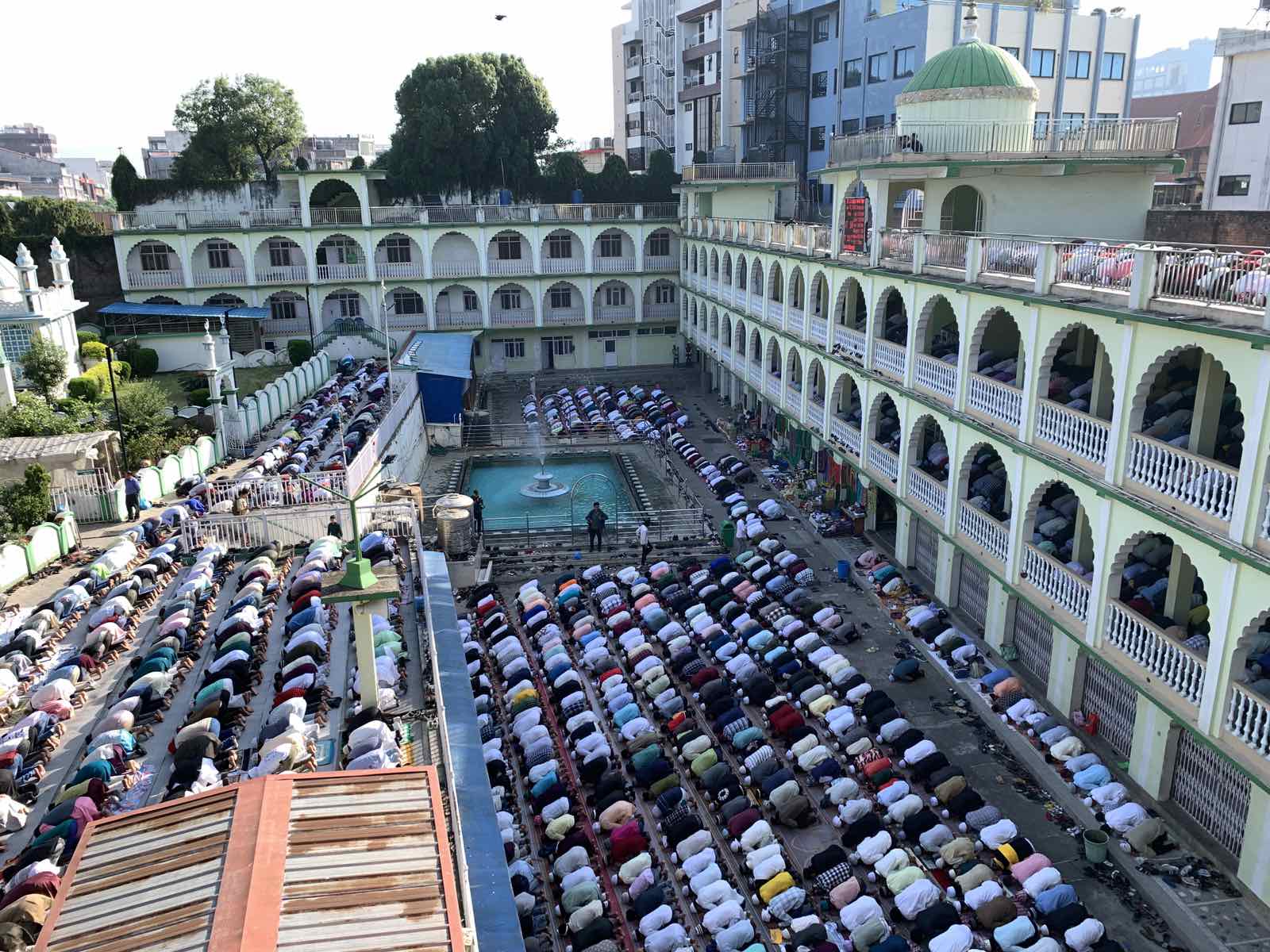
After refraining from food, water and other worldly pleasures for a month, Muslims around the world celebrate Eid ul-Fitr which is believed to strengthen the bond between Allah and his followers.[break]
Apart from its religious significance, Eid is also an opportunity for families and friends to come together. And like any festivity, food is an important part of the celebrations.
“The food for the day of Eid has to be different from other daily dishes,” says Khowaja Moazzam Shah, 78. The three dishes, according to him that every household in Nepal certainly serves, are sewai, a vermicelli pudding, chickpeas and pakora, a fried snack.
Shah also emphasizes that sewai is regarded as a must during Eid in every Muslim household in Nepal. NS Nadwi, the Imam of Jame Masjid, says that it is a culture of serving something sweet for a special occasion that Nepali Muslim community accentuates sewai during Eid.
“Sweet dishes are served in celebratory moments, and Eid is one of the prime celebrations,’ he says.
There are many ways to prepare sewai, and it comes in varieties, too. Shah says that varieties of sewai are sold for a month prior to Eid. Sheer-khurma and Lachha are the ones that are primarily prepared and served in Nepal, among its many other varieties.
Mansoor Hussein, Secretary of Nepal Jame Masjid, says that prices of sewai vary from Rs 150 to 3,000 per kilogram.

“It depends on the quality of the butter and flour used in making it. Also, the quality of flour varies according to the mixture of quantity and quality of dry fruits in it,” he clarifies. He adds that sewai has become a common dish during Eid, also because it can be easily afforded by people from any economic background.
Asif Shah, television presenter, says that after a month of fast, he craves for more delicious foods. And since sewai items are rarely made, unlike other dishes, it is his favorite during Eid.
But sweet dishes are not the only highlights of the extraordinary cuisine served during Eid. Non-vegetarian dishes are also served and consumed with great relish. Banu says that they have dishes made out of mutton, chicken and buffalo meats in different styles.
Fried meat, meat balls, kofta, shami kebab, korma, and biryani are some of the delicious dishes that are prepared for Eid. And she is quick to point that every household carries a different taste for the non-vegetarian dishes.
“The masala that are used and the way the dishes are cooked are almost similar but there’s always some difference in the taste, and it’s always good to have varieties,’ she says.
Hussein, on the other hand, claims that the non-vegetarian varieties may taste differently in a good way because their food is halal. While slaughtering an animal, during halal, they are not hit directly on their spinal cord but their vein on the neck below their face is cut allowing all the blood to flow out of the body. And the name Allah is pronounced during the process.
Imam Nadwi says that according to Islam, it is said that such a process purifies the animal and their religious values also restrict them from consuming blood even though they eat non-vegetarian foods. Whereas Hussein claims it has been scientifically proven that halal meat is healthier.
Banu also agrees with both and shares her experience of non-Muslims coming to Muslim butcher shops to buy halal meat or to get their goats slaughtered by halal. “They say that the meat is tastier,’ she says.
Apart from sweet dishes and non-vegetarian items, there are other elaborate varieties such as pickles made of radish, potatoes, cucumbers; raita and dahi bada made from curd. Samosas, baked pastries with the filling of spiced tomatoes, methi palak (fenugreek spinach) are among many other delicacies. Also, seasonal fruits are served in the feast.
All of these food items are, however, not served all through the day. “If a guest arrives in the morning after namaz, we serve sheer-khurma or lachha. A little later after that, most of the items are served according to the guest’s wish. We serve chapattis in the evening and rice for the dinner,” Banu elaborates.
Hussein argues that most of the food items are mostly energizing.
“Since we fast for a month, we’ll have very less energy conserved in our body during that time. So, during Eid, we have foods that revitalize our body,” he says. He adds that a sweet dish gives one immediate relief while non-vegetarian items are known for its energy replenishing ingredients.
The day of Eid ul-Fitr this year is on Sunday, August 19 when the Muslim community will start their day early, before sunrise, and after daily chores and shower, they put on their new clothes or the best ones. In Nepal, they will break the fast with a sweet meal, preferably sewai, before special Eid prayers. Then will start the serving and eating of the delicacies with the common phrase on everyone’s lips, “Eid Mubarak!”
Related story
Muslim community celebrating Eid-ul-Adha on Saturday





-1782782519.webp)


-1200x560-1774606010.webp)


