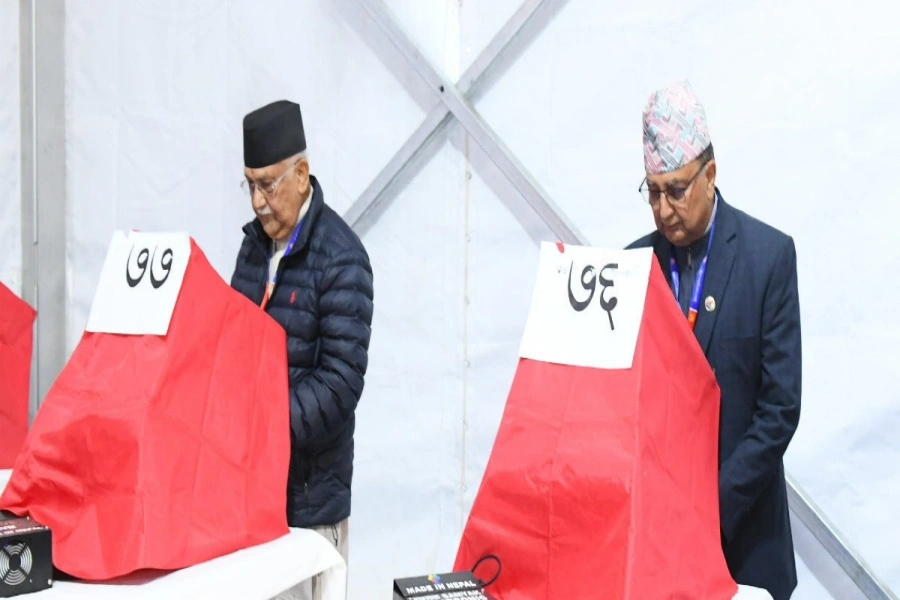
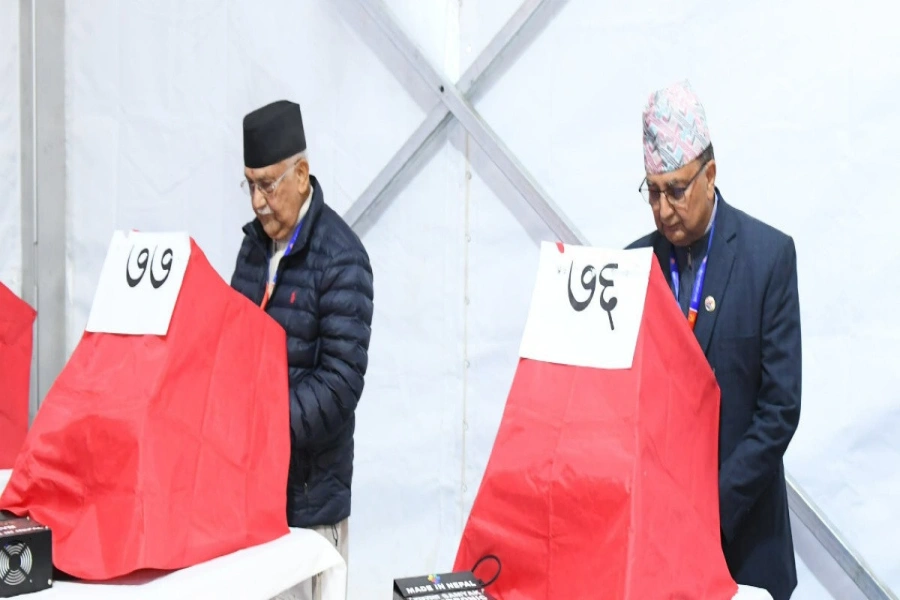
His only rival Ram Chandra Paudel of Nepali Congress (NC) bagged 235 of the total 575 votes cast.
The Maoists´ eleventh hour deal with the United Democratic Madhesi Front (UDMF) paved the way for Bhattarai´s victory. While the UCPN (Maoist), the largest political party in parliament, alone commands 236 seats in the House, UDMF, an alliance of five Madhes-based political parties, altogether has 65 seats in parliament.[break]
Other political parties Madhesi People´s Rights Forum, CPN-Samyukta, Rastriya Janamorcha, CPN-ML (Socialist), Nepal Sadbhavana Party (Anandidevi), Federal Sadbhavana Party, Rastriya Janamukti Party, CPN (Ekikrit), Federal Democratic National Front, Dalit Janjati Party, Nepaa Rastriya Party, Socialist People´s Party, Nepal Democratic Socialist Party, Nepal Family Party and independent lawmaker Sadrul Miya Haque also voted for Bhattarai.
Paudel got votes from CPN-UML, Rastriya Prajatantra Party, CPN-ML, Rastriya Janashakti Party and an independent lawmaker Baban Singh.
In the 601-seat parliament, seven seats have remained vacant as memberships of three lawmakers have been scrapped, one has resigned and three others have passed away.
Of the total 594 members, only 575 lawmakers cast their votes. Of the 19 lawmakers who didn´t cast their votes include five from the Nepal Workers and Peasants Party and four from the Rastriya Prajatantra Party Nepal as both the parties boycotted the voting.

Three lawmakers -- DB Karki, Gayatri Sah and BP Yadav -- were not allowed to vote as they have been suspended for their alleged involvement in the misuse of red passports. Bishwanath Prasad Agrawal and Shalikram Jamakattel didn´t turn up for voting as Agrawal is abroad and Jammakattel was seriously injured on Saturday evening. Similarly, three lawmakers -- Naradmuni Rana of UML, Shivapujan Ray and Salma Khatun of MPRF -- who have been accused of involvement in the red passport scam, are at large and one Maoist lawmaker -- Gunakhar Basyal -- has been out of contact for some months.
After tabling of the proposal for his candidacy at the parliament meeting, Bhattarai said being a prime minister of a majority coalition was not his choice. “Still the doors for transforming the government into a consensus coalition will always remain open and I will make efforts toward that end,” he said.
NC candidate Paudel said his entire political career has been aimed at fighting for democracy and safeguarding the universally-accepted norms of democracy and “this is also the objective of my candidacy.”
“No revolution or transformation is more precious than democracy,” Paudel said.

NC leader Bimalendra Nidhi, seconding Paudel´s candidacy, said there was a problem in basic ideology adopted by the Maoists. “They say there is no such word as pluralism in their dictionary. And there lies the problem. I urge them to study the new dictionaries that define pluralism,” said Nidhi.
Most of the leaders who presented their views at the House meeting before casting their votes appreciated Bhattarai for his intellectual and clean image.
“While he had already established himself as an intellectual and studious political leader, he has also proved to be a leader of peasants and laborers during the decade long conflict,” Maoist Chairman Pushpa Kamal Dahal said while seconding Bhattarai´s candidacy in parliament.
Shankar Pokharel of CPN-UML said the Maoist decision to field Bhattarai for the prime ministerial post might boomerang as he might not succeed in overcoming the grave challenges of the transitional period. “Leaders like him should have been made prime minister after the completion of the transitional phase,” said Pokharel.

Related story
Book on former PM Bhattarai released