


The most revealing moment of Nepal’s recent election did not happen at a rally or during a televised debate. It happened quietly inside homes.
In many households, voters did not necessarily know the name of the candidate they were voting for. But they knew the symbol.
That small but telling detail reveals a deeper shift in Nepal’s political communication landscape: the campaign transformed the party symbol into the central political brand.
From a communications perspective, Nepal’s latest election may eventually be studied as a case study in symbol-driven campaigning in a digital-first political environment.
Rather than building recognition around individual candidates across dozens of constituencies—a costly and time-consuming task—campaign messaging increasingly focused on clear narratives, repeated symbolism, and recognizable visual identity. In doing so, the symbol itself became the anchor of voter recognition.
The rise of the Rastriya Swatantra Party (RSP) took place within a broader political context shaped by public frustration and civic mobilization. Nepal has witnessed waves of protest over the years—from anti-corruption demonstrations to citizen-led movements demanding accountability and institutional reform. More recently, Gen-Z-led protests amplified these demands, reshaping the national political conversation and opening space for new political actors.
In many ways, this election became the institutional expression of that civic momentum—translating protest energy into electoral participation. The campaign strategy appeared to tap into this prevailing public sentiment, framing the election around clear narratives and recognizable symbolic cues that could resonate quickly with voters.
Seen in this light, the approach also reflects a broader global shift in political communication. Across democracies, younger professional entrants and political outsiders are increasingly challenging traditional party hierarchies through direct voter communication, digital storytelling, and strong symbolic branding.
Local level poll candidates receive election symbols

A recent example can be seen in the United States with Zohran Mamdani, whose political rise has been closely associated with digital-first campaigning and grassroots mobilization among younger voters. His communication style—short-form messaging, social media storytelling, and direct engagement—illustrates a wider generational shift in political communication strategies.
Nepal has seen a version of this model before.
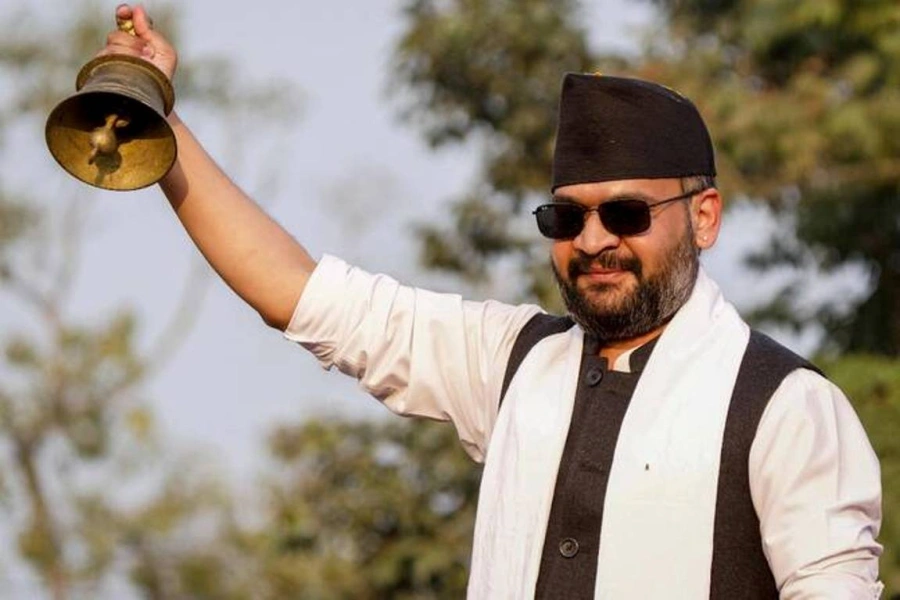
The rise of Kathmandu Mayor Balen Shah in 2022 demonstrated how digital platforms could reshape political legitimacy. His campaign largely bypassed traditional party structures and relied on direct social media engagement, simple messaging, and recognizable symbolism, allowing him to build a strong connection with voters.
Elements of that communication approach appeared to echo in the recent election as well. With a slate that included many younger candidates and first-time entrants, the RSP campaign emphasized visual recall, symbolic identity, and repeated messaging.
From a strategic perspective, this approach simplified the campaign architecture. Instead of building recognition around individual candidates across multiple constituencies, messaging centered on a single, recognizable political identity anchored in the party symbol. In a political environment shaped by public frustration and heightened civic energy, such clarity allowed the campaign narrative to travel quickly across diverse audiences.
Political scholar Murray Edelman argued in The Symbolic Uses of Politics that political symbols often shape public perception more powerfully than policy debates. Nepal’s campaign environment illustrated this dynamic vividly: recognition became the currency of political messaging.
The medium itself also played a defining role.
Media theorist Marshall McLuhan’s observation that “the medium is the message” feels particularly relevant in Nepal’s evolving digital political ecosystem. Campaign communication increasingly unfolded through short-form content, viral clips, and highly shareable graphics, reflecting how citizens now consume political information.
In a fragmented digital media environment where attention is scarce, campaigns appear to have recognized that brevity, symbolism, and repetition travel further than lengthy policy discourse.
The result was a campaign environment where political branding and public sentiment converged.
For communicators, the formula was clear:
simple narrative + recognizable symbol + digital amplification = political traction.
Of course, elections are only the beginning.
Winning an election requires mastering narrative; governing requires mastering institutions. Nepal’s democratic history reminds us that translating electoral momentum into effective governance is often the greater challenge.
Yet the outcome of this election offers one important possibility: the emergence of a stable political mandate for the coming years.
Nepal has experienced many people-powered political moments—from the democratic movement of 1990 to the historic protests of 2006. Yet in an increasingly interconnected world, where political and economic systems move quickly, the country can ill afford endless cycles of upheaval. What Nepal needs now is not another revolution but results that translate public trust into effective governance.
Watching these developments unfold from abroad has been both fascinating and deeply meaningful. For many Nepalis living and working overseas, the past weeks have sparked conversations about the election and what it might signal for the country’s political future.
As a member of the Nepali diaspora living and working abroad while remaining deeply connected to changes at home, I find this moment both hopeful and reflective.
Nepal’s democracy has always been shaped by the determination of its people. This election was another reminder that beneath campaign strategies, digital narratives, and recognizable symbols, one institution ultimately defines the country’s political destiny.
The people themselves—who, this time, made their message unmistakably clear.






