

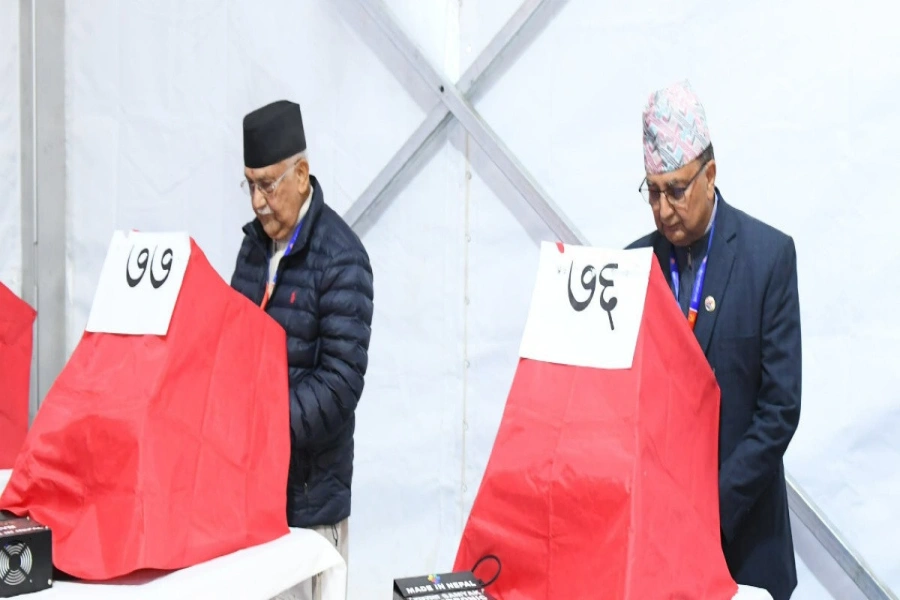
The country’s second-largest party, the CPN-UML, has concluded its 11th General Convention in a grand manner. At a time when it was widely believed that major political party activities had stalled following the Gen Z uprising, the UML has not only revived itself but also sent a message of renewal to almost all political parties. By selecting new leadership through an electoral process during the convention, the party has once again projected itself as a formidable political force. KP Sharma Oli, who was forced out of office as the country’s elected prime minister following the Gen Z movement on September 8 and the arson, looting, and vandalism on September 9, has reaffirmed his dominance by securing a “hat-trick” as party chair. Except for two office-bearers aligned with senior leader Ishwar Pokhrel, most elected officials are seen as close to Oli. Although he has long faced accusations of unilateralism within the party, Oli has demonstrated through an open electoral process that he retains a strong grip over the UML. It is now time for the largest party, Nepali Congress (NC), in the erstwhile House of Representatives (HoR), to hold its General Convention at the earliest opportunity and elect new leadership or reaffirm its legitimacy through the convention in line with the spirit of the recent Gen Z movement. This will allow the NC to demonstrate its commitment to the genuine agenda of Gen Z, regardless of who is elected.
Following the Gen Z uprising, there was a strong narrative around generational change and leadership transfer. However, the election results within the UML do not appear to support that narrative. Instead, the convention has shown that the party is once again seeking firm resolve and strong leadership. Oli has emerged as a leader willing to speak out against the excesses committed in the name of the Gen Z movement, including arson, vandalism, and damage to state and private property. Compared to the pre-Gen Z Oli, the current Oli appears even more assertive. Leaders who have remained at the centre of politics since the political change of 1990 continue to be influential. There has been persistent commentary on the need for alternatives to such leadership. However, leadership is not something that can simply be handed over. Each party has its own statute and traditions that determine how many times leadership can be repeated. As long as Oli felt capable, there was no question of him handing over leadership to anyone else. In the NC, where only two terms are allowed, Sher Bahadur Deuba has stated that he will not seek leadership at the next general convention. In contrast, following the Gen Z uprising, Pushpa Kamal Dahal of the then CPN (Maoist Centre) returned to leadership by forming a new party and engineering political polarisation.
'Social Welfare Act' to be amended as an umbrella act

Although the UML has successfully held its general convention, the process appears more challenging for the NC. Once its convention is completed, the incoming NC leadership will find it easier to play its role in national politics. Most political parties face a challenging period, requiring adaptation to changing circumstances. Parties need to move forward in line with the evolving context. The UML must also keep the party united after the convention. Given the circumstances the country has endured, there is no alternative but to move forward with past experiences in mind. That the UML has rejuvenated itself and moved ahead even in adverse conditions is a positive development. If Oli makes a genuine effort to take everyone along, the outcome could be markedly different. It is now time for the NC to hold its General Convention and elect new leadership. With a renewed leadership, the NC will be better positioned to approach the public ahead of the HoR polls and convince voters that it is ready for change.





