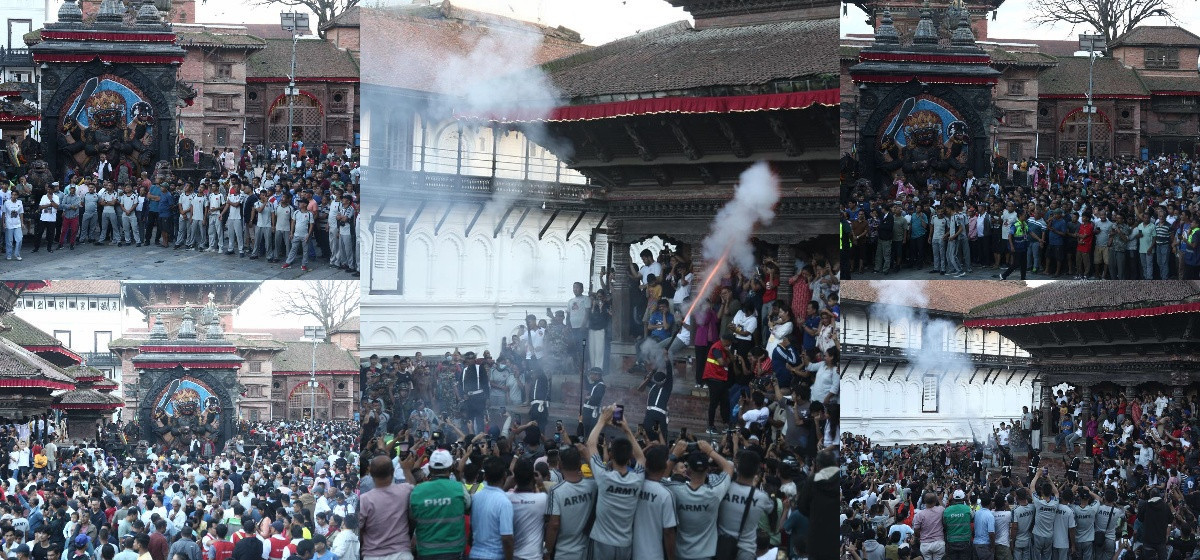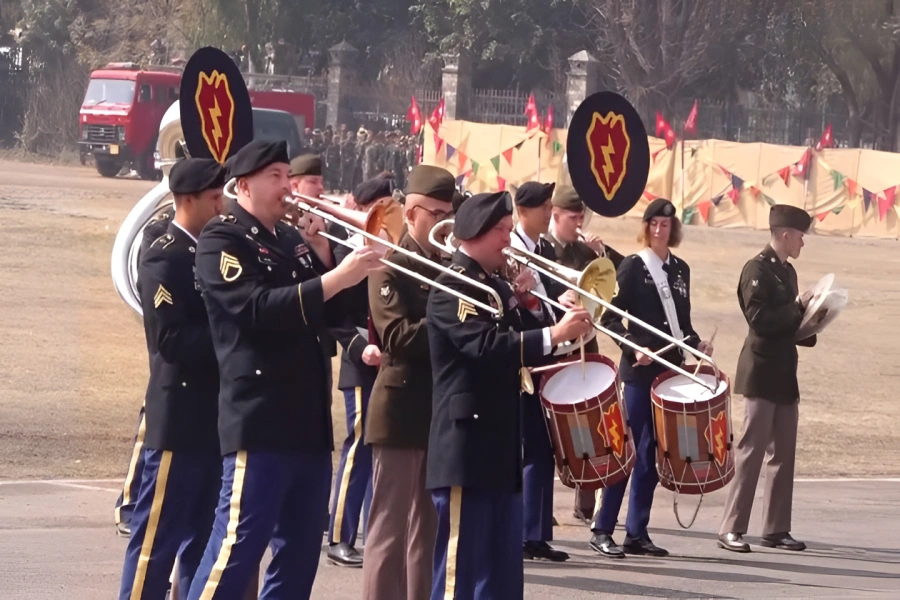
KATHMANDU, Feb 16: With just over two weeks left before Nepal votes for the House of Representatives (HoR) election, a viral video clip showing a US Army band performing at Tundikhel has stirred political debate and social media speculation.
The footage, recorded during the Nepali Army Day and Maha Shivaratri celebrations, was widely shared online, with some users claiming it showed the US military parade in the heart of Kathmandu. As the video gained traction, questions surfaced about its timing amid an already charged pre-election atmosphere.
A section of political leaders and social media users linked the performance to Nepal’s signing of the MCC Compact, reviving claims made by critics that the agreement would eventually pave the way for a US military presence in the country.
CPN-UML Chairman and former Prime Minister KP Sharma Oli criticised the participation of a US Army band in the parade at Tundikhel, describing it as a serious affront to Nepal’s sovereignty and nationalism. Talking to a media outlet, Shilapatra, Oli also argued that the performance, held during the Army Day and Maha Shivaratri celebrations, signalled interference in Nepal’s cultural values.
Experts assess impacts of global geopolitical developments in S...

Echoing Oli’s concerns, the Communist Party of Nepal (Maoist) also protested the US Army’s participation in the Army Day event at the Army Pavilion in Tundikhel. In a statement issued on Monday, General Secretary Netra Bikram Chand ‘Biplab’ said allowing the US Army to join the parade in a “mysterious manner,” without the consent of the Nepali people and political parties, amounted to a grave undermining of national sovereignty and independence.
The Nepali Army (NA) has dismissed such interpretations, calling the performance a routine and reciprocal engagement between friendly militaries. NA officials say it is customary for band teams from friendly nations to participate in Nepal’s Army Day celebrations. In return, Nepal sends its own military bands abroad for similar ceremonial events.
Just last month, a Nepali Army band performed at India’s Army Day in a comparable format, with announcements delivered in Nepali. Such exchanges fall under long-standing army-to-army cooperation, which includes joint exercises, training programmes, ceremonial performances and youth exchanges.
The Indian Embassy in Nepal on Monday also noted that a 35-member Indian Army band, led by Major Rahul Kumar, participated in the 263rd Nepali Army Day celebrations in Kathmandu, describing it as a reflection of enduring military ties between the two countries.
Military relations between Nepal and the US date back to 1947. Over the decades — including during the republican era — military band exchanges, training programmes and joint engagements have continued under successive governments. Nepali Army officers regularly attend staff colleges in the US, while US military personnel visit Nepal for various collaborative programmes.
Beyond the US and India, Nepal also conducts joint military exercises with China, the United Kingdom, Pakistan and several other countries. The NA maintains that such engagements are institutional practices that remain separate from domestic politics.
However, in the thick of an election season, the optics have proved politically sensitive. Some voices have tied the episode to broader geopolitical anxieties and alleged Western involvement in Nepal’s emerging Gen Z activism.
Government officials reject those claims, arguing that similar military exchanges took place during the tenures of former prime ministers KP Sharma Oli, Pushpa Kamal Dahal and Sher Bahadur Deuba without controversy.
As campaigning for the HoR election intensifies, the episode underscores how routine diplomatic and military engagements can quickly become political flashpoints — especially when sovereignty, foreign influence and generational politics dominate public discourse.