As the country edges closer to the House of Representatives (HoR) election scheduled for March 5, the CPN-UML finds itself increasingly isolated in its refusal to participate. With the Nepali Congress (NC) on Saturday formally announcing it will contest the polls—and all other major parties already preparing their campaigns—UML now stands as the only political force publicly declaring a boycott. This stance not only undermines the broader democratic process but also risks pushing the nation toward deeper political uncertainty. UML’s insistence on reinstating the dissolved HoR has been the centrepiece of its recent political campaign. The party argues that the September 12 dissolution was unconstitutional. Yet this argument conveniently overlooks an essential truth: the political ground in Nepal shifted dramatically with the Gen Z–led uprising on September 8 and 9. The uprising resulted in the tragic deaths of at least 74 people and fundamentally altered the power equation. The government led by UML Chair KP Sharma Oli was not undone by constitutional clauses but by a popular rebellion that forced a recalibration of Nepal’s political trajectory.
'NC won’t shy away from leading govt'

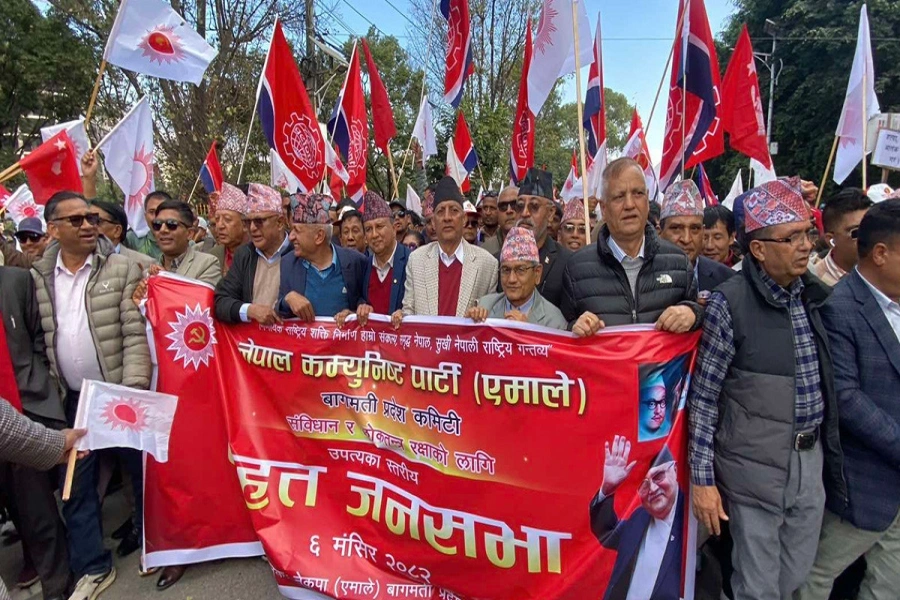
Political change sparked by street protests does not unfold neatly within the articles of the constitution. When a public uprising erupts—especially one on the scale seen in September—the logic of politics changes. The UML must accept that its government fell not through procedural injustice but through a loss of legitimacy in the eyes of an outraged citizenry. To demand that politics now return to a narrow constitutional interpretation ignores the very force that reshaped the present moment. In this context, pushing for HoR reinstatement is not only impractical but potentially destabilising. Analysts have already warned that UML’s confrontational stance threatens to disrupt preparations for the March 5 vote. Saturday’s rally in Kathmandu, framed by many as a show of desperation, underscored this. So did the announcement of the party’s National Volunteer Force—led by a controversial figure convicted of serious crimes—an initiative that has raised legitimate concerns about intimidation and political vigilantism. The UML leadership must accept the fact that its aggressive posture may only further erode public trust. The party appears to be operating under the belief that “offense is the best defence,” a mindset perhaps driven by pressure on its top leadership, which faces accusations surrounding the September 8 crackdown. But this strategy, if continued, will only distance the party from voters and jeopardise its long-term standing.
The decision of NC—the largest party in the dissolved parliament-- to join the polls has now placed additional pressure on UML to reconsider. With all other major parties committed to the election, UML’s solitary boycott is neither sustainable nor strategically sound. As analysts note, the upcoming election remains the only workable route out of the current political fragility. The legitimacy of the dissolved parliament has already evaporated; no amount of street pressure will restore it. The responsible course for UML is to embrace the electoral process, not obstruct it. Preparing for the polls—rebuilding organisation, engaging with youths and reconnecting with disillusioned voters—offers the party a path to recover credibility. Continuing to demand House reinstatement, on the other hand, risks dragging both the party and the country deeper into chaos. It is time for the UML to realign with the democratic momentum gathering across the political spectrum. Joining the March 5 election is not merely an option; it is an obligation to the nation and to the principles of democratic accountability.