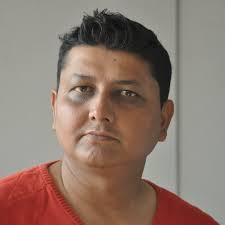
“Many people don’t believe that we can work with normal computers because of our physical condition. But here we are, proving ourselves against the odds,” he declares.
Born in Kathmandu twenty four years ago, Adhikari was not visually impaired at the time of birth. It was only when he was eleven that his eyes gradually lost their power to see. This happened due to an attack of jaundice during infancy that went untreated owing to the lack of awareness.[break]
Photos: Chandra Skhekhar Kark
“I slowly started losing sight of those things that were visible to me only a few days ago. Partial blindness was extremely scary and baffling,” he reminisces.
This incident came as a great shock not just for him but also for his parents. His elder brother was visually impaired by birth. So when even the second son lost his eyesight, their parents, a simple couple from Aarubari, were absolutely devastated.
“Our parents were extremely anxious about what would become of us after their demise,” shares Adhikari.
Deep down, however, his family’s fears and apprehensions continued to drive him on. He may have lost the power to see but he never lost sight of his goals. He completed the sixth grade at Sanjeevani, an integrated school for the blind. The school had a resource person who could read and write in Braille. His job was to translate the Braille into Nepali or English so that the other teachers could understand what the blind children had written.
But later, when Adhikari wanted to join Arunodaya, a regular school with no special provisions for blind children, the principal was worried that he would feel disheartened and humiliated. However, those concerns vanished when Adhikari proved himself by excelling academically. Gradually, he started garnering love, respect and appreciation from his teachers, classmates and the school administration.
“I made notes in Braille and read it out aloud while others submitted written assignments. During exams, I dictated the answers which were written down for me,” he explains.
Currently a graduate in English and sociology, Adhikari’s greatest support and inspiration is his older brother Basudev. A journalist and radio jockey, Basudev is a post-graduate in Nepali. Together, the siblings conduct radio programs that raise awareness about differently able people and how they can be assured better lives and status in society. Adhikari now plans to pursue his Masters in English.
“Our parents who were so worried for us in the beginning are now extremely proud of us. That’s our greatest achievement in life,” Adhikari shares.
However, the journey upto this point in life has not been easy. At first, it had been difficult to perform even the simplest of tasks, like eating, dressing up and using the bathroom. The transition had been even more challenging for Adhikari who had lost his eyesight only later in life than for his brother who was born blind. It was difficult to let go of those shapes, patterns and colors that were once a normal part of his life.
His family helped him get through these difficult times by helping him learn to do things on his own. This approach made him independent and held him apart from a large number of visually impaired populations that is still groping around in darkness in search of their identity and space. Adhikari credits this situation to the society’s attitude regarding the differently able.
“People are either too loving or too indifferent towards us. Only a few actually try to understand us, our requirements and sentiments,” he opines.
In order to battle the social stigmas and create better living conditions for the differently able, the Adhikari brothers have started an organization called Bright Star Society with their personal savings. It provides free health checkups and organizes trainings related to leadership, personality development and public speaking. Recently, they also participated in blood donation programs and eye donation campaigns.
“We create positive vibes in those who have been estranged from the societal mainstream and make them aware of their rights, responsibilities and talents,” Adhikari shares.
He describes physical barriers and attitudinal barriers as the major hindrances faced by the differently able in the society. He shares his own experiences on the roads of Kathmandu where new pits and holes keep popping up overnight. It is quite tricky to maneuver his way through them without hurting himself.
As a student and professional, he travels to different places in and around the city, and sometimes he is unsure regarding the way. More than once, people have played practical jokes by pointing him to the wrong directions.
“It’s difficult to say which is more painful, when people tease us and call us names or when they show us pity and treat us like worthless baggage,” Adhikari sighs.
Another problem he faces is with public vehicles. They have seats allotted for the differently able but those seats are already occupied by regular passengers who often refuse to give up. He shares one particular incident when a crowded microbus refused to stop by saying that he would not be able to travel in such chaos.
“And sometimes, the drivers and conductors blatantly lie about where they are going so that I don’t get on as that would cause them inconvenience,” he reveals.
These are bitter experiences, undoubtedly, and it’s demoralizing when one has to go through these things merely due to certain social stigmas. But despite all this, he is determined to maintain a balance between the aesthetic and the scientific in academics. And for that reason, he keeps himself up to date with the most recent scientific developments even while being a student of literature.
In fact, Adhikari recently visited a couple of blind schools in India in order to familiarize himself with the latest technology applied to train and teach the visually impaired. He considers this a fruitful journey not just because he returned home with a lot of new information but also because he made the trip all by himself on a railway train.
“I found that there are engineers, administrators and programmers in India who are visually challenged. This trip made me more optimistic and confident about myself,” he says.
However, unlike many other people of his age and status, Adhikari has no desire to settle abroad. He wants his abilities to be recognized in his own country. He only wishes to go overseas for trainings and seminars where he can share his talents and benefit from those interactions.
Someone who loves music and is good on harmonium and madal, Adhikari also expresses his dreams and feelings in verses. The author of a dramatic memoir, “The Quest for the Third Eye,” Adhikari does not believe that disability is inability. For the blind, their greatest strength is their powerful sense of sound and touch. In the same way, every person with disability is endowed with something extra to make up for the deficiency. This additional talent has to be spotted and made the best use of for a better life and brighter future.
younitya@gmail.com
Related story
Youth activists raise questions on social stigma