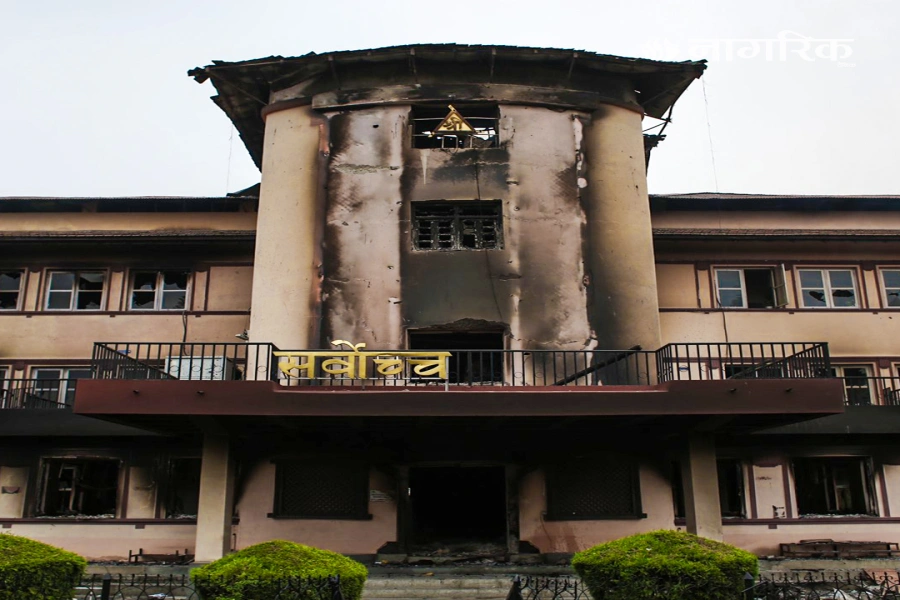
Given the obvious adverse side effects of encouraging marriage for financial gains without doing much to improve access to health, education and employment, the Supreme Court filed a Stay Order on the policy.[break]
Well, why the back-and-forth seesawing? Because of objections by the dynamic and well-coordinated Women for Human Rights (WHR) Single Women Group, an NGO that seeks to economically, socially and politically empower widows – or single women – in Nepal.
In the months after the budget declaration, WHR seriously lobbied to have the decision revoked, eventually filing a writ against the government at the Supreme Court.
“That policy reestablishes single women on the patriarchal system. It gives a clear message that women will be happy to be dependent on male members,” objects Lily Thapa, Founder President of WHR, “Nepal is a poor country where girls are trafficked at the maximum amounts of Rs. 25,000. An incentive of Rs. 50,000 is a huge amount, which would lead people to marry widows just for the money.” The radical policy turned out to be a gross miscalculation.

Since its establishment in 1994, WHR has seen many such victories, but its ambitions seem infinite. With a member base of over 41,000 single women across 54 districts, it supports their education through scholarships, their economic self-reliance through micro-credit programs, provides them with legal counseling and assistance in reintegration into society, and most importantly, a community for companionship.
Basanti Gathani of Ilam has truly benefited from WHR’s workshops. Since becoming a single woman, she has converted her two-storey house into a 16-room abode, runs a stationery store, and is financially secure enough to provide employment to other needy single women.
On the legal front, WHR has overturned several discriminatory laws. Instances:
– In case of a woman’s remarriage, property inherited from her deceased husband no longer needs to be returned to his family
– Inheritance of the deceased husband’s land is not barred until the single woman reaches the age of 35
– No male consent is required to acquire a passport
– No consent needed from an adult son or unmarried daughter to sell property
WHR also launched a “color is our birthright” campaign to bring iridescence back into single women’s lives.
Despite their solid efforts, single women in Nepal continue to face hardship not only as a result of their widowhood but also due to other crosscutting factors that affect women in general – patriarchal system, domestic violence, and trafficking – and that affect Nepalis in general: poverty, caste biases, armed conflict and diseases.
In a just-launched publication, “A Journey Towards Empowerment and the Status of Single Women in Nepal”, WHR statistically analyzes the profiles of its wide member base. The findings reveal that 78% of respondents admitted to various forms of violence inflicted on them after their husbands’ deaths; 80% reported verbal violence; 12% reported of physical violence; and 8% sexual violence.
Besides violence, the social stigmas smeared on single women can often be just as searing. Most women reported mistreatment from their families and communities after their husbands’ deaths. Nearly 44% were tormented by their families.
“We face many restrictions when it comes to food, attire, religious practices and public engagements. I’m working, through WHR, to stop this discrimination,” says Saraswati Pandey of Kailali whose husband passed away six years ago of brain hemorrhage.
The lachrymal glands of Devi Chapagain from Khotang have dried up from all the tears she has already shed; today she suffers from depression and mostly closes her eyes to the world.
Some 64% of the single women are below 40 years of age at the time of their husbands’ deaths, which is hardly an age to renounce oneself.
On June 24 and 25, WHR is organizing an international conference under the heading Widows Voices Empowered. The conference seeks to highlight issues faced by single women in South Asia, call for the inclusion of widows’ rights in international human rights declarations and draw attention to the role of single women as peacemakers in post-conflict situations.
“If you look at all the international human rights instruments regarding women, they never address the issues of widows,” points out Lily Thapa.
The number of widows in the region is said to be proliferating due to armed conflicts, AIDS, natural disasters and harmful traditional practices. The special guest at the conference, Margaret Owen, Director of Widows for Peace through Democracy, was a focal person in drafting the Widow’s Charter, which has since been tabled at the SAARC ministerial summit, pending endorsement. She says that such declarations are “bullets that can be used against governments” to promote the rights of widows. Owen is advocating for a United Nations rapporteur for widowhood, and a UN report on the conditions of widows in armed conflicts.
Mohini Giri, Chairperson of the Guild of Service, India, makes more demands – a separate Widow’s Day.
For both, the concern is the uniform cataloging of women.
“Being a widow is a special category of woman that requires special treatment,” says Owen.
The single women’s rights movement may have won many medals in Nepal, but it still hopes to make a similar impact in the international fora.
Related story
BLACKPINK release their awaited single ‘Pink Venom’


-1778465739.webp)