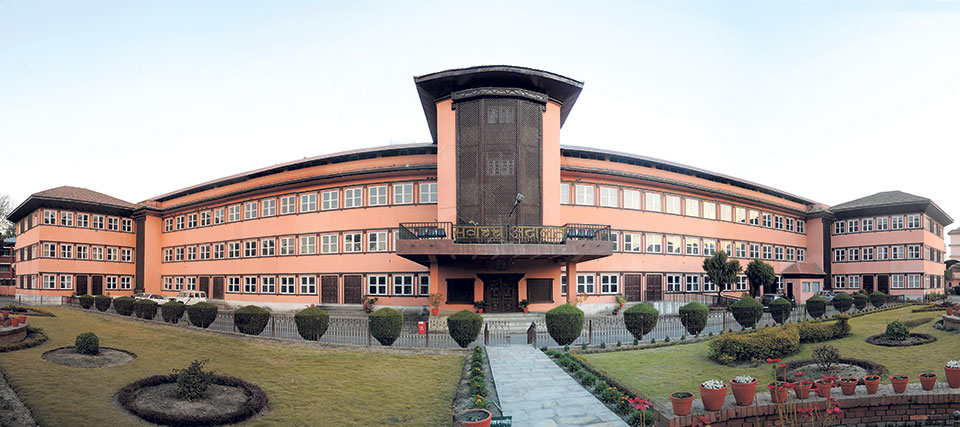
KATHMANDU, Aug 6: The Supreme Court (SC)'s decision on Thursday to admit a review petition in the dispute over the official status of the Nepali Congress (NC) has reopened one of the country's most closely watched political and legal battles, raising fresh questions over the future of the party's leadership.
By granting permission for a review, the apex court has agreed to revisit its earlier ruling that upheld the legality of the NC's Special General Convention and the leadership elected through it. The decision does not overturn the previous judgment, but it signals that the court has found sufficient legal grounds to re-examine the case from the beginning.
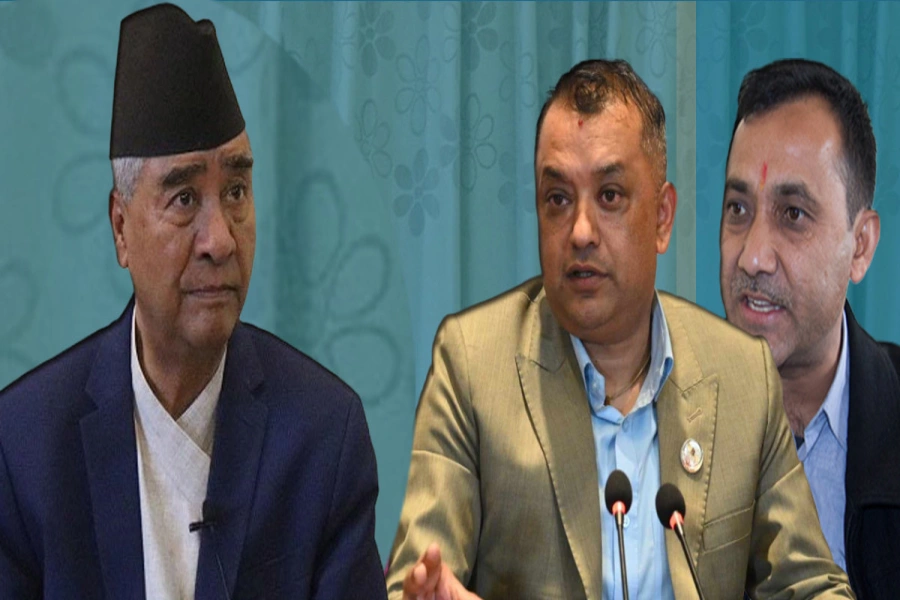
The review petition was filed by former NC President Sher Bahadur Deuba and former Acting President Purna Bahadur Khadka, who argue that the earlier judgment contained serious legal and factual errors.
The dispute revolves around the NC's Special General Convention held in Kathmandu on January 11–12, which the Election Commission (EC) recognized as valid. The convention resulted in the election of Gagan Kumar Thapa as party president.
That decision was challenged in court, but on April 17, a division bench of Justices Sharanga Subedi and Nripa Dhwaj Niraula upheld both the EC's decision and the legality of the convention.
Unconvinced by the verdict, Deuba and Khadka filed a review petition on July 23, naming President Gagan Kumar Thapa, Vice President Bishwa Prakash Sharma and the party's Central Working Committee as defendants.
With Thursday's order, the legal battle enters a new phase.
Writ Petition filed at SC against attorney general’s decision n...

New full bench to rehear case
The SC will now hear the dispute afresh before a newly constituted full bench.
The three justices who allowed the review petition—Chief Justice Dr. Manoj Sharma and Justices Nityananda Pandey and Shrikant Poudel—will not participate in deciding the merits of the case.
Likewise, Justices Subedi and Niraula, who delivered the original verdict, are also barred from sitting on the review bench because judges who have already expressed an opinion on a case cannot participate in its review.
According to SC Spokesperson Arjun Koirala, a separate full bench of three justices will be constituted to hear the petition.
The new bench will examine the case from the beginning before deciding whether to uphold or overturn the earlier judgment.
Deuba-Khadka challenge cites legal errors, 2002 precedent
In their review petition, Deuba and Khadka contend that the earlier judgment failed to objectively assess the evidence presented before the court.
Their principal argument is that only the party's Central Working Committee has the constitutional authority to convene a Special General Convention. They maintain that any convention called by any other body is legally invalid and that the EC should not have recognized it.
The petition also argues that the EC departed from its own precedent established during the Nepali Congress split in 2002.
Following the political rift between then party president Girija Prasad Koirala and Sher Bahadur Deuba, the EC recognized the Koirala faction as the official Nepali Congress. Although Deuba later held a Special General Convention and declared himself party president, the Commission refused to recognize his faction as the legitimate party.
According to the review petition, the EC applied different legal standards in two disputes of a similar legal nature.
The mechanics and limits of judicial review
A review is an extraordinary legal remedy that allows the SC to revisit its own final judgment when serious legal grounds exist.
Under Nepal's judicial system, only the SC has the authority to review its own decisions. The power is provided under the Supreme Court Rules, 2074 BS and the Judicial Administration Act, 2073 BS.
A review may be granted if significant new evidence emerges that could not reasonably have been produced during the original hearing. It may also proceed if the earlier judgment contains a serious legal error or contradicts established judicial precedent.
However, not every judgment is open to review. Decisions delivered by an extended full bench or cases that have already undergone review cannot be reconsidered.
The SC's final decision on the review petition will ultimately determine the official status of the NC leadership.
Although relatively uncommon, SC judgments are not always final in practice. Nepal's legal system allows the apex court to reverse or modify its own decisions through the review process when it concludes that a significant legal or factual error has occurred.
The apex court's decision to grant a review does not mean the earlier verdict will necessarily be overturned. It simply indicates that the petition raises substantial legal questions warranting a fresh hearing. Whether the original ruling stands or is reversed will now depend on the findings of the newly constituted full bench after a complete rehearing of the case.