



KATHMANDU, Nov 22: A storage-capacity enhancement project—featuring two petroleum pipelines and involving an investment of around Rs 24.5 billion for the transport and storage of petroleum products—has entered the implementation phase.
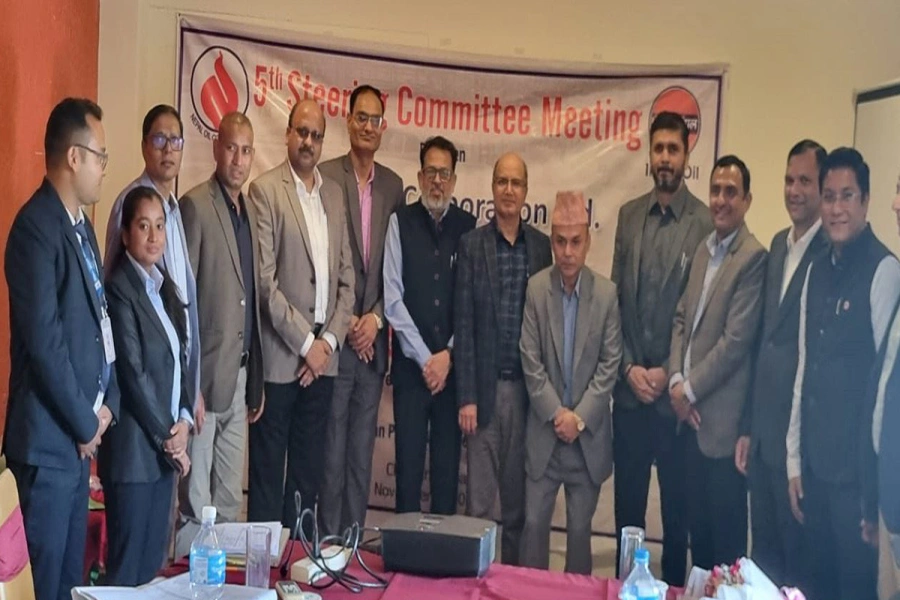
A meeting held in Chitwan on Friday between officials of Nepal Oil Corporation (NOC) and the Indian Oil Corporation (IOC) decided to move forward with the pipeline extension projects from Siliguri (India) to Charali in Jhapa and from Amlekhgunj to Chitwan.
The Nepali side was led by NOC Deputy Managing Director Deepak Baral, while IOC’s Nepal Country Manager Nirupam Raizada led the Indian delegation.
Nepal and India had earlier signed a G2G agreement for the construction of these two projects. Of the four components, India will provide a grant to construct the Siliguri–Jhapa pipeline, the Amlekhgunj–Lothar petroleum pipeline, and the storage terminal in Jhapa. IOC will also build the Chitwan terminal, while the construction costs will be borne by NOC. IOC, owned by the Government of India, will implement all the projects. IOC will provide around Rs 15 billion in grants, while NOC will invest around Rs 9.5 billion.
Petroleum pipeline to be built with an investment of INR 17 bil...

According to NOC Director Binitmani Upadhyay, the bilateral meeting focused on taking the projects into the implementation phase. “Both sides have agreed to move forward according to their respective responsibilities,” he said.
He also stated that the design for the greenfield terminal to be built in Lothar has been finalized. “We have finalized and signed the drawing design,” he said.
The IOC delegation included Anirudha Thatte, General Manager of New Business; Rajat Sarkar, General Manager of Finance and Pipelines; Apil Agrawal, General Manager of PJ–S&G; and Deputy General Manager of PJ–Pipelines Pravin Kumar. From Nepal, NOC Deputy MD Baral, Purna Prasad Rijal, Directors Upadhyay and Suraj Shah, and Deputy Directors Nawabinod Pokharel, Pradeep Yadav, and Surendra Mahato, among others, participated in the meeting.
Of the Siliguri–Jhapa pipeline, about 35 kilometers lie in India and 15 kilometers in Nepal. A storage facility with a capacity of 18,900 kiloliters will be built at Charali in Mechinagar Municipality-13, Jhapa. The agreement includes constructing storage facilities for 6,600 kiloliters of petrol and 12,300 kiloliters of diesel in Jhapa.
In Lothar of Rapti Municipality, Chitwan, a storage facility with a capacity of 91,900 kiloliters will be constructed. The plan includes storage for 33,000 kiloliters of petrol, 46,500 kiloliters of diesel, 1,600 kiloliters of kerosene, and 10,800 kiloliters of aviation fuel.
Pradeep Yadav, coordinator of the Lothar–Chitwan Petroleum Pipeline Project, said that land acquisition for the Chitwan storage terminal has been completed. “All necessary land in Chitwan has been secured,” he said. “The project is now moving into implementation.”
The Siliguri–Jhapa pipeline is expected to meet the fuel demand of eastern Nepal, particularly Koshi Province. As the existing Motihari–Amlekhgunj pipeline cannot meet national demand, the new project is intended to supply the eastern region. The Amlekhgunj pipeline is now planned to be extended to Chitwan. The Jhapa terminal will have a storage capacity of 42,000 kiloliters, while the Lothar terminal will have a capacity of 103,150 kiloliters.
Kathmandu, the federal capital city, and Pokhara, another major city, have the highest fuel consumption in the country. The Chitwan pipeline is expected to reduce transport costs for supplying these regions. Extending the pipeline from Amlekhgunj to Chitwan will also make the long-term distribution and management of petroleum products more efficient.
Pipeline transport reduces transportation costs, ensures product purity, and helps prevent leakage. It also minimizes issues of theft, spillage, and adulteration. Moreover, it helps reduce road traffic congestion and environmental pollution caused by fuel tankers.
During then Prime Minister Pushpa Kamal Dahal’s visit to India, Nepal and India signed a G2G agreement under which IOC would build two pipelines and one greenfield terminal for Nepal as a grant. The agreement was signed in the presence of Dahal and his Indian counterpart Narendra Modi by then Minister for Industry, Commerce, and Supplies Ramesh Rijal and Indian Petroleum Minister Hardeep Singh Puri. The projects are targeted for completion within 54 months.
The Motihari–Amlekhgunj pipeline has been operational since September 10, 2019. Seeing the numerous benefits of pipeline-based fuel import, NOC moved forward with new pipeline projects.





