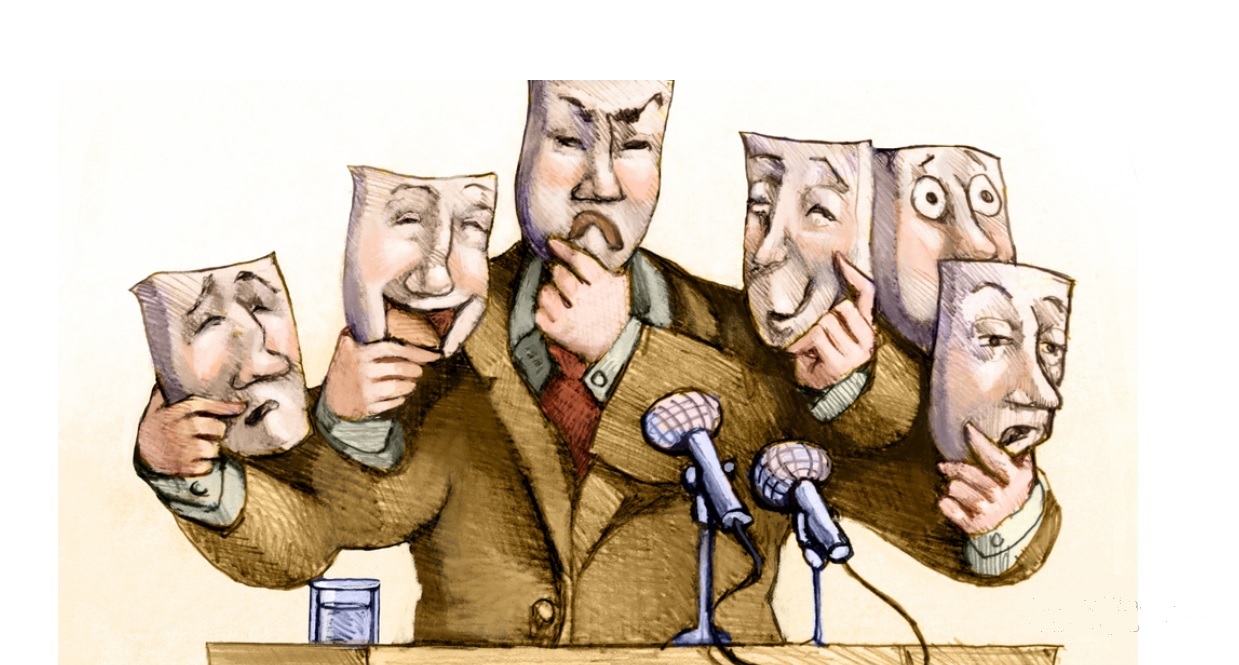
There is a question here: Between the larger societal trends interlinked with global trends and the politics increasingly influenced by issues of race and ethnicity, which one is guiding whom? Democracy with its intrinsic values of fairness and equality must be sufficient to ensure a fair place for any race or ethnicity. However, for the discrimination caused by the autocratic rulers of Nepal in the past, universal democratic values of fairness and equality are becoming a casualty as the politics of ethnicity reins supreme not only in the regional political parties explicitly based on ethnicity but also in the otherwise national parties historically based on ideology, not ethnicity.
There should be no hiding of the fact that human beings are fundamentally racists, though. The very ideology of nation-state is racism, which is only sublimated by the popular discourse of nationalism that pretends to be non-racist. Look at the history of the world, human beings are ‘civilizationally’ shaped to be different from each other. It is the civilization (not civilizations) that has taught people to go beyond racism and most of us pretend that we have overcome racism. When occasion comes, the evil that has been suppressed will just come out and we may all be in our complete racist form. History has demonstrated this too. That is why we have valued civilizations and systems of governance (like democracy) that get the best out of the human fundamentals and suppress the worst.
In Nepal’s major national political parties, there is no strong voice that can boldly present itself against the politics of ethnicity. In these parties, leaders from certain minority groups or ethnicity are getting much greater prominence than they deserve simply because they belong to those certain races. It is not that these parties do not have leaders who do not understand this. The point is that those leaders have not been able to come out of the populist trend for fear of being termed as “regressive”. Nepal is such a strange country where it was looked down upon as “regressive” even to argue against federalism until sometime ago. The populist, fashionable trend was that federalism would bring an end to all the sufferings of the Nepali people. This trend simply ignored the point that federalism was simply one of the models of state structure and it was neither the best nor the worst. In a country that has such occasional pervasive waves in favor of certain things at a given time, the issues of ethnicity are talked about much more than necessary and all at the cost of the required talks on the fundamentals of democracy in the new constitution.
Like globalization is convergence of peoples across nations, so is a nation-building process that brings about convergence among peoples within the nation. But that convergence can happen around a set of principles and values, which are commonly owned by all members concerned. Once that convergence takes place at the national level, regional and local commonalities could converge locally under the broader convergence owned at the national level, which is the nation on the whole. Nepal’s political process struggles between the line that desires to return to history and the one that aspires to move ahead. In this process, as if the politics of ethnicity and nationalities as championed by the political parties—willingly or unwillingly—is not enough, there are numerous groups even outside the parties that claim to represent those ethnic movements. This has further weakened the parties with regard to their capacity to represent their respective ideologies as opposed to movements representing rights of people as ethnic groups.
I read Nepal’s current political process between the two trends of returning to history and being part of the global democratization process. This is not to argue that globalization is necessarily the best thing that has happened in the world. The point is about globalization of democracy as a value in its ideal sense. If there is a clear line adopted in favor of this in the new constitution—whose birth seems to be as elusive as never before—we still have a chance for a smooth transition into stability. But if the political parties do compromise between the return to history and the leap to future, we are sure to waste another few years before we are able to take one line clearly once again. At moments of frustration over the directionless political process, it is often some solace to read this process as a fascinating plural text of history being written and rewritten infinitely.
Related story
Is Nepal the winner of globalization?