In this column, I have repeatedly asked why Nepal remains a country that is wounded, trapped, stagnant, and steadily losing its people to migration. Today, I want to shift the lens—not to revisit our failures, but to show what Nepal can still become. Even in that more hopeful frame, I cannot pretend Nepal is on the verge of becoming a notable nation of opportunity and dignity, or that the world has something to learn from how we build, govern, and grow.
Nepal Can Rise
But I can say this: if our leaders chose seriousness over slogans, action over rhetoric, and ambition over a defeated mentality, Nepal could begin to embody those very virtues. It will not become Switzerland or Singapore, but it can become a steady, decent, confidently growing country—one where young people believe they can build a future at home. A country where people feel proud to work in their own soil because it is fair, functional, and worthy of their effort and ambition.
The question is not whether transformation is possible—it is. What stands in our way is not capacity but mindset, and the obstacles we keep creating for ourselves. Let us face it: Nepal has not been a country of builders—not in our recent memory. We have mastered the art of surviving; now we must learn the discipline of building. Nepal can build, and it must. The ingredients are already here—we only need the will, the courage, and the determination to assemble them.
Building a nation begins with one idea: every Nepali must feel they have a fair chance to rise. That requires equality before the law, affordable opportunities, strong public education, and institutions that enable rather than obstruct. It means using technology, talent, and private enterprise to widen possibilities, not restrict them. Above all, it requires social trust—the belief that rules will hold, merit will matter, and effort will not be wasted. Everything else flows from this mindset. Great nations are built not by chance but by clarity and resolve. Progress is never accidental; it is engineered—and Nepal must choose to do so now.
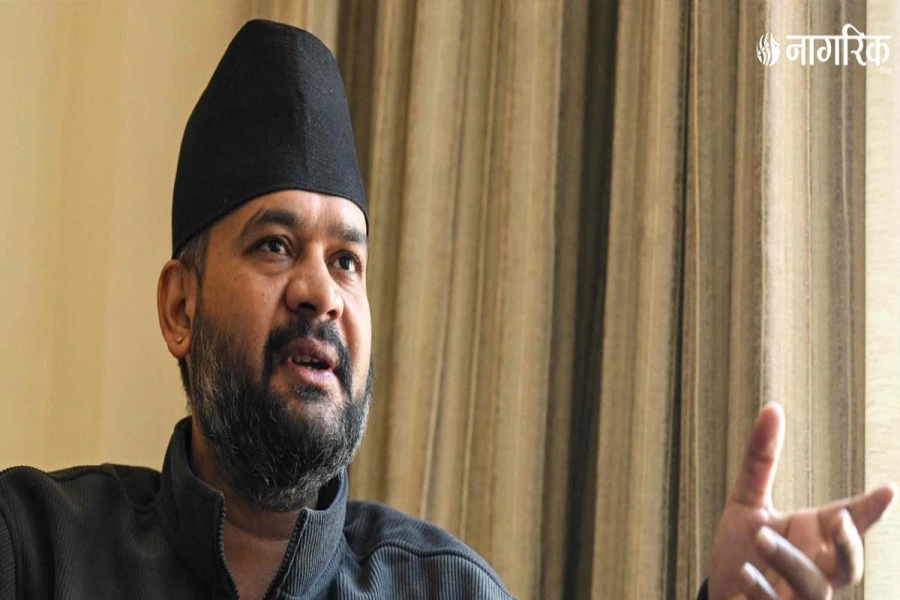
UML will build the nation: General Secretary Pokhrel

A nation cannot build everything at once, but it can focus on the few things that matter most—areas where effort compounds, confidence grows, and progress accelerates. If we direct our energy toward these, Nepal could move from stagnation to a dynamic and just nation within the next two decades. These priorities take concrete form in five pillars.
The Five Pillars
Those pillars begin with the most fundamental one: rule of law. Nepal must create an atmosphere in which every citizen can say with confidence that they are treated equally under the law. That single change would unlock the motivation of every economic agent in nation-building. Nepal’s biggest constraint is the absence of a system where laws are applied equally and institutions act without fear or favor. Citizens cannot trust, investors cannot plan, and innovators cannot scale when rules shift with politics. If Nepal ensures fairness, speed, and predictability in its policing, courts, regulatory bodies, and civil service, every other reform becomes easier. Without this foundation, nothing else will hold.
Second, every child in Nepal—regardless of caste, ethnicity, or region—should be able to say: “If I do well until Grade 10 in my local public school, I can choose any field of study in this country.” That is the promise a nation owes its young people. Public schools must become reliable places of learning, not institutions parents escape by moving cities or paying for private alternatives. A strong public-school system lowers the cost of opportunity and expands mobility for every child, giving the nation’s youngest—and also the poorest—citizens a fair start and a fighting chance. Ultimately, a country rises only as far as the skills and ideas of its own people allow.
Third, every household, entrepreneur, farmer, and factory in Nepal should be able to rely on affordable, dependable electricity whenever they need it. That single assurance would transform our economic potential overnight. Nepal is among the lowest energy-consuming countries in the world, and even then barely 10 percent of that consumption comes from electricity. That must change. Reliable energy is about energizing industries, irrigation, cold storage, digital services, transport, and the thousands of enterprises that never start because they cannot trust the grid. Nepal’s rivers carry enough energy to lift the nation, yet hesitation and mismanagement have turned abundance into scarcity. Building Nepal requires powering it.
Fourth, make the nation tech-savvy and entrepreneur-friendly so that anyone with a viable idea and the discipline to execute it can build and scale an enterprise here. Nepal has paid a high price for an environment where approvals are slow, compliance is unpredictable, and innovation is treated as a risk rather than an opportunity. A productive economy needs thousands of enterprises experimenting, adopting new technologies, reducing costs, and connecting to markets. When enterprise is trusted and technology is widespread, an economy shifts from stagnation to dynamism. A nation that celebrates enterprise creates prosperity.
Fifth, Nepal must eliminate the psychology of landlockedness by creating a country where every citizen can say they can reach markets, services, and opportunities without losing time, money, or dignity to bad roads and weak connectivity. Nepal’s geography is challenging, but it must not be our destiny. Reliable east–west and north–south highways, regional airports, digital connectivity, irrigation systems, and modern logistics are not luxuries—they are the backbone of a functioning economy. When travel becomes predictable, commerce expands, supply chains strengthen, tourism flourishes, and entire regions open up to possibility. A well-connected country climbs the development ladder faster.
If Nepal grounds these pillars, it will finally become the country we have been searching for all along—a Nepal that is finally built.
Now We Must Build
These pillars will also generate three outcomes. First, Nepal’s per-capita income can rise from its 3.4 percent average of the last decade to around 6 percent annually—still way below what China sustained for forty years and what India is achieving now, but enough to transform living standards within two decades. With that income growth, we can build a health system that protects every citizen, not just those who can pay.Second, these pillars—where workers are skilled, firms are equipped with technology, innovators have room to experiment, and the government acts as a facilitator rather than a barrier—will finally ignite real job creation. Third, Nepal will be an exporting nation as production costs fall with cheaper energy, skilled manpower, and lower compliance burdens.
The costs of building these pillars are not higher than what we already spend—not financially and certainly not emotionally. Nepal lacks these foundations not because we invest too little, but because we mismanage and misallocate what we have. Our wounds are, in many ways, self-inflicted. With fairness, skills, energy, enterprise, and connectivity, Nepal can become the beacon on the hill we always believed it could be.
The path is clear. The choice is ours. We have survived long enough; now we must build.
(The author holds a PhD in Economics, and writes on economic issues in Nepal and Canada. He can be reached at acharya.ramc@gmail.com)


-1200x560-1774606010.webp)
-1200x560-1783685616.webp)