Much awaited because, as curator of the show Sujan Chitrakar points out, Birendra Pratap remains a vital figure in modern Nepali art – not only because of his art making but also for the active role he has played in creating or invigorating a number of art institutions in the country.
Incidentally, Chitrakar's team has done an outstanding job of putting together a tightly knit show from what must have been an overwhelming number of artworks spanning the artist's prolific career. The artist himself admits that the current exhibition showcases a mere one-third of his oeuvre. Counting nearly 300 on the show, that is indeed a stupendous number!
Educated at Banaras Hindu University (BHU) and Lalit Kala Academy in India, Singh is a revered senior artist of Nepal. He has shown extensively in India, Bangladesh, South Korea, Japan and UK as well as Nepal and his works are in a number of prestigious international and national collections, including that of the Fukuoka Art Museum of Japan.
From as early as his teens, Birendra Pratap's doodles showed a distinct trajectory towards the surreal. Psychic automatism is a label the artist offers himself for his work. Trained under the renowned Dipak Banerjee and Dilip Dasgupta at BHU, his fascination was honed to skilful perfection as his early pen and ink drawings show. These simultaneously call up formal resonances not only from Dali but surprisingly, and much more relevantly perhaps, from William Blake as well.
Over a career spanning more than 40 years, the artist has delved deeper and deeper into the human subconscious with his tools, dredging up realms that defy the rational but portray the tortuous workings of our brains. He has consistently worked on the mind's innerscape from as early as 1976, his human figures distorting and melding into each other and into objects birthed from unreason with uncanny regularity. They're crafted with a skillfulness and unity of vision that easily elevate them to a level at par with international greats. His works could easily have hung with equal alacrity anywhere in the world.
But the artist does not rest here. With equal commitment and clarity of vision, Birendra Pratap has pursued the other extreme of the human experience – the urban shell of the human soul – the City. His restless seeking, coupled with an early and acute perception of the world gasping in the throes of modernization had opened his works up to explorations of the architecture of cities – be it the Varanasi ghats of his student days or be it Nepal's thousands of glorious but ill-fated traditional urban structures.
Recording the real has never been his forte though – the exquisitely crafted drawings of rural homesteads or urban heritage sites are each caught in a moment of tremor. Is it a tectonic shift that catches them unguarded, unprotected, un-conserved by indifferent owners and authorities? Or is it the universe's flux of energy that penetrates our dry rational consciousness through his automatism? These cityscapes, or stray hamlets and homesteads, waver and vibrate with an intensity that calls out for preservation and empathy with equal urgency. He eschews the concrete city in favor of a past. Understandably so if we recognize this as a symptom of his characteristic withdrawal from the everyday and real. For a mind that delves into the subconscious on a psychological plane can only confront the surrounding and gross modernization through a withdrawal into remembrances of things about to be past.
Tremors running through the drawings of 1985 have the same intensity and visual immediacy as those done a few months ago – their scale have changed perhaps, somewhat in direct proportion to the dwindling of human figures in them, but the intensity is as palpable as it was 40 years ago. When accosted, the artist replies, "I've been working on environmental issues for a long time and have singularly devoted myself to it for the past few decades."
Therefore his newer series, pieces of which he showed at the Kathmandu International Art Festival (KIAF) in 2012, called Earth Body Mind takes this same theme forward in color on lokta paper. "The theme of climate change and its impact on humans held a special resonance for me. My piece (for KIAF 2012) is called Environment in which I'm sending things that science has created back to the sun, since it seems we're in need of a new civilization. I've tried to show the five continents with their cultural and architectural definers—the Vitruvian Man represents for me the Renaissance. Greed and warring instincts have overtaken the human race. May be it is time for us to return to an earlier time and an earlier way of life, in a way begin all over again!"
The sequential pieces on show at Nepal Art Council emanate the same.
For me, the one great discovery was Birendra Pratap's exceptional proficiency in printmaking. Subtle, evocative, luminescent – they open up a surreal world of the soul, of human tangled experience. It is indeed a pity that we have seen so little of them!
'Birendra Pratap Singh: A Retrospective' will conclude on April 26.
The author is an Indian artist/writer/actor based in Kathmandu.
Related story
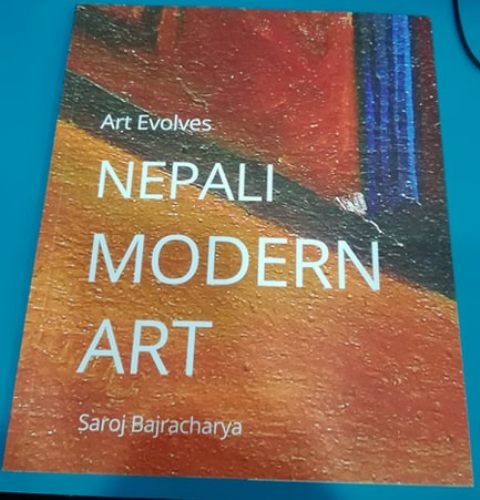
‘Art Evolves: Nepali Modern Art’: Review