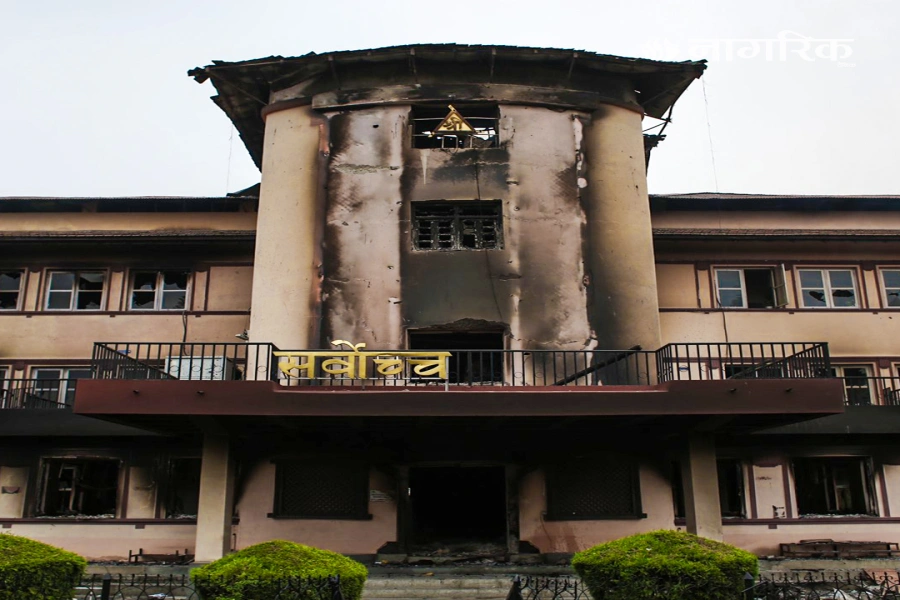
It is hardly surprising that the rule of law is undermined when force becomes the decisive factor in the conduct of state affairs. Yet, so long as the judiciary remains competent and independent, there is a widely held belief that the courts safeguard the rights of the weak and give voice to the voiceless. But when judges themselves come under threat, that protective shield collapses, leaving the most vulnerable without any recourse. If recent reports are accurate, Nepal may be edging dangerously close to such a moment. During the events of September 8 and 9, the Supreme Court and several other courts were set ablaze, with storerooms containing case files of specific individuals allegedly singled out by vandals. Now, just as court benches are slowly resuming, a disturbing rise in threats against judges has emerged as a grave concern for all who uphold the rule of law. In a recent interaction with journalists, Chief Justice Prakash Man Singh Raut acknowledged that judges are increasingly being targeted to influence verdicts, striking at the very heart of judicial independence. Reports that political cadres linked to certain parties, along with criminals who escaped from prisons during the Gen Z protests, are issuing threats to judges and their families make the situation even more alarming. This is an exceptionally serious matter and it demands an urgent and resolute response from the government.
Pakistan security forces free 190 hostages in train siege

With threats being routinely issued through SMS messages and social media even before court benches convene, a full-court meeting was held on Monday with the participation of representatives from the Nepal Bar Association (NBA) and the Supreme Court Bar. All judges of the SC attend such full-court sessions. Recognising the gravity of the situation, the NBA has also consulted legal advisers. Nepal has witnessed troubling precedents in the past, when political leaders themselves led protests against the judiciary. During the reinstatement of the House of Representatives in 1995, leaders of some political parties even raised slogans calling for the then chief justice to be hanged. Yet, when their own rights were later violated, they too were compelled to seek refuge in the judiciary. Judges are expected to remain restrained and dignified, and therefore cannot engage in public protest or self-defence. Even in cases involving those who threaten them, judges are duty-bound to adjudicate impartially. For this reason, journalists, legal professionals and civil society must act as a protective shield to ensure that intimidation and pressure do not influence judicial decisions. Above all, it is the government’s responsibility to ensure that judges can function without fear or pressure. Given that the country is currently led by a prime minister who is a former chief justice, the public had expected greater sensitivity and seriousness in safeguarding the dignity and independence of the judiciary. Recent developments, however, offer little ground for such confidence, which is deeply troubling.
This does not mean that all judges are beyond criticism. Misconduct by some has contributed to public disillusionment, and certain verdicts may indeed have caused injustice. However, the legal system provides mechanisms to address such grievances. Justice cannot be secured by threatening judges. At the same time, judicial officers must work to correct their shortcomings and strengthen their moral authority. The recent rearrest of a convict previously sentenced for spreading distrust against the judiciary—who had escaped during the Gen Z movement and reportedly continued issuing threats to judges—underscores the seriousness of the challenge. Police say no formal complaint has yet been filed regarding threats to judges. But when the NBA is already involved, law enforcement need not wait for a complaint to initiate an investigation. Judges rarely speak out or file complaints unless the situation becomes unbearable. Home Minister Om Prakash Aryal must therefore issue clear instructions to ensure firm legal action against anyone threatening judges. Protecting the judiciary is not about shielding individuals; it is about defending the rule of law and ensuring justice for those who have already suffered injustice.


_20220412075015.jpeg)