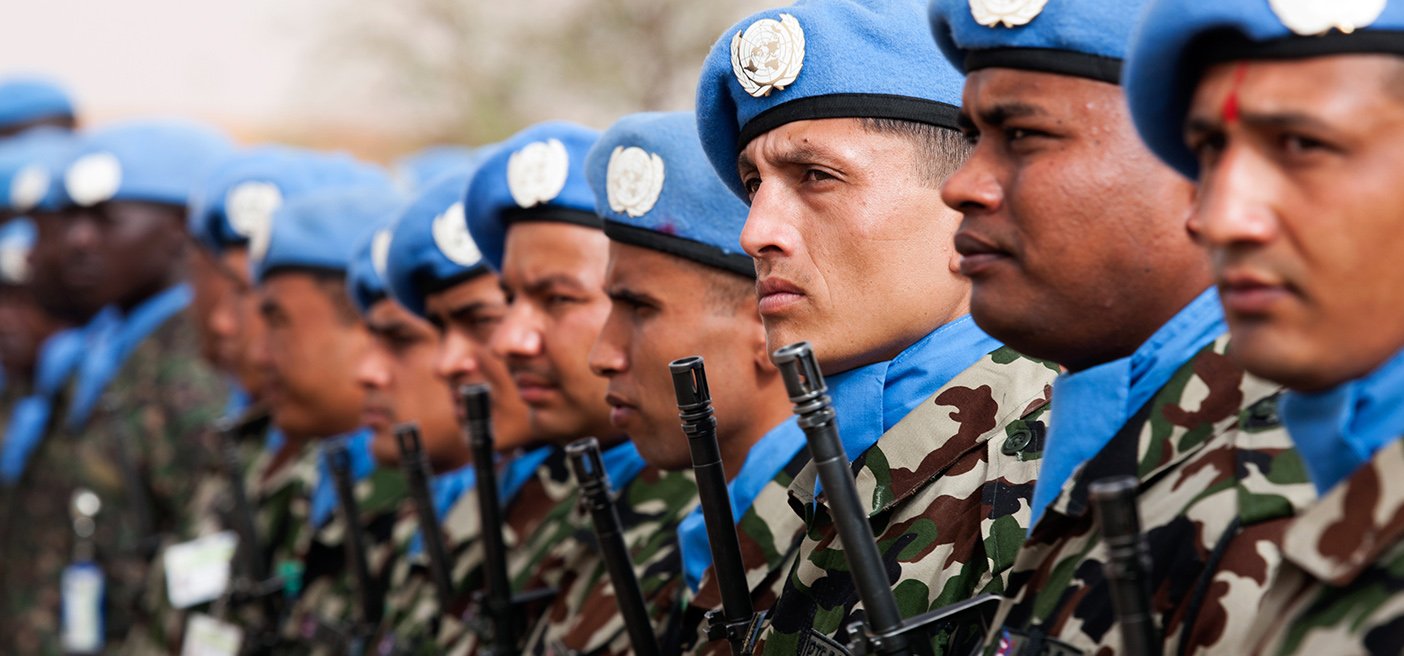
With the emergence of new threats and conflict environments, the United Nations Peacekeeping (UNPK) missions have become multi-dimensional these days. Effective peacekeeping is thus a tough challenge, both for the organization as well as participating countries.Before, when threats were clear and common, supervision, monitoring and reporting of conflict used to be the primary roles of peacekeepers. Only unarmed military observers and lightly armed troops used to be included in the missions. But with the end of Cold War, the spectrum of peacekeeping expanded. Roles like protection of civilians, guarding of human rights, institution building for good governance and security sector reform have became its prominent features. Today, we are in the age of 'offensive mandate' with fighting machines like attack helicopters, tanks and drones as their integral parts.
Hence ensuring proficiency and competency of peacekeepers has been a big challenge to a third-world country like Nepal. To improve Nepal's contribution Nepal Army in 1986 established an ad-hoc 'peacekeeping training camp', which was later developed into Birendra Peace Operations Training Center (BPOTC), a dedicated training institute for the purpose. The center has since produced 6,000 national and international peacekeepers for deployment in various UN peacekeeping missions.
The primary role of the center is to train peacekeepers on peace support operations. Military contingents and individuals receive vigorous training prior to their deployment. Students from other countries also participate. During the exercise 'Shanti Prayas Two', held in 2013, there were 871 participants, along with 455 foreigners.
Undoubtedly, since the establishment of the training center, GPOI (Global Peace Operations Initiative), the US Government funded program to enhance regional peace support operations and US PACOM (United States Pacific Command) have been prominent partners in its modernization. Recently, with their assistance, the center has been recognized as having 'full training capability' by US government. The institution is now competent to train a battalion of 835 personal at a time. Infrastructures like lecture halls, lane field class rooms, multiple firing ranges, language lab, modern gymnasium, sophisticated auditorium, night landing facilitated helipad and level one hospital are integral structures of the center. It can accommodate around 2,000 personnel at a time.
But army chief, Rajendra Chhetri, is not satisfied and wants to develop the institution into a 'Center of Excellence', providing academic curriculum along with training and research capabilities on peace support operations. The Kofi Annan International Peacekeeping Training Centre (KAIPTC), located in Accra, Ghana, is the ideal example of such a center of excellence.
KAIPTC was established in 2000 to train African peacekeepers. But within a few years of its establishment, it was developed into a world class 'academic institute' with full training and research facilities. Presently the institution is also running post-graduate programs in conflict, peace, security and gender. Both national and international students from security, civil, diplomatic and non-governmental agencies are studying there.
Indeed our own BPOTC can also be a premier educational hub, not only for Nepal but also for the whole of South Asia. This goal can be achieved by associating the center with the Ministry of Education and renowned global universities. Already, the Military Academy and Army Command and the Staff are affiliated with Tribhuwan University and conduct bachelor- and master-level programs.
Once, UN Gen Secretary Banki Moon had said: "UN peace operations are the global instrument and making them fit for the purpose is a collective responsibility." So we need a holistic approach, incorporating people from academia, civil society, diplomatic community and security sector.
Today UN Peacekeeping missions have become a vital tool to bring failed states back to life, often after decades of conflict. And Nepal being the sixth largest troop contributor to UN peacekeeping missions, it should take up this worthy cause. A lot of credit goes to Nepal Army for continuing to serve in peacekeeping missions with such distinction despite the loss of 58 of its soldiers and disability of another 19 while serving in various peacekeeping missions.
I believe improvement of BPOTC will add new dimension to peacekeeping. It could also lay the foundation for better civil-military relations in Nepal. Most Nepalis still have poor understanding of military matters and the state is at least partially responsible for this.
The author was a UN Peacekeeper in UNMIL (Liberia) and MONUSCO (Congo)
shijan7malla@hotmail.com
Related story
Nepal's statement on Peacekeeping delivered in New York





-1200x560-1783685616.webp)