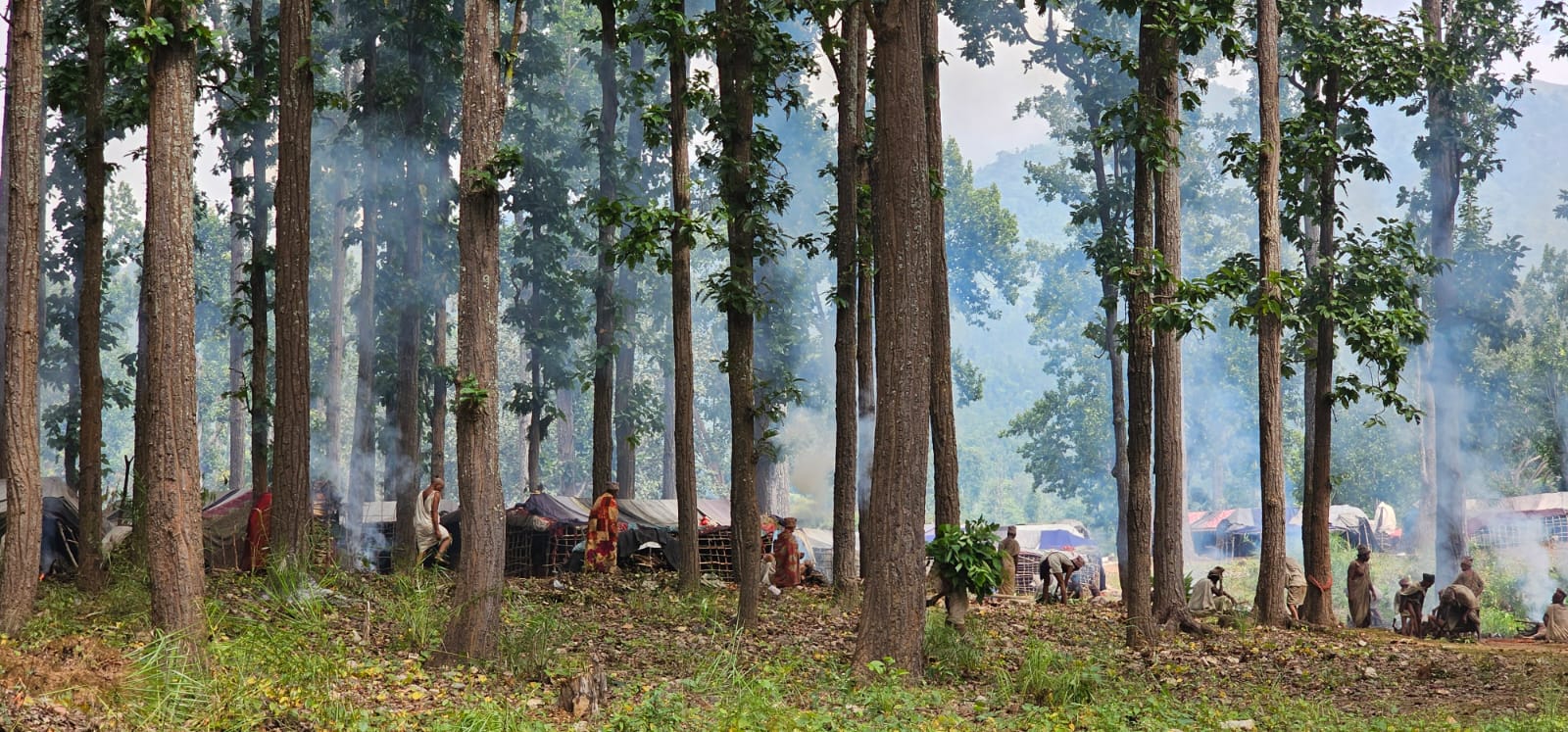
SURKHET, Oct 2: For many, the idea of Dashain conjures images of bustling markets, vibrant decorations, and family gatherings. But in the heart of Surkhet, Nepal’s only nomadic tribe—the Raute—celebrate the festival in a way that is entirely their own. This community, which neither settles permanently nor engages in farming or formal education, currently resides in Lekbesi Municipality–10. For the Rautes, Dashain unfolds over two days: Mahanawami and Vijaya Dashami.
Women at the Center
On Mahanawami morning, the settlement comes alive with a uniquely Raute ritual. All the women gather at the village center, while a priest chants sacred mantras. Each household brings a goat or sheep, circling it around the women as rice grains and water are sprinkled to complete the ceremony.
“We perform this worship so that we don’t fall ill or get harmed by evil spirits,” explains Gajuli Shahi, a young Raute girl. “Other rituals only begin after the women’s worship is completed.”
Integrated policy to be introduced for Raute Community

The Raute are a female-led community where violence against women and children is virtually nonexistent. Outsiders are strictly forbidden from entering the settlement during women’s rituals—a testament to the respect and autonomy women hold here.
Honoring the forest deity
The day’s celebrations continue with worship of the forest deity. Each household ventures into the surrounding forest with one goat or sheep for the ritual. With 40 households in the settlement, this year saw 40 animals offered in honor of the forest deity.
“As we live in the forest, hunt monkeys and langurs, and craft wooden utensils for trade, we worship the forest deity,” Gajuli explains. “The sacrifices ensure successful hunts, protection from wounds, and safety from evil spirits.”
Because the community did not receive government social security allowances this year, they borrowed animals from neighboring villages. After the forest sacrifice, the animals are roasted on the spot, and the chiefs (Mukhiyas) distribute the portions. “Those who do the hard work must eat more,” says Mukhiya Bir Bahadur Shahi. “Small shares are set aside for the slaughterers before the rest is taken home.”
Household rituals on Vijaya Dashami
On Vijaya Dashami, the Raute continue the celebrations with household sacrifices. Goats are slaughtered inside homes, and the first drops of blood are offered to barley, maize, and other shoots (jamara) planted five days earlier.
“Only jamara purified with blood is worn,” Mukhiya Shahi says. “After the offering, we put on new clothes and apply jamara and tika.” Within the settlement, chiefs, healers, shamans, and priests hold authority, guiding the timing of rituals and ensuring traditions are faithfully observed.
For the Raute, Dashain is not just a festival—it is a living celebration of their culture, beliefs, and the deep connection between community, nature, and ritual.






-1200x560-1774606010.webp)
-1200x560-1783685616.webp)