In Nepal, classrooms often mirror the nation’s politics more than its promise of education. I must admit, I was naïve about this. I had no experience of university education in Nepal. I had only heard stories from others. When I first visited classrooms to give a few lectures, I assumed students simply sat with their friends. They walked together, ate together, and formed circles like in any school.
Later, I learned something more profound was happening. Out of curiosity, I asked a few people at the canteen, and later I also spoke with some students. Their answers shocked me. The groups were not casual cliques. They were extensions of political party wings.
The more I asked, the clearer it became. Students openly said they aligned with specific parties. Teachers and staff also had party ties; what I had dismissed as ordinary behavior was, in fact, partisan politics shaping classroom life. Realizing it felt strange and unsettling. Education, meant for curiosity and learning, had become another battleground of party loyalty.
The divisions even reached the canteens. Students loyal to one party ate in one canteen. Students from another party chose a different canteen altogether. The campus fractured into zones of allegiance. What should have been a place of learning turned into a miniature version of national politics.
The Long Grip of Party Wings
This system lasted for decades. Student wings of major parties became permanent fixtures of higher education. In the Free Student Union elections, these wings dominated year after year. A Kathmandu Post article noted that the student wings of Nepali Congress, CPN-UML, and the Maoist Centre retained dominance in Tribhuvan University’s Free Student Union elections, despite criticism of national politics. Independent groups remained too weak to mount a serious challenge.
For many, joining these wings was not optional. It was a way to survive on campus, to find protection, and sometimes to secure favors. Political networks promised jobs, scholarships, or influence. In return, students offered loyalty.
This culture created a cycle. Senior party leaders relied on students as foot soldiers for rallies and strikes. In turn, students saw politics as a career path. Universities, instead of neutral spaces of knowledge, doubled as training centers for party cadres.
The effect on education was profound. Trust among students weakened. Even friendships became filtered through party lines. Young people, barely out of high school, carried banners of parties older than their grandparents. Their identities as learners took a backseat to their roles as political representatives.
NCC, ASCOL, Surkhet Campus into semis

Gen Z Pushes Back
But in recent days, something new has begun to shift. The Gen Z protests that swept Nepal in the early week of September 2025 called for integrity, accountability, and freedom. They began as a demand for transparency, but soon they grew into a broader movement. On the streets and online, young people declared that they were tired of corruption, nepotism, and the culture of impunity.
These protests also shook student politics. On social media and in public statements, several unions announced they would no longer carry party flags. They said they would not identify as representatives of national parties. For the first time in decades, student groups are trying to break free from party labels.
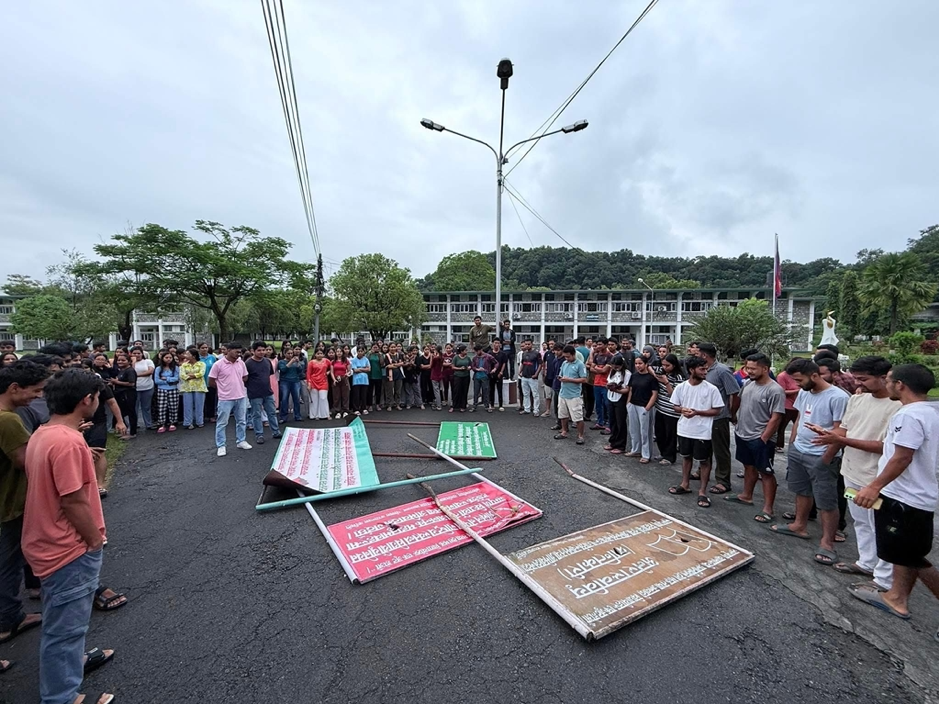
Some social media handles went further. They declared that no student wings would be present inside certain campuses. At the Institute of Forestry, Pokhara Campus, students announced they would not allow political wings to operate. A similar stance was seen at the College of Natural Resource Management in Puranchaur, Kaski, under the Agriculture and Forestry University (AFU).Students also signaled they would bar partisan activity. These examples show that the shift is not only a matter of words but also of actions on the ground.
The choice to put away party flags is more than symbolic. It is a refusal to act as pawns of the political elite. It is a claim that students are students first. Young people want to reclaim their voices, their education, and their future from partisan control.
Students at the Institute of Forestry, Pokhara Campus, are dismantling the signboards of political parties.
Ayush Pokhrel, president of ANNFSU Purunchaur Campus, Kaski, announced on Facebook that he has formally dissolved the campus committee. He said the decision came in response to the government’s “inhumane suppression” of recent protests and in solidarity with young Nepalis demanding a corruption-free future.
Cracks Inside the Parties
The cracks are visible even inside the party wings themselves. Republica (September 16, 2025) quoted Padma Bhusal of the Nepal Student Union (NC) saying: “Many of us felt trapped in the party because of our political beliefs… the leadership never recognized the strength of our voices. I believe this moment will change that.”
Others went further. Siddhanta Bhatta of ANNFSU-Revolutionary (UML) resigned after the protests. He explained: “What people demand is simple: good governance, reduced corruption, and an end to ministers’ extravagant lifestyles. This can only happen if new cadres are allowed to step forward.”
Even those who stayed admitted to weaknesses. Sulav Aamrai of ANNFSU-Revolutionary (Maoist Centre) said: “The Gen Z protests were necessary, but their lack of organizational structure allowed internal and external forces to influence the movement.” These words show a rare honesty from within. The old structures are cracking, yet the path forward remains uncertain.
To understand the depth of this moment, we must look back. Student politics in Nepal once had a noble record. During the Panchayat era, student movements demanded democracy. In 1990 and again in 2006, students marched on the streets, organized rallies, and faced state repression. They helped topple autocracy and monarchy.
But over time, this legacy hollowed out. Instead of challenging power, many student wings became extensions of it. They no longer fought for universal ideals but for party interests. Strikes often disrupted classes, not to improve education but to serve a party’s strategy.
That is why the current break matters. Gen Z is rewriting the script. By rejecting flags, they are reclaiming the older spirit of independence but stripping away the baggage of party control. They are saying: we will protest, but not as extensions of old parties. We will fight, but not as someone’s loyal army.
The Stakes Ahead
The transition will not be easy. Political parties have long used student wings to groom future leaders and loyal cadres. They will not give up their foothold on campuses without a fight. Teachers and staff often hold party ties too. The system is deep.
Already, parties appear to be moving to strengthen their student wings again. They stayed quiet during the height of the protests, but now that the streets are calmer, they have begun to raise their voices. Although the exact details of how they rebuild their networks on campus may not be clear, their intent is. If these wings regain their old space, the promise of change may quickly erode. Party influence has shaped not only student groups but even the hiring of professors and lecturers, undermining fairness and quality in education.
This is why the refusal to wave flags matters. It marks a conscious step toward independence. I hope this moment opens the way for something better: the disappearance of partisan student wings and the rise of non-partisan groups that can truly represent students, free from political patronage.
A Different Future
As an educator, this has given me a new perspective. I once overlooked the depth of partisan influence, but after speaking with students, I see how deeply it undermines education. The protests show that young people themselves are leading the effort to undo this pattern.
If the change gathers momentum, it could reshape classrooms and civic life. Imagine a Nepal where students do not split into factions, where teachers are not judged by party allegiance, and where education serves progress rather than politics.
The stakes are high. If this moment fades, parties may once again tighten their grip. But if it lasts, the impact will ripple far beyond campuses. This generation does not want only new politicians; it wants a new kind of politics. Nepal has often turned to its youth in times of crisis, and today Gen Z shows that the real revolution is not just about who holds power, but about redefining what power means.
The author is a postdoctoral scientist at the University of Hohenheim, Germany. Twitter: @prayanlikesbugs






.jpg)