The news she writes is edited by a young Nepali man, Ajay Shrestha, who is from Kalimati in Kathmandu.[break]
When asked about her residence in Nepal, she explains, "No, no. I´m a Chinese citizen. I write news in Nepali. That´s why I changed my name from Chang Ching to Heema."
Just like Heema, 12 other Chinese youth and two Nepalis are working in the Nepali bureau as journalists for CRI. CRI is famous in the world as Radio Beijing. Since 1975, it has been broadcasting news in Nepali language.
"We have Nepali names for everyone working here. These names were given based on the meaning of our Chinese names," shares Barsha who is the Bureau Chief for the Nepali bureau. "My Chinese name is Jhang Yiu. But for the past 14 years, I´m known as Barsha," she adds.
The news, programs and interviews produced by these Chinese journalists use their Nepali names as their respective bylines.

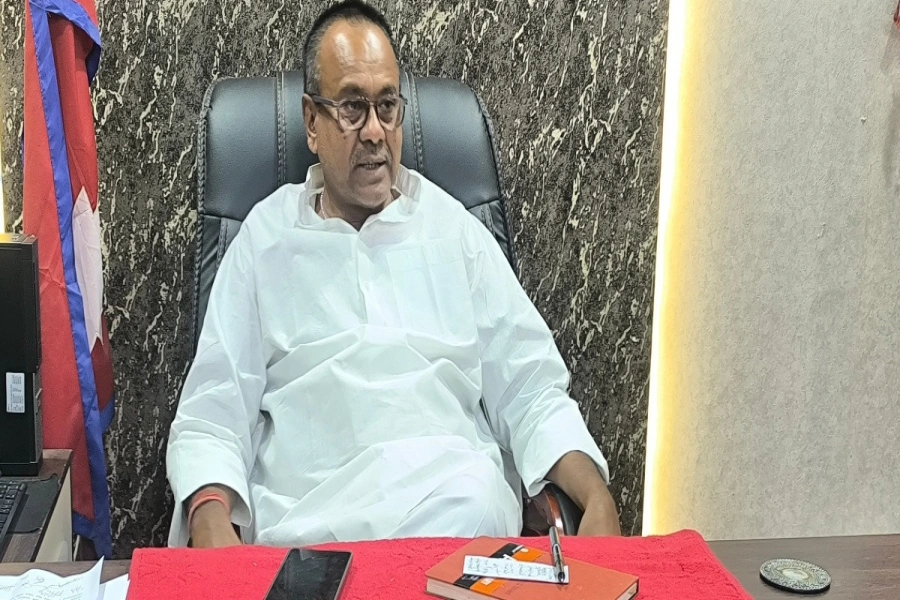
Heema, whose real name is Chang Ching, at her desk at China Radio International. (Photo: Subodh Gautam/Republica)
Barsha has interviewed many politicians who have come from Nepal, including Madhav Kumar Nepal. In the course of becoming familiar with the Nepali language and learning it, she has also lived in Kathmandu. Non-Nepalis who want to work as Nepali-language journalists are required to learn Nepali for four years.
"If one is practicing journalism in Nepali language, then one must be known by her Nepali name," says Barsha.
Chang Min, a young Chinese, is also an active journalist with CRI. However, he introduces himself as Rabi. Rabi has, during his involvement with CRI, interviewed Nepali politicians, including Jhalanath Khanal.
Lalima, originally Liu Shang, is another journalist in the Nepali section while Sumedha, or Liu On, is the Sub Head of the Nepali Bureau.
"It is fun working with the Chinese journalists," shares Editor Shrestha. "Sometimes, they make mistakes and I teach them on the job itself," he adds. Shrestha has been working at CRI for the past two years.
These journalists produce current events in both Nepal and China and interview personalities associated with both these countries. They also produce awareness programs in Nepali language. These programs are aired on Miteri FM, a Kathmandu-based radio station. There are talks of airing it through one more radio station in Kathmandu as well.
Apart from news, the team also brings out a tri-monthly newspaper called "Miteri." They are also on the website.
In the CRI offices located in Sijingshang Road in Beijing, programs in over 60 different languages, including of countries like Nepal, India, Pakistan and Bangladesh, are produced. These programs are broadcast via 80 other mediums in China.
"We initiated this project to improve and strengthen the relationship between the different countries. By broadcasting programs related to different countries in their own languages, we´re also addressing the weaknesses we might have in the dissemination of news," says Luo Hungbing. "We sometimes get wrong information and news from local media. To prevent this, we´re preparing programs in many languages," he says.
CRI operates under the aegis of the China International Broadcasting Network.
Related story
Do you like your name?


-1200x560-1773818828.webp)








-1773673205.webp)