This was just before the all-important Copenhagen conference on Climate Change. What we experienced on that trip would change our lives forever.[break]
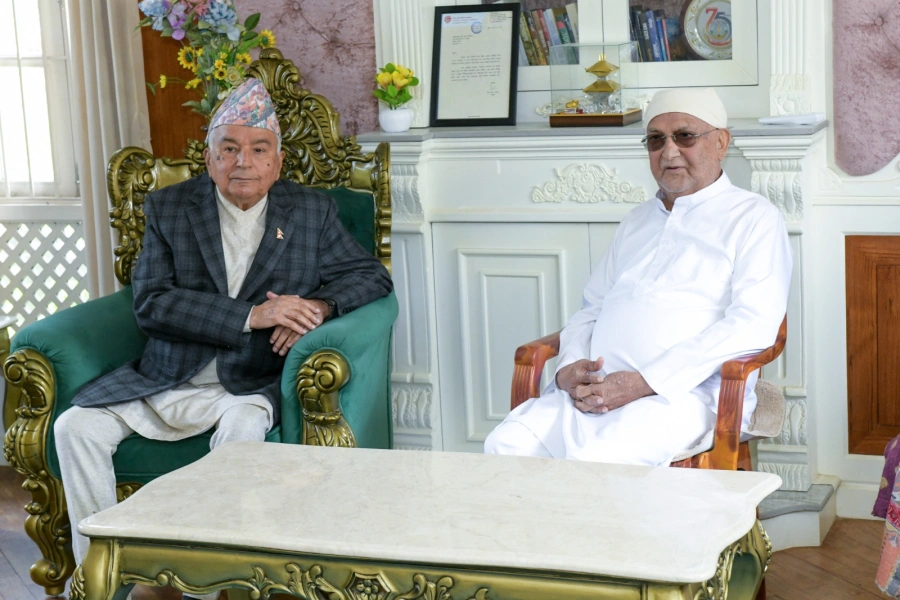
At a very short notice, the President of Austria, Heinz Fischer, not only agreed to meet us, but also made us feel at home at his Presidential Palace by pouring coffee for all three of us.
He clearly was fascinated by the Himalaya, and was keen to learn the impacts of climate change on Nepal’s pristine mountain ecology. Two days later, with almost no notice, we were allowed to speak at the European Parliament at Brussels on the impacts of climate change in the Himalaya.
When I introduced Apa Sherpa at the Parliament as someone who had climbed Mount Everest 19 times (since then he has climbed two more times), there was an instant pin-drop silence in the gathering followed by a long applause and a standing ovation.
That is the power of the Himalaya. That is the charm of our hero Apa Sherpa, known in the wider world as Super Sherpa. We must apply this to our advantage.
Only a couple of months before Copenhagen, thanks again to Apa’s efforts, we had reached out to President Barack Obama in New York.
This time, carrying some pebbles from the top of Everest as a memento, a reminder to him, and through him to the world that global warming is robbing the Himalaya of its constant companions – snow and water. And this should not just worry the Himalayan communities.
It is a clarion call to billions living on both sides of this greatest mountain range on earth that depend on the freshwater provided by it. The world had to pay attention.
And attention, they did pay. Global media of the likes of CNN, BBC, NHK, Guardian, Time,– all wrote and talked extensively about the challenges of the Himalaya.
It was possibly the biggest media coverage any Nepali campaign had ever accomplished.
Yet when it came to doing something about the cause, Copenhagen turned out to be a complete disappointment. So were the Climate Conventions at Cancun, and more recently in Durban, South Africa.
One of the reasons why the Himalaya do not get the requisite attention in global climate debate, despite holding such significance for the humanity, is the lack of science, and compelling research and stories.

More importantly, it is the lack of effective articulation of the same by the mammoth Nepali contingents that flock every climate convention. While we citizens can do very little to improve our representation at Climate Change Conventions, thanks to the frequent transfers of key human resources at our focal governmental agencies, and lack of concerted action on the part of the countries that share the Himalaya, we can do a lot to help bring out compelling stories from our backyards to the world.
Henceforth, we three decided to dig deep into it, and bring out the hitherto unheard of pains and perils of our mountain communities by arranging a high-profile walk across the Himalaya.
Come January 15, 2012, Apa Sherpa and Dawa Steven Sherpa will embark on 120-day trek across the entire stretch of Nepal’s Himalaya’s 1,700km journey.
The historic journey hailed by the Prime Minister-led Climate Change Council as one of the priority activities of the Government of Nepal on Climate Change Advocacy is being supported by government agencies and many of its development partners.
The Himalaya is known for its aesthetic values – a gift of nature that gives visitors fascinating sights of some of the most pristine landscapes our planet offers.
The Great Himalaya Trail (GHT), the 1,700km-long stretch Apa Sherpa would be hiking on is the ultimate spectacle of this grandeur as the trail passes by eight of the ten tallest mountains of the world. Apa Sherpa’s trek, besides highlighting the climate concerns of Nepal, would draw global attention to GHT, christened aptly as “a trail to rule them all.”
The tourism industry, despite its exponential growth since the 1950s, is still confined to only a very few mountain areas of Nepal – Khumbu, Langtang, and Annapurna. These, put together, constitute a miniscule of what Nepal is blessed with in terms of potential tourism products.
The GHT promises to take tourism resources to where they are needed the most – Nepal’s far-flung districts that are yet to enjoy the fruits of modern development. GHT has the potential to be a game changer for Nepal’s tourism-led poverty reduction strategy, indeed carry Nepal’s tourism to the next level.
The economic development will build climate resilience too: a grave need of our mountain communities, many of them living in highly climate vulnerable districts, as identified by National Adaptation Program of Action (NAPA), the most comprehensive assessment of vulnerability and adaptation needs of Nepal.
The charm of being amidst the fabled Himalaya, and to help its millennium old cultures and communities in their climate battle, Apa Sherpa is inviting local, regional and global celebrities to join him in this noble activity.
The celebrities and the global media will help take the message Apa is trying to disseminate to the world and help Nepal’s case for better and preferred treatment in global climate deliberations.
The celebrities may join part of the trek, hop in at the trail to meet with Apa and his entourage to understand the ground realities in the Himalaya, or show support for the cause from wherever they are.
Nepal is one of the most loved countries in the world. Yet, only smart acts on our part will help us profit from this global goodwill. Apa’s efforts exemplify such one smart act.
The writer is the founder and CEO of Himalayan Climate Initiative and can be reached at prashant.singh@himalayanclimate.org
Related story
DoR constructs over 36,000 kilometers of roads across Nepal so...